
Engineers at NASA’s Jet Propulsion Laboratory just proved that rotor blades can survive the chaos at the speed of sound in a Martian atmosphere. The test results arrived with little fanfare. Yet they mark a concrete advance for the next wave of robotic explorers bound for the Red Planet.
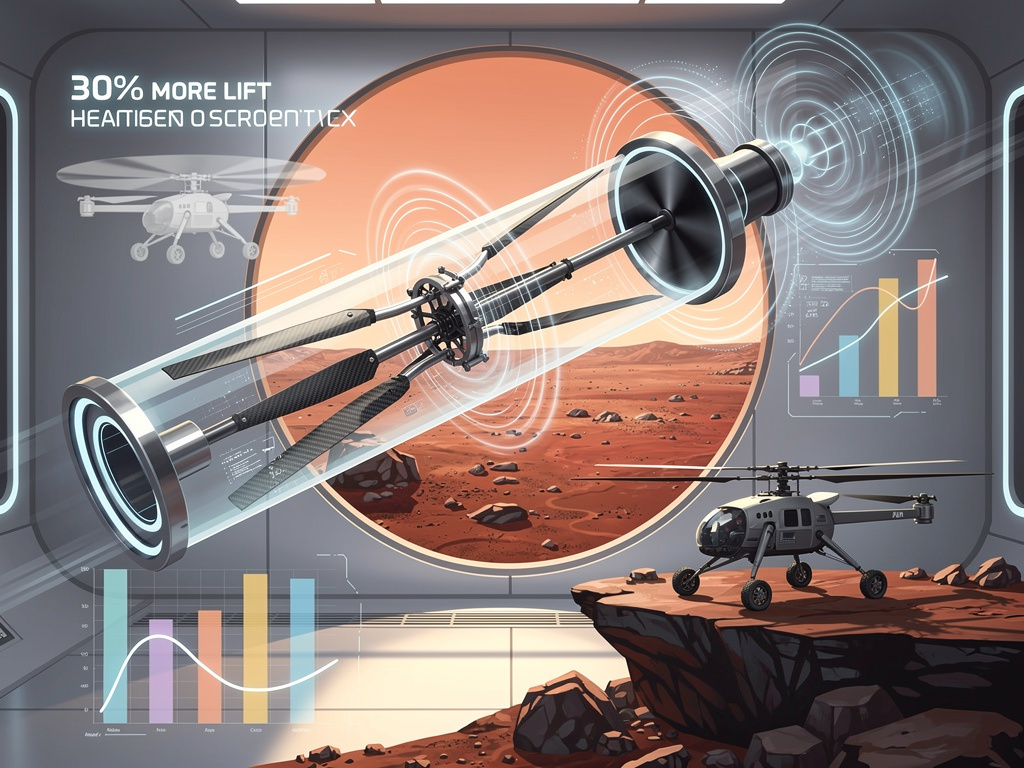
Data from 137 runs inside JPL’s 25-Foot Space Simulator show the blade tips reached Mach 1.08 without coming apart. That speed translates to roughly 580 miles per hour in the thin carbon-dioxide air. Lift capability jumped 30 percent. Future vehicles can now carry real science instruments instead of cameras alone. Finally.
The work builds directly on Ingenuity, the small helicopter that hitched a ride with Perseverance and flew 72 times before its January 2024 crash. Ingenuity never pushed its four-foot rotors past 2,700 revolutions per minute. Its tips stayed at Mach 0.7 in calm conditions to avoid any risk of supersonic shock waves ripping the blades apart. “If Chuck Yeager were here, he’d tell you things can get squirrely around Mach 1,” said Jaakko Karras, the rotor test lead at JPL, in the NASA announcement.
But more performance demands more speed. Mars’ atmosphere registers just 1 percent the density of Earth’s at sea level. Generating enough lift requires aggressive rotation. So Karras and his team mounted next-generation blades, built by AeroVironment in Simi Valley, California—the same partner behind Ingenuity—inside the historic vacuum chamber. They pumped in the right mix of carbon dioxide, spun the rotors to 3,750 rpm, and then hit them with artificial headwinds from an internal fan. The chamber walls wore sheet-metal armor. Just in case.
Nothing broke. The three-bladed test rotor hit near-sonic speeds first. Then the actual two-bladed SkyFall design, slightly longer, reached the same velocities at a lower rpm. “We thought we’d be lucky to hit Mach 1.05, and we reached Mach 1.08 on our last runs,” said Shannah Withrow-Maser, an aerodynamicist from NASA’s Ames Research Center who worked on the test team. “We’re still digging into the data, and there may be even more thrust on the table. These next-gen helicopters are going to be amazing.” Her comments appear in both the JPL release and Ars Technica’s coverage published May 8.
Al Chen, Mars Exploration Program manager at JPL, put the stakes plainly. “NASA had a great run with the Ingenuity Mars Helicopter, but we are asking these next-generation aircraft to do even more at the Red Planet. That’s not an easy ask. While everything about Mars is hard, flying there is just about the hardest thing you can do.” The thin air makes lift scarce. Gravity remains punishing. Success here opens doors that ground rovers cannot reach.
SkyFall itself represents the immediate beneficiary. The mission, targeted for a December 2028 launch aboard the nuclear-powered Space Reactor-1 spacecraft, will deliver three larger helicopters. They will deploy mid-air after atmospheric entry rather than ride down on a rover. No Perseverance-style base station will stand nearby. Communication will run through orbiters or direct-to-Earth links. The extra lift from supersonic tips means these craft can haul advanced sensors, ground-penetrating radar, and bigger batteries for flights that stretch far beyond Ingenuity’s 161-second maximum.
Scientists envision them scouting candidate sites for human landings, mapping subsurface ice, and gathering data that rovers alone would take years to collect. The SkyFall concept, developed jointly by JPL and AeroVironment, draws its name and ambition from the need to drop in from the sky and then operate independently. Recent coverage in Space.com from March outlined how the nuclear carrier could shorten transit times and increase payload mass for the entire stack.
But the rotor test stands apart from other JPL propulsion news this week. While engineers there also fired up a high-power lithium-fed thruster in February, the helicopter work addresses a completely different regime. It solves the unique aerodynamic headaches of low-density flight rather than deep-space cruise efficiency. And it does so with hardware that has already proven itself once on another world.
Ingenuity’s success surprised even its creators. What began as a 30-day technology demonstration stretched into nearly three years of operational scouting. Its longest single hop covered less than half a mile. The new vehicles aim for more ambition with less hand-holding. Larger size. Heavier mass. Independent operation. Supersonic blade tips that stay intact.
The test campaign was funded through the Mars Exploration Program. JPL manages that program for NASA’s Science Mission Directorate. Results have already fed back into SkyFall performance specs. Engineers now possess hard data where once they held only models and caution. They know the blades hold together at speeds that would have terrified the Ingenuity team.
Of course, many steps remain. Full vehicle prototypes must fly in Earth chambers that mimic Mars conditions. Flight software needs expansion for autonomous navigation without a nearby rover. Power systems must scale up. Communication protocols have to prove reliable across interplanetary distances without relay help on the surface. Yet the rotor integrity question—the one that kept Ingenuity safely subsonic—no longer looms as an unknown.
Jaakko Karras and his colleagues watched the data streams from a control room yards away as the rpm dial climbed. They saw the Mach meter creep past 1.0. Then 1.05. Then 1.08. The blades kept their shape. The chamber stayed intact. In that moment, planetary aviation moved forward by a tangible margin.
NASA has spent decades refining entry, descent, and landing techniques for Mars. Rovers grew larger and more capable. Orbiters mapped with increasing precision. Now aerial platforms join the toolkit with genuine payload capacity. The difference traces back to these blades and the willingness to spin them faster than anyone had dared on another planet.
Future missions could deploy swarms. Or single heavy-lift rotorcraft capable of ferrying instruments to crater rims and ancient riverbeds. The 30 percent lift gain compounds across design trades. Bigger batteries mean longer endurance. More sensors mean richer science return. All of it rests on the simple fact that the rotors did not disintegrate.
So the SkyFall helicopters have a clearer runway. Their larger frames and ambitious goals no longer carry the same aerodynamic uncertainty. The sound barrier on Mars has been crossed in testing. The hardware survived. Exploration from the air just became a good deal more practical.


 WebProNews is an iEntry Publication