
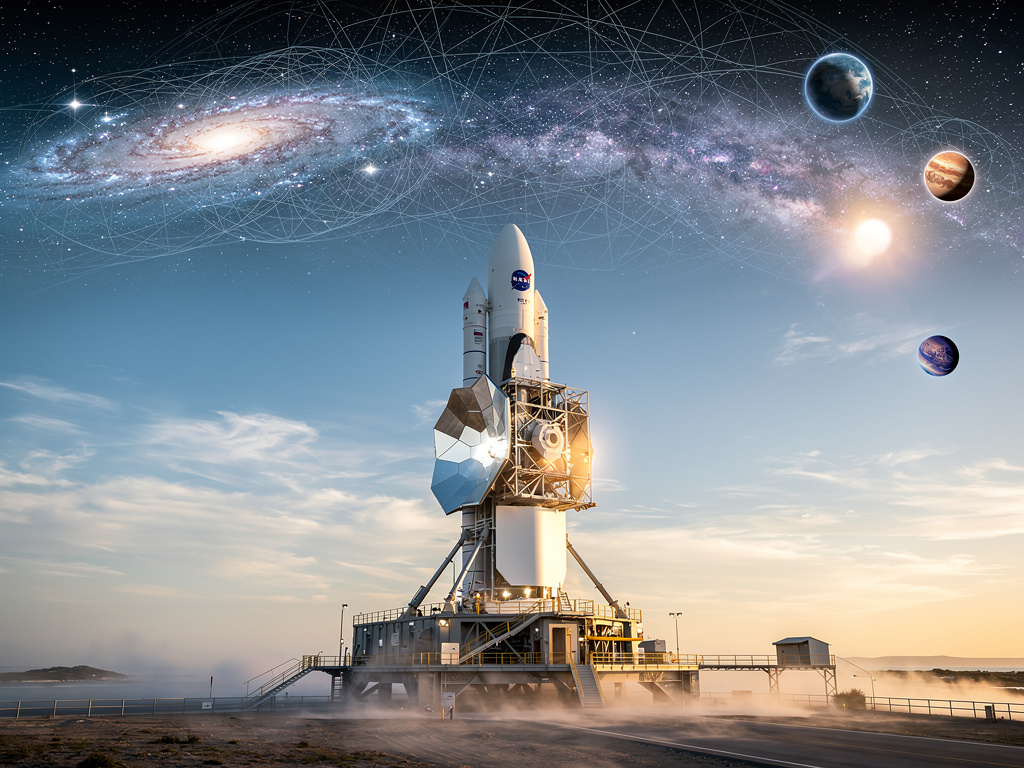
NASA’s gleaming Nancy Grace Roman Space Telescope stands fully assembled in a vast clean room at Goddard Space Flight Center, its silver form bathed in purple light. Eight months ahead of schedule. Under budget. The agency now eyes an early September liftoff on a SpaceX Falcon Heavy rocket from Kennedy Space Center in Florida—a feat that bucks decades of overruns plaguing big astronomy projects. NASA officials unveiled the observatory Tuesday, shipping it south by mid-June after final tweaks like antenna deployments and solar panel fixes.
Administrator Jared Isaacman hailed the milestone. “Roman will investigate dark matter, dark energy and the structure of the universe itself,” he said during the event, standing before the tractor-trailer-sized craft. SpaceNews reported the $4.3 billion mission’s completion amid broader science budget squeezes, positioning it as proof NASA can deliver flagships on time. No small irony. James Webb Space Telescope ran years late and billions over; Hubble faced mirror flaws post-launch. Roman? Finished early.
But. How did they pull it off? Teams built and tested components in parallel, from the 2.4-meter mirror—Hubble-sized—to the 300-megapixel Wide Field Instrument. Over a thousand engineers logged millions of hours. Rigorous shake, bake, and acoustic tests simulated launch and space rigors. The spacecraft passed vacuum chambers mimicking L2 orbit’s chill, a million miles sunward where Webb already peers out. Space.com noted the infrared surveyor’s field of view dwarfs Hubble’s by 100 times, scanning billions of galaxies in visible-to-near-infrared light.
Picture this. Roman’s panoramic sweeps feed deeper dives by Webb and Chandra X-ray Observatory. “Roman’s much larger field of view will reveal many such objects that were previously unknown,” said senior project scientist Julie McEnery. “And since we’ve never had an observatory like this scanning the cosmos before, we could even find entirely new classes of objects and events.” Engadget quoted her on the synergy. Dark energy, that phantom force accelerating cosmic expansion and comprising 68% of everything? Roman maps its effects via supernova distances and galaxy clusters. Exoplanets? A high-contrast coronagraph blocks starlight, spotting worlds otherwise lost in glare—potentially thousands more.
The backstory traces to 2016. Born as Wide Field Infrared Survey Telescope, or WFIRST, amid Obama-era funding fights. Renamed for Nancy Grace Roman, NASA’s first chief astronomer and Hubble’s “mother,” who died in 2018. Congress mandated launch by May 2027; the team beat it handily. SpaceX’s Falcon Heavy, with its proven 100% success rate on 11 flights, clinches the ride at $255 million. Space Policy Online highlighted Isaacman’s announcement, tying it to L2’s stable halo orbit.
Industry watchers buzz. Scientific American called it a flagship poised for breakthroughs, despite past Trump-era cuts eyed but dodged. Post-launch, first light could hit by June 2027. Five-year prime mission ahead, plus guest observer time. Core surveys target high-latitude skies for dark energy, time-domain fields for transients, and Milky Way’s bulge for rogue worlds and microlensing.
Challenges linger. Budget clouds hover over astrophysics. But Roman’s ahead. Technicians now fold solar arrays, pack for the road. Florida processing follows: fueling, encapsulation. Liftoff targeted early September—no later than May ’27. Success here? It sets the pace for Vera Rubin Observatory and beyond. A new atlas of the universe incoming. Cosmic transients. Rogue planets. Dark energy’s grip. All sharper than ever.
And the payoff? Unseen before. Roman charts billions of galaxies, probes exoplanet atmospheres, hunts isolated black holes. Paired with ground-based giants, it builds the era’s widest cosmic map. Early images alone will stun. Skeptics quieted. For astronomers, it’s wide-open skies.


 WebProNews is an iEntry Publication