
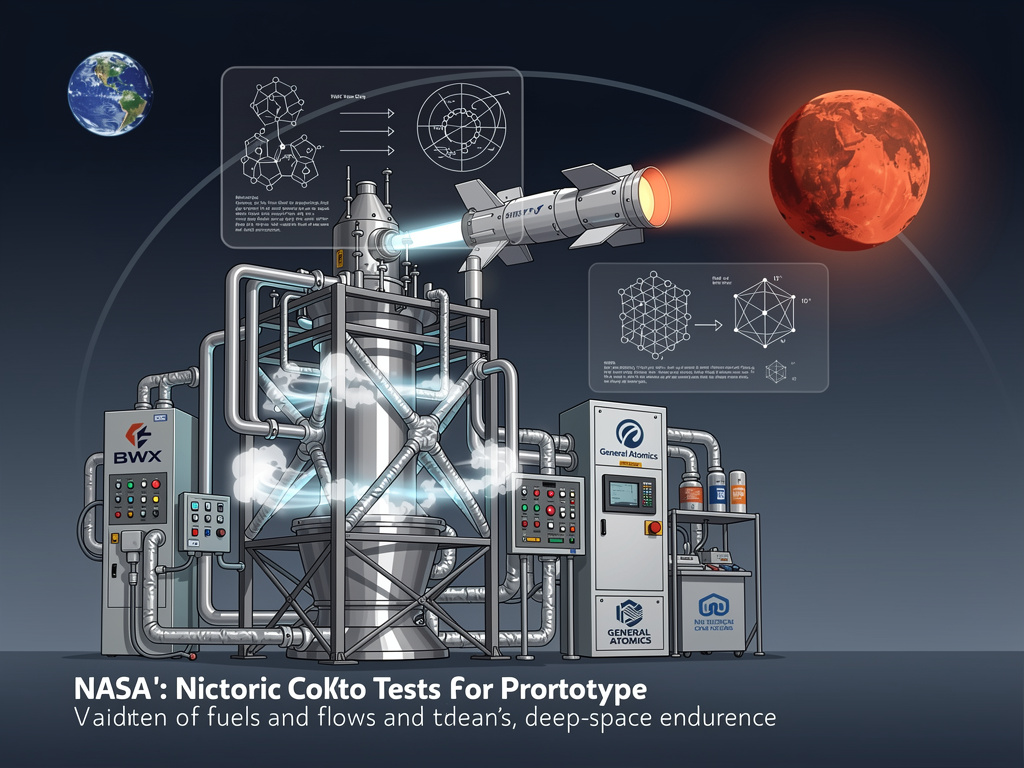
In a quiet milestone at NASA’s Marshall Space Flight Center, engineers have completed the first cold-flow tests of a full-scale nuclear reactor prototype since the 1960s, signaling a resurgence in space nuclear propulsion that could halve transit times to Mars and redefine deep-space missions. The tests, conducted from July to September 2025 on a 44-inch by 72-inch engineering development unit built by BWX Technologies, simulated propellant flow without nuclear reactions, proving the design resists destructive vibrations and pressure waves.
“Nuclear propulsion has multiple benefits including speed and endurance that could enable complex deep space missions,” said Greg Stover, acting associate administrator of NASA’s Space Technology Mission Directorate, in a statement from NASA. Over 100 tests provided the most detailed flow data for a flight-like reactor in more than five decades, validating models for future flight systems.
Jason Turpin, manager of the Space Nuclear Propulsion Office at Marshall, emphasized the breakthrough: “We’re doing more than proving a new technology. This test series generated some of the most detailed flow responses for a flight-like space reactor design in more than 50 years and is a key steppingstone toward developing a flight-capable system.” The unit, akin to a 100-gallon drum, mimics nuclear thermal propulsion operations where hydrogen propellant heats via fission for exhaust at twice the efficiency of chemical rockets.
Reviving Six-Decade-Old Ambitions
This effort builds on the Nuclear Engine for Rocket Vehicle Application program halted in 1973, now powered by high-assay low-enriched uranium to address proliferation concerns. NASA’s Space Nuclear Propulsion Office, under the Technology Demonstration Missions Program, leads development alongside partners like BWX Technologies of Richmond, Virginia.
Earlier in 2025, General Atomics Electromagnetic Systems tested NTP reactor fuel at Marshall, exposing samples to hot hydrogen at 2,600 Kelvin over six cycles, confirming durability under extreme conditions, as reported by General Atomics. “We are excited to continue our collaboration with NASA as we mature and test the fuel to meet the performance requirements for future cislunar and Mars mission architectures,” stated GA-EMS.
The fuel advances support nuclear thermal propulsion’s promise: specific impulse of 850-900 seconds versus 450 for chemical systems, enabling heavier payloads and shorter trips. NASA and the Department of Energy fund these efforts, targeting Moon, Mars, and beyond.
DRACO’s Turbulent Path Forward
Central to these tests was the joint DARPA-NASA Demonstration Rocket for Agile Cislunar Operations (DRACO), aimed at an in-orbit NTP demo originally slated for 2027. Lockheed Martin led spacecraft integration, with BWX handling the reactor. However, by January 2025, technical hurdles like ground-testing nuclear reactors—unattempted in decades—pushed timelines indefinitely, per Wikipedia.
The FY2026 budget, released May 2025, slashed $531 million from NASA’s Space Technology Mission Directorate, canceling DRACO funding. DARPA terminated the program, transferring knowledge to NASA, as detailed in Breaking Defense. A senior official cited costs outweighing benefits, though nuclear thermal offers thrust-to-weight ratios 10,000 times electric propulsion and 2-5 times chemical efficiency.
Despite setbacks, NASA persists. Contract extensions in 2025 went to General Atomics and Standard Nuclear (acquirer of Ultra Safe Nuclear Technologies), per NASA. Fuel tests at NASA’s NTREES simulator validated HALEU performance.
Fuel and Reactor Innovations Accelerate
General Atomics’ January 2025 tests at Marshall subjected fuel to 4,220°F hydrogen flows for 20 minutes per cycle, exceeding requirements. Additional non-hydrogen runs hit 3,000 K, as covered by Space.com. These elements are vital for reactors heating hydrogen without melting.
NASA’s FY2025 plans include nuclear electric propulsion concept designs at 10 kWe, per advisory council documents. Meanwhile, the MARVL project at Langley explores scalable nuclear electric systems, with Julia Cline noting, “I think it’s going to expand what we think of when it comes to nuclear propulsion,” from NASA.
BWX’s engineering unit installation at Test Stand 400 in April 2025 enabled the cold-flow campaign, gathering data on oscillations and informing flight controls. This pathfinder aids manufacturing flight-capable systems.
Strategic Shifts Amid Budget Pressures
DRACO’s end echoes past cancellations like NERVA, but knowledge transfer ensures progress. Aviation Week reported in February 2025 that reactor test needs halted the 2027 launch, with DARPA seeking innovations leveraging DRACO designs, via Aviation Week.
NASA Administrator Bill Nelson highlighted potential: enabling unprecedented speeds for Artemis and Mars goals, as in Gadgets 360. Partnerships with DOE advance low-enriched fuels surviving 4,600°F.
Industry momentum continues: BWX, Lockheed, and General Atomics push prototypes. X posts from January 2026 amplified NASA’s announcement, underscoring industry buzz.
Path to Operational Systems
These tests de-risk fluid dynamics, crucial for reactor stability. Data refines instrumentation and controls, boosting payload capacity and power for comms and science. Shorter Mars trips reduce radiation exposure, vital for crews.
National Academies’ 2020 report urged maturation, noting LH2 storage challenges by 2025. NASA addresses boiloff with advanced tanks. Integrated strategies from NTRS papers outline Gen-1 demos.
While DRACO faltered, cold-flow success positions NASA for FY2026 pivots, potentially integrating NTP with Starship for Mars. Nuclear propulsion endures as the enabler for solar system expansion.


 WebProNews is an iEntry Publication