
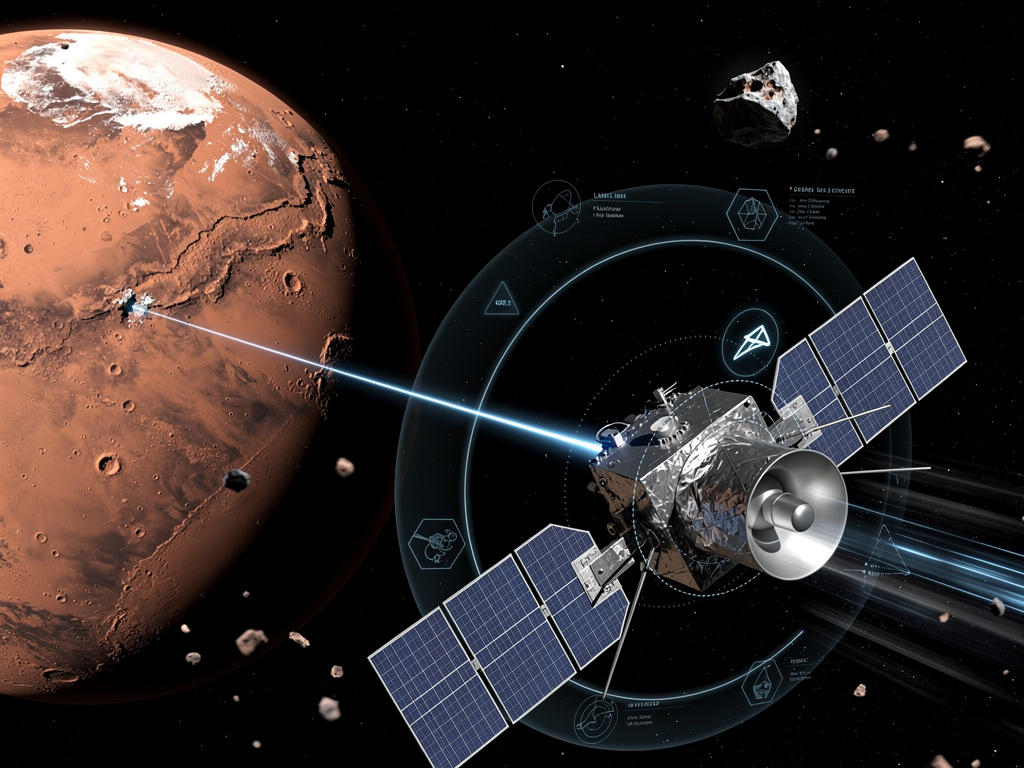
NASA’s Psyche spacecraft, originally designed to explore a metal-rich asteroid between Mars and Jupiter, will swing past the Red Planet in late 2026 for a short scientific encounter that offers both operational testing and fresh data collection opportunities. The flyby, set for late May of that year, comes as the mission team adjusts timelines following earlier delays in the project’s ambitious schedule. According to reporting from The Register, engineers now anticipate the probe will come within roughly 500 kilometers of Mars’ surface, providing a valuable chance to calibrate instruments and gather supplementary observations before the craft continues its long trek toward the asteroid 16 Psyche.
The Psyche mission has experienced a series of schedule adjustments since its approval. Originally slated for launch in 2022, technical challenges with the spacecraft’s flight computer and telecommunications systems pushed the departure to October 2023. Even with that postponement, the probe successfully lifted off aboard a SpaceX Falcon Heavy rocket from Kennedy Space Center. After a gravity-assist maneuver at Earth in 2025, the trajectory now lines up for this Mars encounter in 2026, followed by arrival at the asteroid in 2029. Mission managers view the upcoming Mars pass as an unexpected bonus rather than a core objective, yet one that could yield meaningful scientific returns.
At the heart of the spacecraft sits a sophisticated suite of instruments built to examine 16 Psyche, an object believed to be the exposed nickel-iron core of an ancient protoplanet. The asteroid, measuring about 140 miles across at its widest point, represents a rare chance to study material that usually remains hidden beneath rocky mantles. Scientists suspect its composition could reveal clues about how terrestrial planets like Earth formed their metallic centers billions of years ago. The orbiter carries a multispectral imager, a gamma-ray and neutron spectrometer, and a magnetometer array designed to map magnetic fields with high precision.
During the Mars flyby, these same tools will turn their attention to the planet and its moons. The imager will capture high-resolution views of surface features, potentially adding to existing datasets from dedicated Mars orbiters. The gamma-ray and neutron spectrometer may detect variations in elemental composition across regions of the Martian crust, while the magnetometer could record interactions between the solar wind and Mars’ weak, localized magnetic fields. Such measurements complement information gathered by missions like MAVEN, which has studied the planet’s atmospheric loss over time. The flyby also presents an opportunity to test the spacecraft’s autonomous navigation systems in a real-world environment near another planetary body.
One of the most intriguing aspects of the Psyche mission involves its experimental deep-space optical communications package. Known as the Deep Space Optical Communications system, or DSOC, this technology uses infrared laser pulses to transmit data at rates far higher than traditional radio systems. During the Mars encounter, engineers plan to demonstrate the laser system’s performance at interplanetary distances. If successful, the test could pave the way for future missions to send back vastly more information from distant destinations. The system has already shown promising results during earlier checkout phases, achieving data rates up to 267 megabits per second at distances comparable to the Earth-Moon separation.
The spacecraft’s journey relies on electric propulsion rather than conventional chemical rockets for much of its travel. Four Hall-effect thrusters, powered by solar arrays that span nearly 800 square feet when fully deployed, provide gentle but continuous thrust. Xenon gas serves as the propellant, offering high efficiency for the long cruise to the asteroid belt. This propulsion approach allows the craft to carry less fuel mass while still achieving the necessary velocity changes over years of operation. The same solar-electric system will support operations at 16 Psyche, where sunlight intensity drops to about one-tenth of what reaches Earth.
Mission planners have structured the encounter with Mars to minimize risk to the primary science goals. The flyby occurs at a high relative velocity of approximately 16,000 miles per hour, meaning the spacecraft will spend only a few hours within range for close observations. Precise timing and pointing become essential. Teams at NASA’s Jet Propulsion Laboratory have conducted extensive simulations to ensure the probe maintains proper orientation and that instruments collect usable data during the brief window. Should any anomalies arise, onboard fault-protection software can place the spacecraft into a safe configuration until ground controllers respond.
Beyond the immediate scientific measurements, the Mars flyby serves as a dress rehearsal for arrival at 16 Psyche. Controllers will practice command sequences, data downlink strategies, and instrument handovers in a dynamic environment. The experience gained will help refine procedures for the more complex orbital operations that begin after the probe reaches the asteroid in 2029. Once there, Psyche will spend roughly 26 months mapping the surface, measuring its gravity field, and analyzing its chemical makeup from a series of successively lower orbits.
The asteroid itself continues to intrigue planetary scientists. Radar observations and spectral analysis suggest 16 Psyche contains far more metal than typical stony or carbonaceous bodies. Some models propose it formed through collisions that stripped away its outer silicate layers, leaving the dense metallic interior exposed. Others suggest it might represent primordial material that never fully differentiated. Resolving these questions could reshape understanding of conditions in the early solar system when planets were accreting. The presence or absence of a remnant magnetic field within the asteroid would provide particularly telling evidence about its thermal history.
Public interest in the mission has remained strong, fueled by the unusual nature of the target and the innovative technologies aboard. Educational outreach programs have used the spacecraft’s development as a teaching tool for topics ranging from electromagnetism to solar system formation. The optical communications demonstration has drawn attention from both space enthusiasts and telecommunications engineers eager to see laser systems applied beyond Earth orbit.
Budgetary realities have influenced the mission’s pacing. NASA selected Psyche as part of its Discovery program, which emphasizes cost-capped, competitively chosen projects. The original budget stood at roughly $450 million not including launch costs, though overruns and delays have increased the total. Despite these pressures, the project has maintained strong support within the science community because of its potential to address fundamental questions about planetary cores.
As the spacecraft continues its current trajectory through the inner solar system, ground teams monitor its health through regular checkouts. The Mars encounter represents the next major operational milestone before the long haul to the asteroid belt. Data returned during the flyby will undergo careful calibration against known Mars properties to ensure the instruments perform as expected at 16 Psyche. Any adjustments made based on these observations could improve the quality of information collected during the primary mission phase.
The Psyche team has also coordinated with operators of other Mars missions to maximize the scientific value of the flyby. Orbiters already at the Red Planet may adjust their activities to observe the same regions at the same time, creating opportunities for comparative measurements. Such coordinated observations have become more common in recent years as the number of active spacecraft around Mars has grown. The European Space Agency’s Trace Gas Orbiter and NASA’s Mars Reconnaissance Orbiter could contribute context that enhances Psyche’s snapshot views.
Looking further ahead, the mission’s success could influence the design of subsequent asteroid exploration efforts. The combination of electric propulsion, advanced telecommunications, and a focused instrument payload offers a model for cost-effective deep-space science. Future proposals may draw on lessons learned from Psyche’s development challenges and the adaptive strategies employed to keep the project on track after its launch delay.
For now, attention centers on the approaching Mars flyby and the engineering and scientific activities it will enable. The brief visit offers a rare chance to study another world with hardware built for a different destination, highlighting both the flexibility of modern spacecraft and the interconnected nature of solar system exploration. As the 2026 encounter date draws nearer, teams across multiple NASA centers and partner institutions continue refining plans to extract every possible bit of knowledge from those few hours in the vicinity of the Red Planet.
The data collected during the flyby will join the growing archive of Mars observations accumulated over more than two decades of robotic exploration. While Psyche will not linger to study seasonal changes or search for signs of ancient water, its unique vantage point and instrument capabilities may still reveal details not easily obtained from dedicated orbiters. The magnetometer readings, in particular, could help map small-scale crustal magnetic anomalies that influence the planet’s interaction with charged particles from the Sun.
Engineers emphasize that every test performed near Mars reduces uncertainty for the asteroid encounter. The ability to point instruments accurately while moving at high speed, to maintain stable communications during a planetary encounter, and to manage power and thermal conditions in varying sunlight all translate directly to operations at 16 Psyche. In this sense, the flyby functions as both an additional science opportunity and an essential operational proving ground.
With launch already behind it and the Earth gravity assist successfully completed, the Psyche spacecraft has demonstrated that its core systems function well in the space environment. The upcoming Mars pass will provide the next test of its full capabilities. If all proceeds according to plan, the mission will deliver a rich scientific harvest both during the brief planetary encounter and over the extended stay at its metallic target. The combination of careful engineering, adaptive planning, and scientific curiosity continues to drive the project forward as it travels through the solar system on its way to an ancient core waiting to tell its story.


 WebProNews is an iEntry Publication