
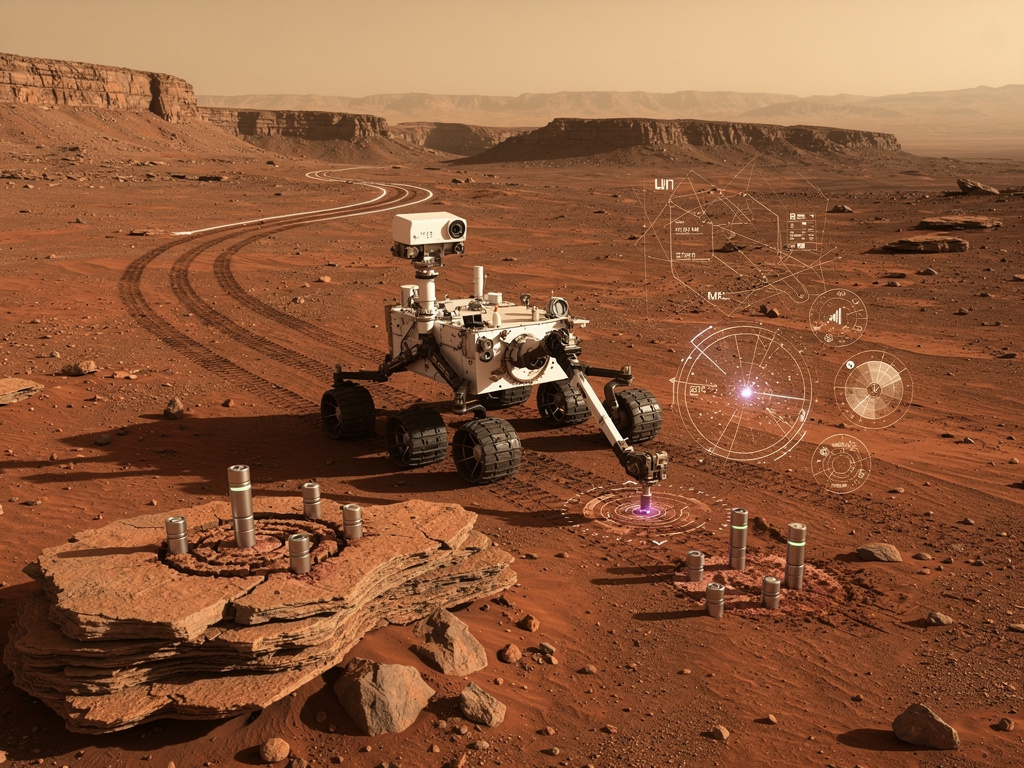
Perseverance has done it. The NASA rover rolled past the 26.2-mile mark on Mars on June 14, 2026. That distance equals a full marathon. It took the six-wheeled robot five years and four months. Not bad for a machine that tops out at 0.1 miles per hour under ideal conditions.
The milestone arrived while Perseverance explored intriguing ancient terrain west of Jezero Crater. There the rover has examined remnants of an ancient lake and gathered clues that could point to past microbial life. And the accomplishment puts it in rare company. Perseverance now joins NASA’s Opportunity rover, which reached the same distance back in 2015 after 11 years and two months of driving. Engadget reported the news shortly after NASA shared confirmation on social media.
By contrast, the Curiosity rover, operating on Mars since 2012, has logged just over 23 miles. Opportunity’s long trek set a high bar. Perseverance smashed the timeline. Its steady progress reflects careful route planning, improved autonomy software, and a robust power system still operating well beyond original expectations. Steve Lee, acting project manager for the mission at NASA’s Jet Propulsion Laboratory, captured the mood in May as the rover closed in on the mark. “Having the benefit of four previous rover missions, the Perseverance team has always known our mission was a marathon and not a sprint,” he said, according to The Daily Galaxy.
Yet distance traveled tells only part of the story. Perseverance has collected dozens of rock cores and atmospheric samples. As of mid-2026 it had studied more than 60 rocks and secured at least 27 core samples destined for eventual return to Earth. Those tubes hold material from diverse geologic settings inside and around Jezero Crater, a 28-mile-wide impact feature that once held a deep lake fed by a river delta. The samples could answer whether Mars ever hosted life. They might also reveal how the planet lost its thicker early atmosphere and abundant surface water.
Recent findings have sharpened the focus on that question. In July 2024 the rover drilled into a reddish rock nicknamed Cheyava Falls in an ancient river valley called Neretva Vallis. The sample, later named Sapphire Canyon, contains intriguing features. Scientists observed small dark specks resembling leopard spots. Chemical analysis revealed minerals such as vivianite and greigite that on Earth can form through reactions linked to microbial activity. A peer-reviewed paper published in Nature in September 2025 laid out the evidence. NASA described the find as the closest the agency has come to identifying potential biosignatures on Mars. Nicky Fox, NASA’s science mission chief, acknowledged the discovery stops short of proof. “This is certainly not the final answer,” she noted, “but it’s the closest we’ve actually come to discovering ancient life on Mars.” The details appeared in a NASA news release.
Additional research has shown Jezero experienced multiple episodes of water activity over billions of years. Minerals detected in rocks examined during Perseverance’s climb up the crater rim point to changing environmental conditions, some of which could have supported life. A study published in the Journal of Geophysical Research: Planets in 2025 drew on the rover’s early data to map these episodes. Rice University researchers contributed to the work, which Rice News summarized last September. Such layered history makes the collected samples even more valuable.
Engineering feats have kept the mission on track. Perseverance has demonstrated autonomous driving capabilities that reduce reliance on Earth-based commands. In December 2025 it completed drives planned entirely by generative AI, a first for Mars exploration. The rover also set a single-day driving record of more than 1,350 feet in June 2025. These advances let it cover ground faster than earlier vehicles while avoiding hazards in rough terrain. Mission manager Robert Hogg told Reuters in May 2026 that the rover’s radioisotope power source still had at least a decade of life left. “We’ve almost reached marathon distance,” he added in related coverage. “Our selfie may show that the rover is a bit dusty, but its beauty is more than skin deep.” The Reuters article captured the team’s confidence.
A striking selfie released in May 2026 shows the rover parked beside a freshly abraded rock patch near the crater rim. The image, stitched from 61 separate frames, reveals sharp ridgelines, rounded boulders, and what may be a volcanic dike exposed by erosion. Ken Farley, the mission’s deputy project scientist at Caltech, examined the scene. “What I see in this image is excellent exposure of likely the oldest rocks we are going to investigate during this mission,” he said, per a Space.com report from mid-May. The rocks could preserve records of Mars’ earliest crust. They might hold evidence of a warmer, wetter past.
Yet challenges remain. Mars’ distance from Earth creates communication delays of up to 20 minutes one way. Solar conjunction periods, when the sun blocks radio signals, force the rover to pause major activities for weeks. Dust accumulation on solar panels is less of an issue for Perseverance than it was for Opportunity, thanks to its nuclear power source. Still, the team monitors wheel wear and instrument health constantly. The rover has already survived one major software update and several autonomous navigation tests that pushed its systems harder than originally planned.
The ultimate goal extends far beyond a symbolic marathon. NASA and international partners hope to retrieve the cached samples through a complex multi-mission campaign. That effort has faced budget pressures and technical questions about the return spacecraft and lander. Even so, the scientific payoff could reshape understanding of life’s origins in the solar system. Each new rock Perseverance examines adds context. Each additional mile brings it closer to formations that might contain definitive signs of ancient biology. Or they might not. Either outcome would teach scientists something fundamental about planetary evolution.
Perseverance keeps moving. It has already begun pushing toward ultramarathon territory, eyeing 50 kilometers and beyond. Recent drives have taken it into regions never before visited by human-made machines. The data stream arriving daily includes high-resolution images, chemical analyses, and weather readings that feed both immediate science and long-term mission planning. And the public follows along. Social media reactions to the marathon milestone mixed amazement at the achievement with simple questions about whether humans could match the feat on Earth. Most could not sustain 0.1 mph for five straight years across broken, dusty ground.
The rover’s success rests on decades of prior Mars exploration. Lessons from Sojourner, Spirit, Opportunity, and Curiosity informed its design, from the larger wheels that handle bigger obstacles to the suite of instruments that can identify minerals from a distance. Future missions will build on what Perseverance has learned. China’s Tianwen program and private efforts may one day place additional rovers on the surface. For now, this one vehicle carries the hopes of an international scientific community eager to understand whether life ever gained a foothold on the Red Planet.
So the marathon is complete. The real work continues. Perseverance will keep driving, sampling, and photographing as it ascends further along Jezero’s rim and eventually descends into new terrain. Its odometer will climb. Its sample tubes will fill. And one day, if all goes according to plan, those tubes will land on Earth, bringing Martian rock into laboratories where researchers can apply tools far more powerful than anything that fits on a rover. The distance covered so far is impressive. The knowledge still waiting to be uncovered may prove far more significant.


 WebProNews is an iEntry Publication