
Creasing the Cosmos: NASA’s Origami Odyssey from Rocket Science to Foldable Futures
In the realm of cutting-edge engineering, where precision meets creativity, an unlikely art form has emerged as a powerhouse for innovation: origami. This ancient Japanese practice of paper folding is no longer confined to crafting cranes or boxes; it’s revolutionizing how we design deployable structures for space exploration and beyond. At the heart of this transformation stands Robert Lang, a physicist whose journey from NASA’s Jet Propulsion Laboratory to full-time origami artistry exemplifies the unexpected synergies between rigorous science and delicate artistry.
Lang’s story begins in the late 1980s at JPL, where he delved into optoelectronics, developing semiconductor lasers and spatial light modulators for potential optical computers. Funded partly by the Ballistic Missile Defense Organization, his work aimed to harness light for computation, a pursuit that honed his mathematical prowess in complex patterns. But it was his passion for origami that truly took flight, leading him to apply folding principles to real-world engineering challenges.
By the early 2000s, Lang had transitioned from a 20-year engineering career to become a professional origamist, armed with tools born from his NASA tenure. His software, TreeMaker, allows users to design intricate crease patterns for origami figures, drawing directly from algorithms he developed for laser design. This toolkit has since found applications far beyond art, influencing fields from aerospace to medical devices.
The Mathematical Backbone of Folding
The elegance of origami lies in its mathematics—rigid rules governing how flat sheets can transform into three-dimensional forms without stretching or tearing. Lang’s experience at NASA equipped him with the computational skills to model these transformations digitally. As detailed in a NASA Spinoff feature, his JPL background in simulating light paths mirrored the crease patterns in origami, enabling him to create software that optimizes folds for efficiency and strength.
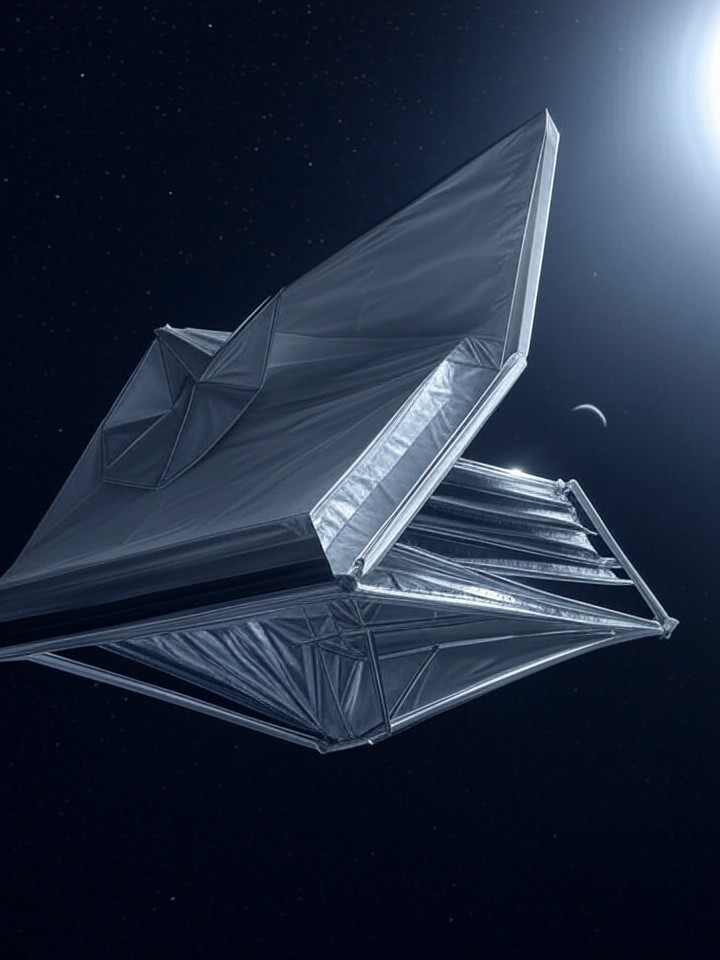
This intersection has proven invaluable for space missions, where size and weight constraints demand compact, deployable technologies. For instance, NASA’s James Webb Space Telescope, launched in 2021, embodies origami principles in its massive sunshield and primary mirror, which folded tightly for launch and unfurled in orbit. An educational activity on the NASA Science site invites enthusiasts to build origami models of Webb’s mirror, illustrating how folding enables the deployment of structures too large for conventional rockets.
Beyond telescopes, origami inspires solar arrays and antennas that pack small but expand vastly in space. Lang consulted on the Eyeglass space telescope concept at Lawrence Livermore National Laboratory, designing folds for a 100-meter lens that could deploy crease-free. His expertise, rooted in NASA-honed engineering, makes him a go-to consultant for such projects.
Spinoff Innovations on Earth and Beyond
The ripple effects of NASA’s origami pursuits extend to terrestrial applications, showcasing technology transfer at its finest. Lang’s TreeMaker software, refined through his space agency experience, now aids in designing everything from airbag deployment patterns to foldable medical stents. A Tech Briefs article highlights how this tool empowered Lang to leave his engineering job, pursuing origami full-time while patenting optoelectronic inventions.
Recent developments amplify this trend. In 2025, NASA’s Goddard Space Flight Center announced the MODeL-T project, exploring origami-inspired foldable flat optics for compact lidar systems. As reported by the NASA Earth Science and Technology Office, this initiative aims to slash costs for space-based lidar missions by enabling telescopes that fold into small packages and deploy autonomously, drawing on kirigami techniques—origami’s cousin involving cuts.
Social media buzz on platforms like X underscores public fascination with these advancements. Posts from outlets such as Interesting Engineering and Quanta Magazine describe origami’s role in deployable shields for law enforcement and massive solar panels for satellites, reflecting a growing sentiment that folding tech could redefine portability in extreme environments.
Challenges in Scaling Origami for Space
Yet, integrating origami into high-stakes applications isn’t without hurdles. Materials must withstand vacuum, radiation, and extreme temperatures, complicating the transition from paper prototypes to space-grade composites. NASA’s Technology Transfer Portal details a UV-curable composite for origami structures, capable of supporting 600 kilograms on Earth, yet it’s still at a mid-level readiness for full deployment.
Lang’s consulting work with NASA on the Starshade project—a giant, flower-like occulter to block starlight for exoplanet imaging—highlights these challenges. As per a NASA JPL Education resource, modeling such folds requires precise simulations to ensure flawless unfolding, where even minor creases could derail a mission.
Moreover, the field grapples with scalability. While small-scale origami works wonders for stents or foldable electronics, enlarging designs for habitats or solar sails demands advanced robotics and actuators. A 2025 study in ScienceDirect explores origami principles in deployable membrane structures, emphasizing their potential for high-power satellites but noting the need for better actuation mechanisms.
Emerging Frontiers in Kirigami and Beyond
Kirigami, which adds cuts to folding, opens new doors for adaptive structures. A recent New Atlas piece describes MIT researchers’ kirigami-inspired designs for helmets, robots, and even Mars bases that deploy with a simple string pull, potentially revolutionizing rapid-setup infrastructure.
In optoelectronics, origami enables switchable 2D-to-3D devices. A paper in Nature Communications from just days ago discusses advances in origami and kirigami for deformable optoelectronics, where properties shift during transformation, promising smarter sensors for space probes.
NASA’s ongoing investments, as seen in a NASA Tech Today update, continue to fold these concepts into practical tools. Lang’s story, revisited in various publications, serves as a testament to how individual expertise can bridge disciplines, fostering innovations that ripple through industries.
Industry Implications and Future Trajectories
For aerospace firms, origami offers a path to lighter, more efficient spacecraft. Companies consulting with experts like Lang are developing foldable habitats for lunar bases, where compact transport is key. X posts from users and tech accounts, such as those discussing origami wheels for lunar rovers, indicate rising interest in applying these principles to mobility challenges on extraterrestrial terrains.
The medical sector benefits too, with origami-inspired stents that expand minimally invasively. Automotive industries eye foldable components for crash safety, echoing airbag designs Lang influenced. Even consumer products, like collapsible furniture or portable solar chargers, draw from these space-derived techniques.
Looking ahead, collaborations between artists, engineers, and scientists promise to push boundaries further. NASA’s spinoff programs ensure that origami’s evolution continues, turning what was once a hobby into a cornerstone of modern engineering.
Voices from the Fold: Expert Perspectives
Interviews with pioneers like Lang reveal the human element behind the tech. In reflections shared across sources, he credits NASA’s rigorous environment for sharpening his problem-solving skills, which he now applies to artistic commissions and engineering consults alike.
Emerging researchers, inspired by such trails, are experimenting with smart materials that fold via stimuli like heat or electricity. A 2024 X post from Quanta Magazine notes applications in underwater robots for environmental monitoring, expanding origami’s reach into oceanography and climate studies.
As global space ambitions grow—with private players like SpaceX entering the fray—origami’s role in enabling affordable, scalable tech becomes ever more critical. The fusion of art and science, as embodied by Lang’s career, suggests that the most profound innovations often arise from unexpected folds in one’s path.
Sustaining Momentum in Foldable Tech
To maintain this momentum, investments in education and open-source tools are vital. NASA’s outreach, including origami activities for students, plants seeds for future innovators. Meanwhile, patents from Lang’s era at JPL continue to influence commercial products, demonstrating the long-term value of public research.
Challenges remain, such as standardizing origami design languages for broader adoption. Yet, with advancements in AI-assisted modeling, the field is poised for acceleration. X discussions, including recent threads on bio-inspired folding like insect wings for satellites, hint at nature’s untapped lessons.
Ultimately, the origami revolution, sparked by NASA’s needs and fueled by visionaries like Lang, is creasing new possibilities across sectors. From the vastness of space to everyday inventions, these folding frontiers promise a more adaptable future, where constraints become canvases for creativity.


 WebProNews is an iEntry Publication