
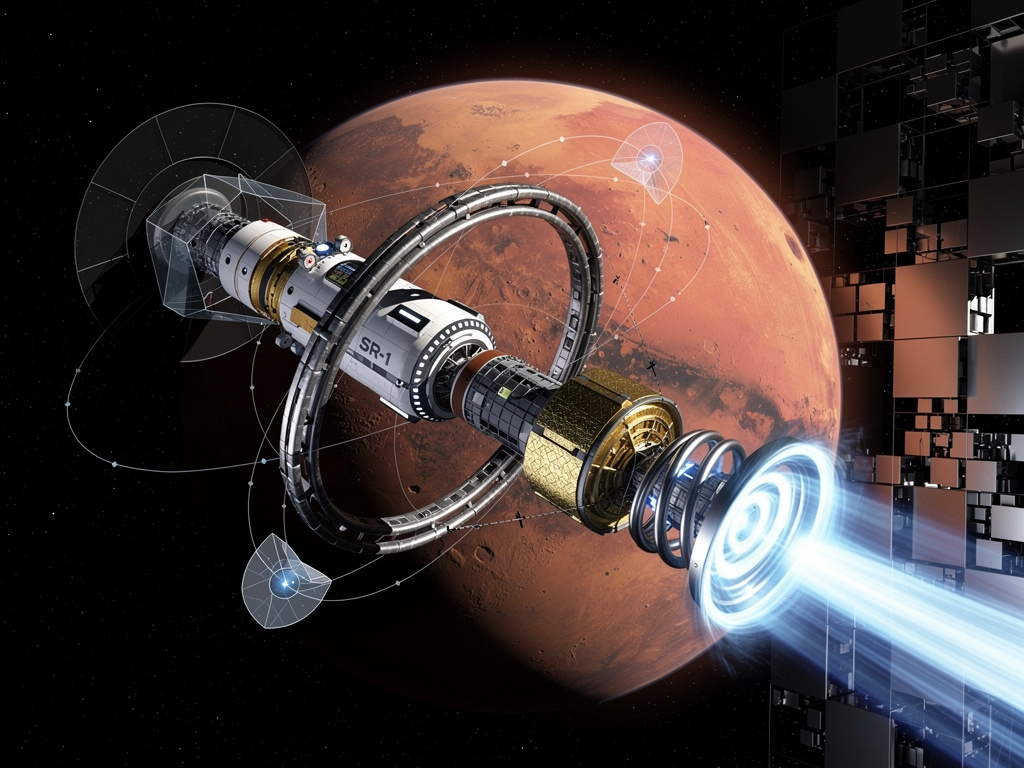
The spacecraft that will carry the first humans to Mars now has a name: SR-1 Freedom. And with that name comes a set of ambitions so sprawling they make the Apollo program look like a commuter flight.
NASA and its partners at Applied Physics, a research organization based in Huntington Beach, California, unveiled the conceptual design for what they’re calling the first deep-space crewed vessel purpose-built for interplanetary transit. The SR-1 Freedom isn’t a capsule perched atop a rocket. It’s a ship — a genuine spacefaring vehicle designed to sustain a crew of up to eight astronauts for the roughly 45-day journey to Mars and back, operating under a propulsion concept that, if it works as advertised, would compress a trip that currently takes six to nine months into something closer to a cross-country road trip, cosmically speaking.
The announcement, reported in detail by CNET, arrived during a presentation at the International Astronautical Congress in Milan. Applied Physics founder Gianni Martire described the SR-1 Freedom as a vessel that could reach Mars in as few as 45 days using what the team calls a “helical engine” — a closed-loop propulsion system that generates thrust without conventional propellant expenditure. That claim alone is enough to raise eyebrows across the aerospace industry, and it should.
Here’s the context that matters. NASA has been studying crewed Mars missions for decades, cycling through architectures and timelines that have consistently slipped further into the future. The agency’s current Artemis program, designed to return astronauts to the Moon, has itself faced repeated delays and cost overruns. The Space Launch System rocket, Artemis’s backbone, costs roughly $2.2 billion per launch. Against that backdrop, the idea of a purpose-built interplanetary cruiser operating on novel physics feels either visionary or premature, depending on whom you ask.
Applied Physics isn’t a traditional aerospace contractor. The organization describes itself as an independent research lab focused on theoretical and applied physics problems, including advanced propulsion. Its team includes former NASA personnel and physicists who have published peer-reviewed work on topics ranging from warp field mechanics to energy-density requirements for faster-than-light travel concepts. The helical engine concept at the core of SR-1 Freedom’s propulsion architecture was first proposed by NASA engineer David Burns in 2019. Burns’s original paper described a system that exploits the mass-changing effects of special relativity within a closed loop to produce thrust — no exhaust, no propellant consumption in the traditional sense.
The physics community’s reaction to helical engines has been, to put it diplomatically, mixed. Critics argue the concept may violate conservation of momentum. Proponents counter that relativistic effects at near-light particle velocities within the engine create a legitimate asymmetry. The debate is unresolved. Applied Physics says its own modeling suggests the engine can produce meaningful thrust at scales relevant to crewed spaceflight, but no full-scale prototype has been built or tested.
So why does this matter now?
Because NASA is involved. Not as a passive observer, but as a collaborating partner. The agency’s Innovative Advanced Concepts program, known as NIAC, has funded early-stage work on advanced propulsion systems for years. And NASA officials were present at the Milan unveiling, lending at least institutional credibility to the SR-1 Freedom concept. That doesn’t mean the agency has committed billions to building the ship. But it does mean the idea has cleared a threshold of seriousness that most speculative propulsion concepts never reach.
The SR-1 Freedom’s design specs, as presented, are striking. The vessel would measure approximately 300 feet in length, with a rotating habitation ring to generate artificial gravity — a feature that would address one of the most persistent biomedical challenges of long-duration spaceflight. Bone density loss, muscle atrophy, and cardiovascular deconditioning have plagued every long-duration mission aboard the International Space Station. A rotating habitat section producing even partial gravity could mitigate those effects substantially. The ship would also carry shielding against galactic cosmic radiation and solar particle events, two hazards that currently have no adequate solution for multi-month transits beyond low Earth orbit.
Applied Physics has put a preliminary cost estimate on the program: roughly $100 billion over 15 to 20 years. That figure is enormous by any standard, but it’s also comparable to what the United States has spent on the ISS over its operational lifetime. And it’s a fraction of what some earlier Mars architecture studies projected for conventional chemical-propulsion missions, which would require massive fuel depots, in-space assembly, and transit times long enough to demand years of crew provisions.
The timeline matters too. Applied Physics is targeting an initial uncrewed test flight by the mid-2030s, with a crewed Mars transit potentially following in the early 2040s. That puts SR-1 Freedom roughly in the same planning window as NASA’s own aspirational Mars targets, though the agency has been deliberately vague about committing to specific dates.
Not everyone in the aerospace community is buying it. Robert Zubrin, president of the Mars Society and one of the most vocal advocates for crewed Mars exploration, has long argued that the fastest path to Mars uses existing or near-term propulsion technology — chemical rockets and possibly nuclear thermal engines — rather than waiting for exotic physics to mature. His Mars Direct architecture, first proposed in the 1990s, relies on in-situ resource utilization and Spartan mission design to keep costs manageable. Zubrin’s criticism of advanced-propulsion-dependent architectures has always been the same: they become an excuse to delay action indefinitely.
That tension — between building with what we have and waiting for something better — defines the current moment in Mars planning. SpaceX’s Starship, the massive fully reusable rocket Elon Musk has positioned as his Mars vehicle, represents the “build now” philosophy. Starship’s development has been turbulent but rapid, with multiple test flights in 2024 and 2025 producing incremental progress toward full reusability. Musk has repeatedly stated his goal of landing cargo on Mars before the end of this decade, though few outside SpaceX consider that timeline realistic.
SR-1 Freedom represents something fundamentally different. It’s not an iteration on existing rocketry. It’s a bet that physics we don’t yet fully command can be engineered into a working vehicle within a generation. That’s a big bet. But it’s not without precedent. The Manhattan Project weaponized nuclear fission within three years of its inception, starting from a theoretical base that many physicists considered incomplete. The Apollo program put humans on the Moon eight years after Kennedy’s speech, using technologies that didn’t exist when the commitment was made.
The comparison isn’t perfect. Both Manhattan and Apollo operated under existential or geopolitical urgency that the current Mars push lacks. And both had essentially unlimited budgets relative to their technical scope. SR-1 Freedom would need sustained political and financial commitment across multiple presidential administrations — something NASA programs have historically struggled to maintain.
Still, the naming of the ship signals intent. Naming things matters in aerospace. It creates institutional momentum, public identity, and a psychological anchor for the engineers and scientists doing the work. The SR designation itself is a nod to the SR-71 Blackbird, the legendary Lockheed reconnaissance aircraft that held the speed record for air-breathing manned flight for decades. “Freedom” connects to the Mercury program’s tradition of astronaut-named capsules. Whether deliberate or not, the branding positions SR-1 Freedom as the heir to a lineage of American aerospace ambition.
The technical risks remain formidable. The helical engine must transition from theoretical modeling to laboratory demonstration to engineering prototype to flight-qualified hardware. Each of those steps involves potential failure modes that could kill the program. The artificial gravity habitat ring, while conceptually straightforward, has never been built or tested at scale in space. Radiation shielding adequate for interplanetary transit adds mass, and mass drives cost. Life support systems capable of sustaining eight crew members for 90-plus days (45 days each way, plus margin) must achieve reliability standards far beyond current ISS hardware.
And then there’s the question of what happens when they get there. SR-1 Freedom is a transit vehicle, not a lander. A crewed Mars mission would still require a descent stage, surface habitat, ascent vehicle, and return architecture. Those elements represent their own multi-billion-dollar development programs. Applied Physics has acknowledged this, framing SR-1 Freedom as one component of a larger mission architecture that would need to be developed in parallel.
The financial structure of the program also remains unclear. Applied Physics is a private organization, not a government agency or publicly traded defense contractor. Its funding sources include private investment and government research grants, but a $100 billion program would require either massive federal appropriation, an unprecedented public-private partnership, or some combination of both. Congress has shown willingness to fund ambitious space programs — the Artemis accords and SLS development demonstrate that — but sustained funding at the scale SR-1 Freedom demands would require bipartisan commitment of a kind that has been rare in recent decades.
Recent reporting from SpaceNews suggests that NASA’s budget trajectory is under pressure from competing priorities, including Earth science missions, the Mars Sample Return program (itself facing cost and schedule crises), and ongoing ISS decommissioning planning. Adding a $100 billion interplanetary vehicle to that portfolio would require either dramatic budget increases or equally dramatic reprioritization.
But the physics, if validated, changes the calculus entirely. A 45-day transit to Mars doesn’t just reduce crew exposure to radiation and microgravity. It transforms the mission architecture from an endurance test into something closer to a deployment. Shorter transit times mean smaller life support systems, less food, less water, less consumable mass. They mean crew members arrive at Mars in better physical and psychological condition. They mean abort scenarios become more viable. They mean, in short, that Mars becomes accessible rather than barely reachable.
That’s the prize Applied Physics is chasing. And it’s why NASA, despite the theoretical uncertainties, is paying attention.
The aerospace industry has seen ambitious propulsion concepts come and go. The VASIMR plasma engine, ion drives, solar sails, nuclear pulse propulsion — all have had their moments of enthusiasm followed by decades of incremental progress or quiet abandonment. The helical engine could follow the same trajectory. Or it could be the propulsion breakthrough that finally makes interplanetary crewed travel practical. Nobody knows yet. Not Applied Physics, not NASA, not the critics.
What’s different this time is the specificity. SR-1 Freedom isn’t a white paper or a conference slide deck. It’s a named vehicle with a defined crew capacity, a preliminary cost estimate, a development timeline, and institutional backing from the world’s most prominent space agency. That doesn’t guarantee success. But it does guarantee that the concept will be tested against reality in ways that purely theoretical proposals never are.
The next few years will be decisive. If Applied Physics can demonstrate helical engine thrust in a laboratory setting — even at microscopic scales — the program gains credibility and, more importantly, funding momentum. If the demonstrations fail or prove inconclusive, SR-1 Freedom joins the long list of Mars vehicles that existed only in presentations and press releases.
For now, the ship has a name. It has a team. It has a destination. Whether it ever has a crew remains the most consequential open question in human spaceflight.


 WebProNews is an iEntry Publication