
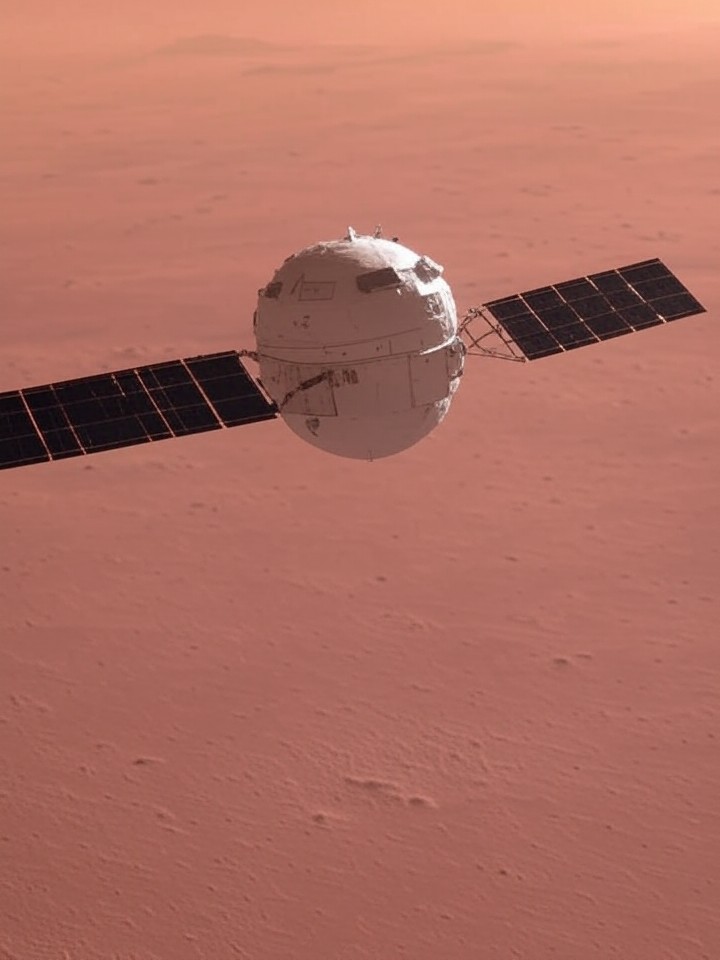
Orbit of Uncertainty: NASA’s MAVEN Mission Hits a Silent Snag on the Red Planet
In the vast expanse of interplanetary exploration, where signals traverse millions of miles through the void, silence can be more alarming than any data spike. NASA’s Mars Atmosphere and Volatile Evolution (MAVEN) orbiter, a key player in unraveling the mysteries of the Red Planet’s thinning atmosphere, has gone quiet. This unexpected communications blackout, which began in early December 2025, has left mission controllers scrambling to restore contact with a spacecraft that has been orbiting Mars since 2014. The anomaly underscores the inherent risks of operating machinery in such a harsh, distant environment, where a single glitch can disrupt years of scientific progress.
MAVEN’s primary role involves studying how solar wind strips away Mars’ atmosphere, providing clues about why the planet transitioned from a potentially habitable world to the arid desert it is today. Launched in 2013, the orbiter has delivered groundbreaking insights, including evidence of auroras and the ongoing loss of atmospheric gases. But now, with no signals received for over a month as of mid-January 2026, NASA officials are confronting the possibility that recovery efforts may fail. Louise Prockter, the agency’s planetary science division director, recently stated that it’s “very unlikely” they’ll regain control, a sentiment echoed in a report from Futurism.
The loss of MAVEN isn’t just a technical setback; it ripples through NASA’s broader Mars program. The orbiter serves as a vital communications relay for surface missions like the Perseverance rover, which continues to traverse Jezero Crater in search of ancient microbial life signs. Without MAVEN, teams have had to rely on alternatives like the Mars Reconnaissance Orbiter and the European Space Agency’s ExoMars Trace Gas Orbiter to maintain links with rovers on the ground. This workaround, while effective in the short term, highlights the fragility of the interconnected fleet orbiting the fourth planet from the Sun.
Relays in Peril: The Domino Effect on Mars Operations
Perseverance, undeterred by the orbital drama, has been making strides in its exploration. Recent images from the rover reveal wind-sculpted features known as megaripples, vast undulations in the Martian soil that speak to the planet’s dynamic weather patterns. These observations, captured in early January 2026, add to the rover’s impressive tally of over 40 kilometers traveled since its 2021 landing. Yet, the communications shuffle necessitated by MAVEN’s silence has forced adjustments in mission planning, potentially delaying data uploads and command sequences.
Broader implications extend to upcoming endeavors. NASA’s Mars Sample Return mission, aimed at bringing back rock samples collected by Perseverance, faces its own hurdles. Experts are pushing back against rumors of cancellation, arguing that retrieving these samples could yield definitive evidence of past life on Mars. A recent article in Space.com details how planetary scientists are advocating for the project’s continuation, emphasizing its scientific value amid budget constraints.
The Trump administration’s influence looms large here. Congressional backing for efforts to terminate the sample return initiative has been reported, with costs ballooning beyond initial estimates. According to Science, the project is effectively “dead” under current fiscal pressures, though advocates insist that international partnerships could revive it. This political tug-of-war reflects deeper tensions in NASA’s funding priorities, where ambitious goals collide with economic realities.
Historical Echoes: Past Setbacks in Martian Exploration
This isn’t the first time NASA has grappled with spacecraft anomalies on Mars. The InSight lander, which ceased operations in 2022 due to dust accumulation on its solar panels, serves as a cautionary tale. Posts on X from users like Latest in Space in 2021 and 2022 highlighted InSight’s “severe energy problems,” illustrating how Martian dust storms can doom even the hardiest probes. Similarly, the Ingenuity helicopter encountered navigation glitches in 2021, as noted by Scott Manley on X, where timestamp errors in camera data led to flight instability.
MAVEN’s current predicament stems from an unexpected anomaly during a routine maneuver, possibly related to its inertial measurement unit or onboard computer. Engineers are attempting safe mode reboots and signal sweeps, but the orbiter’s aging hardware—now over a decade old—complicates recovery. A detailed update from NASASpaceFlight.com explains how the loss affects relay operations, forcing Curiosity rover teams to adapt as well.
Looking back at 2025, NASA’s Mars activities were a mix of triumphs and trials. The Perseverance rover’s discovery of potential biosignatures in the Cheyava Falls rock, published in Nature and referenced in Wikipedia’s 2025 spaceflight summary, marked a high point. Yet, the year also saw orbital emergencies from space debris and the launch of twin ESCAPADE probes to study solar wind effects, as covered in Space.com’s 2025 recap.
Strategic Shifts: Adapting to Orbital Silence
As NASA pivots, attention turns to redundant systems and future missions. The Mars Odyssey orbiter, one of the oldest in the fleet, has stepped up for communications duties, demonstrating the value of long-duration assets. However, with MAVEN potentially out, scientists worry about gaps in atmospheric data collection, which is crucial for planning human missions. Posts on X from users like Planetterrian in early January 2026 discuss ongoing Mars explorations, reflecting public fascination with these challenges.
International collaboration offers a silver lining. China’s Tianwen-2 mission, launched in 2025 and set to rendezvous with asteroid 469219 Kamo’oalewa in mid-2026, could provide complementary data on solar system volatiles. NASA’s own Artemis program, while focused on the Moon, shares technological overlaps with Mars goals, such as radiation shielding and life support systems. A recent X post from The Encyclopaedia highlights human challenges like muscle atrophy in low gravity, underscoring the need for robust health protocols.
Budget battles continue to shape the narrative. The 2026 news releases from NASA’s official site mention accreditation for Artemis II activities, signaling a shift toward lunar priorities. Yet, Mars advocates argue that abandoning sample return would cede ground to competitors like China, which plans its own sample missions. Experts in a Space.com piece stress that returning Mars rocks should be a top U.S. priority to maintain leadership in planetary science.
Emerging Technologies: Bolstering Future Resilience
Innovation is key to mitigating such losses. NASA’s development of advanced propulsion and autonomous systems aims to make future orbiters more resilient. The ESCAPADE mission, launched in November 2025, exemplifies this with its innovative trajectory that includes a year-long loiter phase before Mars insertion. As detailed in Wikipedia, this approach allows for precise atmospheric studies without immediate orbital risks.
On the ground, Perseverance’s ongoing work in Jezero Crater provides a counterpoint to orbital woes. The rover’s February 2026 fifth anniversary will celebrate milestones like sample caching, even as communications adaptations test team ingenuity. An Earth.com report notes the anomaly’s sudden onset, fueling speculation about cosmic ray interference or hardware fatigue.
Public sentiment, gauged from X discussions, mixes concern with optimism. Posts from users like Thomas Swenson in January 2026 touch on delays in related programs like Starship’s human landing system, linking Mars setbacks to broader space ambitions. Meanwhile, Ruby Foxton’s X commentary questions timelines for uncrewed Mars missions, highlighting the 2026 launch window’s pressures.
Global Ramifications: Mars in the Geopolitical Arena
The MAVEN incident also spotlights geopolitical dimensions. With Portugal joining the Artemis Accords in 2026, as per NASA’s releases, international commitments to responsible exploration grow. This framework could extend to Mars, fostering data-sharing amid U.S.-China rivalries. A winning strategy for Mars sample return, as urged in Space.com, involves prioritizing it over less critical expenditures.
Non-Martian events, like the International Space Station’s medical evacuation in January 2026 detailed in Space.com’s live updates, remind us of human vulnerabilities in space. These parallels inform Mars planning, where crewed missions demand foolproof communications.
As NASA navigates this silence, the agency’s resilience shines through. From dust-covered landers to silent orbiters, each challenge refines strategies for the ultimate goal: human footsteps on Martian soil. While MAVEN’s fate hangs in balance, the data it has already provided endures, paving the way for successors in an ever-expanding quest to understand our neighboring world.
Pathways Ahead: Innovating Through Adversity
Looking forward, NASA’s 2025 Mars Report special edition from NASA Science described Perseverance’s investigation of a complex rock, hinting at untapped discoveries. Integrating such findings with orbital data remains essential, even without MAVEN.
Technological shortfalls, as ranked in NASA’s 2026 civil space assessment and discussed on X by Stage Zero Studio, invite industry input on solutions like improved power systems. These efforts could prevent future blackouts.
Ultimately, the MAVEN saga encapsulates the high-stakes nature of space exploration. As probes push boundaries, setbacks like this propel advancements, ensuring that silence in the void leads not to defeat, but to deeper insights into the cosmos.


 WebProNews is an iEntry Publication