
Silent Signals from the Red Planet: Unraveling the Mystery of NASA’s MAVEN Orbiter Blackout
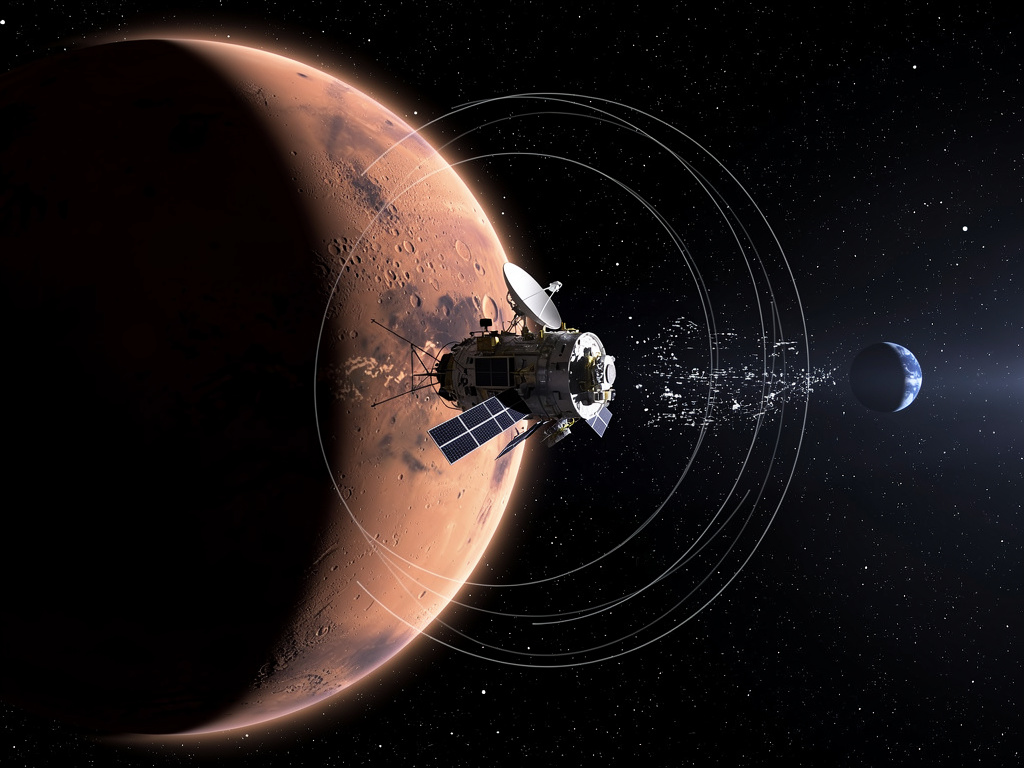
In the vast expanse of space exploration, few events stir as much concern among scientists and engineers as the sudden silence of a veteran spacecraft. NASA’s Mars Atmosphere and Volatile Evolution (MAVEN) orbiter, a key player in unraveling the mysteries of the Red Planet’s atmospheric history, has gone quiet, leaving mission teams scrambling to diagnose the issue. Launched in 2013 and arriving at Mars in 2014, MAVEN has far exceeded its initial mission lifespan, providing invaluable data on how Mars lost its once-thick atmosphere over billions of years. But on December 6, 2025, as the orbiter dipped behind the planet during a routine orbital pass, it failed to reemerge with its expected signal, plunging the project into uncertainty.
The loss of contact occurred abruptly, according to reports from multiple outlets. Engineers at NASA’s Jet Propulsion Laboratory noted that the spacecraft was functioning normally before vanishing from view on the far side of Mars. When it should have reappeared, only silence greeted the ground stations. This incident echoes past challenges in Mars missions, where dust storms, solar conjunctions, or hardware failures have temporarily or permanently severed communications. Yet, for MAVEN, which has been a reliable sentinel for over a decade, this blackout raises questions about the endurance of aging space hardware in the harsh Martian environment.
Mission controllers are now in a race against time to reestablish contact, employing a series of diagnostic commands and listening sessions via the Deep Space Network. The orbiter’s design includes safe modes that could activate in case of anomalies, potentially explaining the silence if it entered a protective state. However, without any telemetry data, speculation abounds about possible causes, from a power system glitch to an unexpected collision with orbital debris—though the latter seems unlikely given Mars’ sparse satellite population.
The Legacy of MAVEN: A Decade of Atmospheric Insights
Since its inception, MAVEN has been instrumental in piecing together the puzzle of Mars’ climatic evolution. The mission’s primary goal was to study the upper atmosphere, ionosphere, and interactions with the solar wind, helping explain why Mars transformed from a potentially habitable world to the arid desert we see today. Over the years, it has relayed data showing that solar wind stripped away much of the planet’s atmosphere, with key findings published in numerous scientific papers. For instance, measurements during solar storms demonstrated rapid atmospheric erosion, offering clues to similar processes on other planets.
Beyond its scientific contributions, MAVEN has served as a communications relay for surface missions, including the Perseverance rover and the now-defunct InSight lander. This dual role amplified its value, making it a linchpin in NASA’s broader Mars exploration strategy. As reported by Space.com, the orbiter’s loss could disrupt ongoing data relays, though redundant systems on other orbiters like the Mars Reconnaissance Orbiter might mitigate some impacts.
The spacecraft’s longevity is a testament to robust engineering. Designed for a primary mission of just one Earth year, MAVEN has operated for more than ten, enduring radiation, temperature extremes, and the occasional software hiccup. Engineers have periodically adjusted its orbit to optimize science observations, including dips into the lower atmosphere for direct sampling. This adaptability has kept the mission relevant, even as newer probes like Europe’s ExoMars Trace Gas Orbiter joined the fray.
Echoes of Past Losses: Lessons from Mars Mission History
This isn’t the first time NASA has faced the heartache of a silent spacecraft around Mars. Historical parallels abound, such as the 2018 dust storm that claimed the Opportunity rover after 15 years of service, as noted in posts found on X recalling that event’s emotional toll. Similarly, India’s Mars Orbiter Mission lost contact in 2022 after eight years, highlighting the finite lifespan of even the hardiest probes. These incidents underscore the challenges of operating in an environment where help is millions of miles away and real-time intervention is impossible.
In MAVEN’s case, the timing of the blackout—occurring on the far side of Mars—suggests a possible onboard fault that triggered during the communications blackout period. According to a blog post on NASA Science, teams are investigating whether a fault protection mechanism activated, perhaps due to a navigation error or power anomaly. The orbiter carries instruments like the Neutral Gas and Ion Mass Spectrometer and the Imaging Ultraviolet Spectrograph, which have been pivotal in detecting atmospheric escape mechanisms.
Comparisons to other missions reveal patterns in spacecraft failures. For example, the Mars Global Surveyor lost contact in 2006 due to a battery issue, while the Phoenix lander succumbed to winter conditions in 2008. Each loss has refined NASA’s approach to redundancy and autonomy, yet MAVEN’s situation tests these advancements anew. Industry insiders point out that as missions age, components like solar panels degrade, reducing power margins and increasing vulnerability to glitches.
Diagnostic Efforts and Potential Scenarios
Recovery operations are underway, with engineers sending “hail Mary” commands to reset systems or switch to backup transmitters. The Deep Space Network’s antennas in California, Spain, and Australia are tuned in, listening for any faint signal that might indicate MAVEN is still operational but in a low-power mode. As detailed in an article from The Guardian, the spacecraft abruptly stopped communicating over the weekend, prompting an all-hands investigation.
Possible culprits include a failure in the attitude control system, which keeps the orbiter oriented correctly for solar power and communications. If the high-gain antenna is misaligned, signals could be too weak to detect. Alternatively, a cosmic ray hit might have corrupted onboard software, a risk in the radiation-heavy space beyond Earth’s magnetosphere. Experts are also considering fuel depletion; MAVEN uses hydrazine thrusters for orbital maneuvers, and after a decade, reserves might be critically low, leading to instability.
The mission’s science team, led by principal investigator Shannon Curry from the University of California, Berkeley, remains hopeful. In statements echoed across media, they emphasize MAVEN’s history of resilience, having survived previous safe mode entries. However, prolonged silence could mean the end, forcing a shift to archival data analysis and planning for successor missions.
Implications for Future Mars Exploration
The potential loss of MAVEN arrives at a pivotal moment for Mars science. With NASA’s Artemis program eyeing human missions to the moon as a stepping stone to Mars, understanding the planet’s atmosphere is crucial for safe landings and habitat design. MAVEN’s data on dust storms and radiation levels has informed models for astronaut protection, making its absence a setback for long-term planning.
Moreover, the incident highlights the need for a refreshed fleet of Mars orbiters. As noted in a piece by Ars Technica, if NASA is committed to deeper exploration, it’s time to launch new missions. The aging infrastructure around Mars, including the Odyssey orbiter from 2001, faces similar risks, potentially leaving gaps in relay capabilities for rovers like Perseverance and Curiosity.
International collaboration could fill voids, with contributions from the European Space Agency and China’s Tianwen-1 orbiter providing overlapping coverage. Yet, MAVEN’s specialized focus on atmospheric dynamics sets it apart, and its loss would create a knowledge gap until a replacement arrives—possibly not until the 2030s under current budgets.
Ripple Effects on Ongoing Missions and Data Relay
Beyond science, MAVEN’s role in communications relay is critical. It has supported data transmission from surface assets, ensuring high-bandwidth links back to Earth. Without it, missions might rely more heavily on the Mars Reconnaissance Orbiter, which itself is over 19 years old. This could strain resources, as reported by PBS News, potentially delaying science returns from active rovers.
The event also sparks discussions on spacecraft design for longevity. Future orbiters might incorporate advanced AI for autonomous fault recovery, reducing dependency on Earth-based interventions. NASA’s proposed Mars Ice Mapper, though canceled, exemplified efforts to bolster the orbital network.
Public sentiment, gauged from recent posts on X, mixes nostalgia with concern, drawing parallels to the emotional farewell for the Opportunity rover. Space enthusiasts mourn the potential end of another era, while underscoring the triumphs of extended missions.
Broader Context in Space Agency Challenges
This blackout occurs amid broader fiscal and technical hurdles for NASA. Budget constraints have delayed projects like the Mars Sample Return mission, and MAVEN’s fate could influence funding debates for planetary science. As covered by U.S. News, the loss underscores the risks of relying on aging assets without timely replacements.
Engineers are exploring all avenues, including using other Mars orbiters to ping MAVEN if it’s in a dormant state. The coming weeks will be telling; if contact resumes, it could yield insights into deep-space resilience. If not, MAVEN joins the pantheon of heroic probes that pushed boundaries until the end.
The saga reminds us of the fragility of human reach into the cosmos. Each silent signal prompts reflection on what we’ve learned and what remains unknown about our neighboring world.
Looking Ahead: Strategies for Orbital Renewal
In response, NASA might accelerate plans for new orbiters, perhaps integrating them with commercial partnerships like those with SpaceX for Starship-based deliveries. Concepts for swarms of small satellites could provide redundant coverage, mitigating single-point failures.
Scientific communities are already advocating for missions focused on atmospheric monitoring, building on MAVEN’s foundation. Data from its instruments have reshaped models of planetary habitability, influencing exoplanet studies.
Ultimately, MAVEN’s story, whether it revives or fades, exemplifies the perseverance inherent in space exploration—a field where silence often precedes breakthroughs. As teams vigilantly listen, the Red Planet holds its secrets close, waiting for the next chapter to unfold.


 WebProNews is an iEntry Publication