
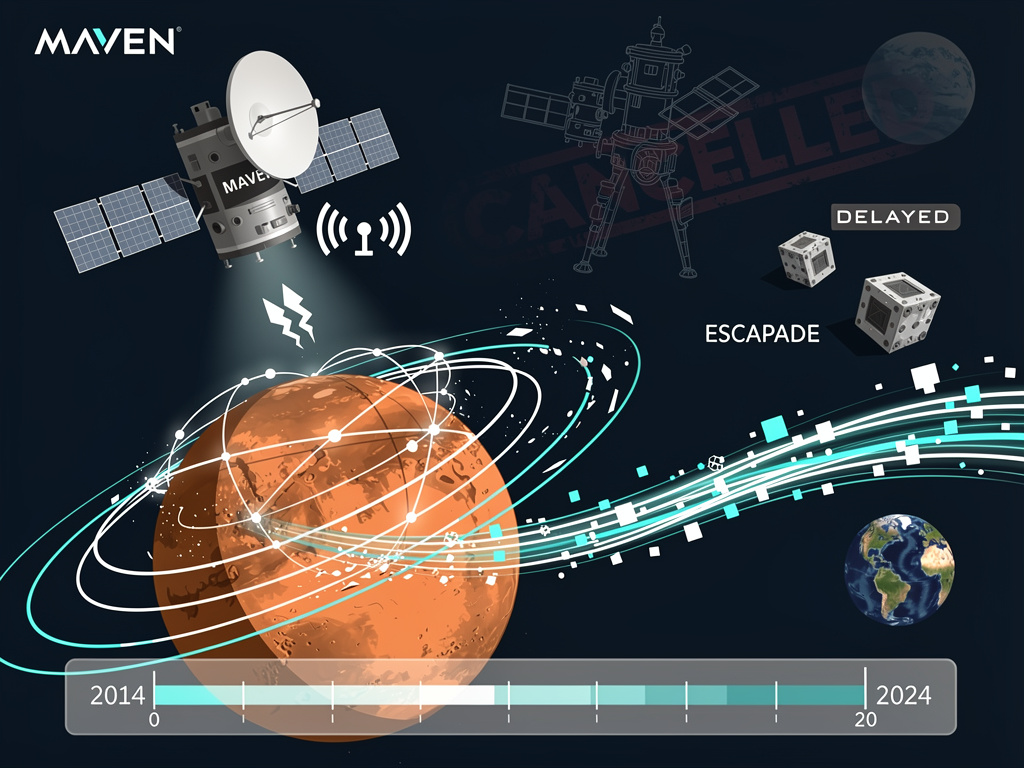
NASA’s Mars Atmosphere and Volatile Evolution mission, known as MAVEN, may have flown its last orbit around the Red Planet. The spacecraft, launched in 2013 to study Mars’s thinning atmosphere, has lost contact, prompting agency leaders to concede recovery is improbable. This development marks a setback for ongoing Mars observations just as other missions face scrutiny.
During a recent briefing, NASA Planetary Science Division Director Louise Prockter stated the agency is "very unlikely" to regain control of MAVEN. Efforts to re-establish communication, initiated after signals ceased nearly a month ago, have failed, according to Futurism. The orbiter’s role in relaying data from surface rovers like Curiosity and Perseverance underscores the potential gap in operations.
MAVEN’s instruments have provided critical data on solar wind stripping Mars’s atmosphere, informing models of ancient habitability. Now, with propellant likely depleted and no response to commands, NASA engineers are assessing alternatives for data relay.
Loss of a Vital Relay Link
The spacecraft’s deep-space network passes yielded no telemetry since early January, as detailed in NBC News. MAVEN has served as a crucial communications bridge, forwarding rover data to Earth when the Mars Odyssey orbiter is unavailable. Its silence could strain mission timelines unless backups prove sufficient.
Engineers attempted safe mode reactivation and antenna realignments, but silence persists. Prockter noted the mission’s extension beyond its primary one-year goal into over a decade of service highlights its resilience amid radiation and thermal stresses.
Industry observers point to MAVEN’s ionospheric data as foundational for future human missions, complicating NASA’s planning horizon.
Technical Failures Under the Hood
Telemetry prior to blackout indicated power anomalies and thruster issues, common in aging spacecraft exposed to Mars’s harsh radiation belts. The orbiter’s solar arrays, scarred by micrometeorites, may have underperformed during recent dust storms, per NASA updates referenced in web searches.
Launched atop an Atlas V rocket, MAVEN entered Mars orbit in 2014, dipping into the upper atmosphere for samples. Its six instruments, including the Neutral Gas and Ion Mass Spectrometer, mapped escape rates that explain Mars’s transition from wet to arid world.
Without MAVEN, Perseverance’s sample collection for eventual Earth return relies more heavily on Odyssey, launched in 2001 and showing its own age-related glitches.
Budget Pressures Compound Challenges
Separate woes plague NASA’s Mars Sample Return program, with Congress backing cancellation amid ballooning costs, as reported by Science magazine. The $11 billion project to retrieve Perseverance’s rock cores faces redesign or demise under fiscal constraints.
Administrators unveiled dual paths forward: a sky-crane lander echoing past successes or commercial partnerships for ascent vehicle launch. NASA targets a 2026 design freeze, per agency statements.
ESCAPADE twin probes, meanwhile, loiter in Earth orbit before Mars insertion, their year-long delay risking component wear, according to Space.com.
Strategic Shifts in Red Planet Exploration
Perseverance continues imaging vast wind-carved features, with recent photos revealing megaripples from Space.com. These observations sustain science flow despite orbital voids.
Posts on X from NASA accounts emphasize innovation in sample return, referencing 2033 goals with helicopters as backups. Yet, MAVEN’s probable loss amplifies calls for robust redundancy in deep-space networks.
Prockter’s candid assessment reflects NASA’s pragmatic turn: celebrating MAVEN’s legacy while pivoting to Artemis and commercial Mars ventures. Recovery odds dwindle daily, but archived data will fuel analysis for years.
Implications for Future Missions
With MAVEN’s 20,000+ orbits yielding petabytes of data, researchers anticipate peer-reviewed papers probing atmospheric loss anew. The mission’s end echoes Voyager’s fading signals, signaling an era’s close.
NASA’s 2026 news releases hint at adaptive strategies, balancing Mars cuts with lunar priorities. Stakeholders urge accelerated relays like Trace Gas Orbiter collaborations with ESA.
As silence from MAVEN persists into mid-January 2026, the agency prepares formal mission-end declarations, redirecting resources to resilient probes ensuring Mars secrets keep flowing Earthward.


 WebProNews is an iEntry Publication