
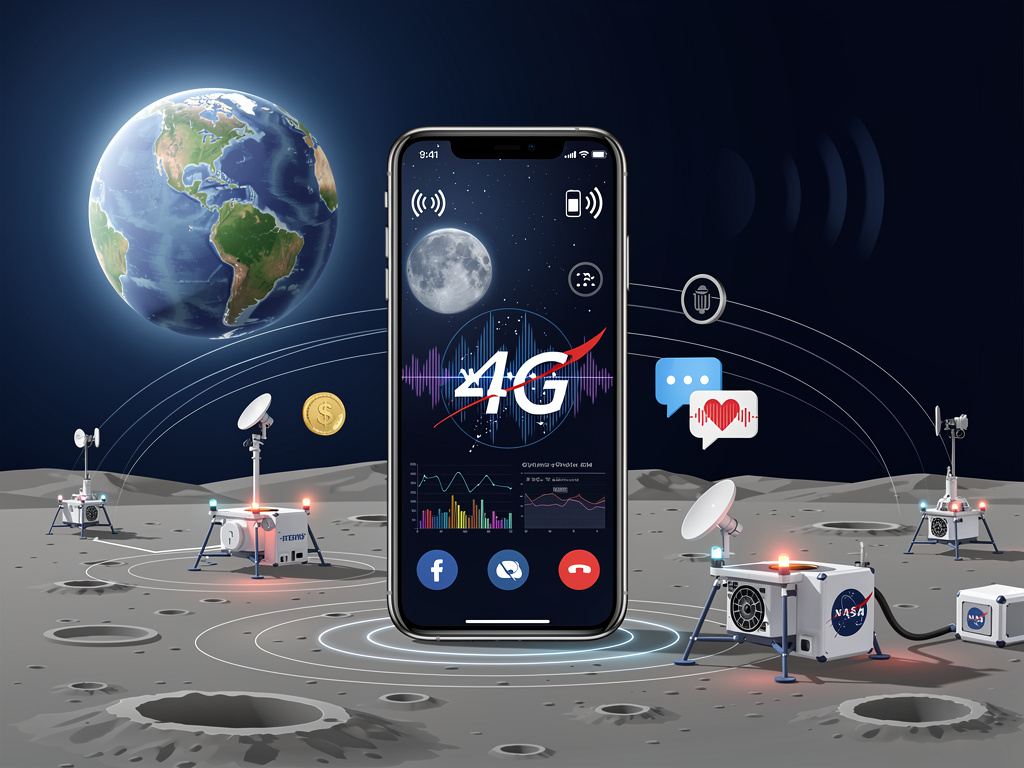
In a watershed moment for space exploration, NASA has authorized astronauts participating in the Artemis program to carry their personal smartphones to the Moon, marking a fundamental shift in how space agencies approach communication technology beyond Earth orbit. This decision, announced in early February 2025, represents far more than a convenience upgrade—it signals a new era where consumer technology intersects with deep space operations in ways previously considered impossible.
According to TechCrunch, the policy change comes after years of rigorous testing and infrastructure development that has finally made smartphone functionality viable in the harsh lunar environment. The breakthrough hinges on NASA’s deployment of advanced 4G/LTE network infrastructure on the Moon itself, developed in partnership with Nokia and other telecommunications companies. This network will enable astronauts to use their devices for everything from photography and note-taking to real-time communication with mission control and loved ones back on Earth.
The implications extend well beyond astronaut morale. Industry insiders recognize this development as a critical stepping stone toward sustainable lunar habitation and commercial space operations. By leveraging existing consumer technology rather than developing proprietary systems from scratch, NASA is dramatically reducing costs while simultaneously increasing functionality and user familiarity—a strategic pivot that could reshape the economics of space exploration.
The Technical Infrastructure Behind Lunar Connectivity
The foundation for smartphone use on the Moon rests on Nokia’s lunar surface communications system, which the company has been developing under contract with NASA since 2020. This 4G/LTE network, designed specifically for the extreme conditions of the lunar environment, must contend with temperature fluctuations ranging from -280°F to 260°F, intense radiation exposure, and the complete absence of atmospheric protection that Earth-based networks take for granted.
Nokia’s lunar network architecture differs significantly from terrestrial cellular systems. The base stations are hardened against radiation and designed to operate in vacuum conditions, with specialized antennas that can maintain signal integrity across the Moon’s dusty surface. The system operates on spectrum allocations specifically designated for space use, avoiding interference with Earth-based communications while providing bandwidth sufficient for high-definition video transmission, crucial for both scientific documentation and public engagement.
Commercial Implications and the Race for Lunar Infrastructure
The smartphone authorization reflects a broader trend toward commercialization of lunar operations. Private sector companies are already positioning themselves to capitalize on the infrastructure NASA is establishing. SpaceX, Blue Origin, and emerging players in the space telecommunications sector view the Moon as a proving ground for technologies that will eventually support Mars missions and deep space exploration.
Financial analysts tracking the space economy suggest that enabling consumer device functionality in space environments could unlock entirely new revenue streams. The ability to maintain normal communication patterns—texting, video calls, social media updates—transforms the psychological profile of long-duration space missions while creating opportunities for commercial partnerships. Telecommunications companies are exploring subscription models for space-based services, while device manufacturers are developing ruggedized versions of consumer smartphones specifically optimized for extraterrestrial use.
Operational Benefits and Mission Efficiency Gains
From an operational standpoint, allowing astronauts to use familiar devices reduces training requirements and cognitive load during missions. Rather than learning entirely new communication systems, crew members can rely on interfaces they’ve used for years. This familiarity becomes increasingly important as mission complexity grows and crew sizes expand under the Artemis program’s ambitious timeline.
Mission planners also recognize smartphones as powerful multipurpose tools that consolidate functionality previously requiring multiple specialized devices. A single smartphone can serve as a camera for documenting geological samples, a voice recorder for mission logs, a computational device for running scientific applications, and a communication terminal—all while weighing mere ounces. This consolidation directly addresses one of space exploration’s most persistent challenges: mass constraints. Every pound of payload costs thousands of dollars to transport to the Moon, making the smartphone’s versatility economically compelling.
Radiation Shielding and Device Modifications
Despite the authorization, the smartphones bound for the Moon aren’t identical to those in consumers’ pockets. NASA has implemented specific modifications to address the unique challenges of the lunar environment, particularly radiation exposure. Beyond Earth’s protective magnetosphere, electronic devices face bombardment from cosmic rays and solar radiation that can corrupt data, damage circuits, and reduce operational lifespan.
Engineers have developed specialized cases incorporating radiation shielding materials, including layers of aluminum and polyethylene composites that significantly reduce radiation exposure to sensitive electronics. Additionally, the devices run modified firmware with enhanced error-checking algorithms designed to detect and correct radiation-induced bit flips—single-event upsets that occur when high-energy particles strike memory chips. These modifications represent a collaboration between NASA engineers, smartphone manufacturers, and radiation physics specialists, creating a template for consumer electronics adaptation to space environments.
Psychological and Human Factors Considerations
The psychological dimension of smartphone access during lunar missions cannot be overstated. Previous space station research has consistently demonstrated that maintaining connection with Earth—particularly through visual communication with family and friends—significantly impacts crew mental health and mission performance. The International Space Station has long provided internet access and video calling capabilities, but extending these services to the Moon represents a qualitative leap in maintaining astronaut wellbeing during missions that will eventually extend to weeks or months.
NASA’s Human Research Program has been studying the psychological effects of deep space isolation for decades, and their findings have directly influenced the smartphone authorization decision. The ability to share experiences in real-time through photos and videos, to maintain social media presence, and to engage with Earth-based communities provides astronauts with a psychological anchor that previous generations of space explorers lacked. This connectivity may prove essential as missions push further from Earth, where communication delays grow from seconds to minutes and eventually hours.
Security Protocols and Data Management
The introduction of consumer devices into mission-critical space operations raises significant cybersecurity concerns. NASA has implemented comprehensive security protocols governing smartphone use during lunar missions, including network segmentation that isolates personal devices from mission-critical systems. Astronauts’ phones will operate on a separate network partition from the systems controlling life support, navigation, and scientific instruments, preventing potential security breaches from compromising essential operations.
All data transmitted through the lunar network undergoes encryption using quantum-resistant algorithms, anticipating future threats to current cryptographic standards. Additionally, NASA maintains strict controls over which applications can be installed on mission smartphones, with each app undergoing security vetting before approval. This approach balances astronaut autonomy with operational security, allowing personal communication while maintaining the integrity of mission systems.
International Collaboration and Standards Development
NASA’s smartphone initiative is occurring within a broader context of international space cooperation and standards development. The European Space Agency, China National Space Administration, and other national space programs are closely monitoring NASA’s approach, with several indicating plans to adopt similar policies for their own lunar programs. This convergence toward common communication standards could facilitate future international lunar missions and the development of shared infrastructure.
The International Telecommunication Union has been working to establish frequency allocations and technical standards for lunar communications, recognizing that multiple nations and commercial entities will soon operate simultaneously on and around the Moon. The success of consumer device integration into NASA’s Artemis program provides valuable data points for these standardization efforts, potentially accelerating the development of interoperable systems that benefit all lunar operators.
Looking Forward: Mars and Beyond
The smartphone authorization for lunar missions serves as a proof of concept for more ambitious applications. NASA engineers are already considering how similar approaches might work for Mars missions, where communication delays of up to 24 minutes each way fundamentally change the nature of real-time interaction. The technologies and protocols being developed for lunar smartphone use will inform the design of communication systems for the Red Planet, where astronauts will need even greater autonomy and more robust local communication networks.
As humanity’s presence in space evolves from brief visits to sustained habitation, the normalization of consumer technology in extraterrestrial environments represents a critical transition. The smartphone, perhaps more than any other device, symbolizes this shift—transforming space exploration from an endeavor requiring specialized equipment for every function to one where familiar, versatile tools can be adapted to new frontiers. This evolution promises to accelerate the pace of space development while making participation in that development more accessible to a broader range of people and organizations.
The authorization of smartphones for lunar missions ultimately reflects a maturation of space exploration philosophy. Rather than viewing space as a realm requiring complete technological reinvention, NASA is increasingly recognizing opportunities to adapt and leverage existing innovations. This approach not only reduces costs and development timelines but also maintains stronger connections between space operations and Earth-based technological advancement. As the commercial space sector continues its rapid expansion, this integration of consumer and space technologies will likely accelerate, bringing the dream of routine space access closer to reality while keeping astronauts connected to the world they temporarily leave behind.


 WebProNews is an iEntry Publication