
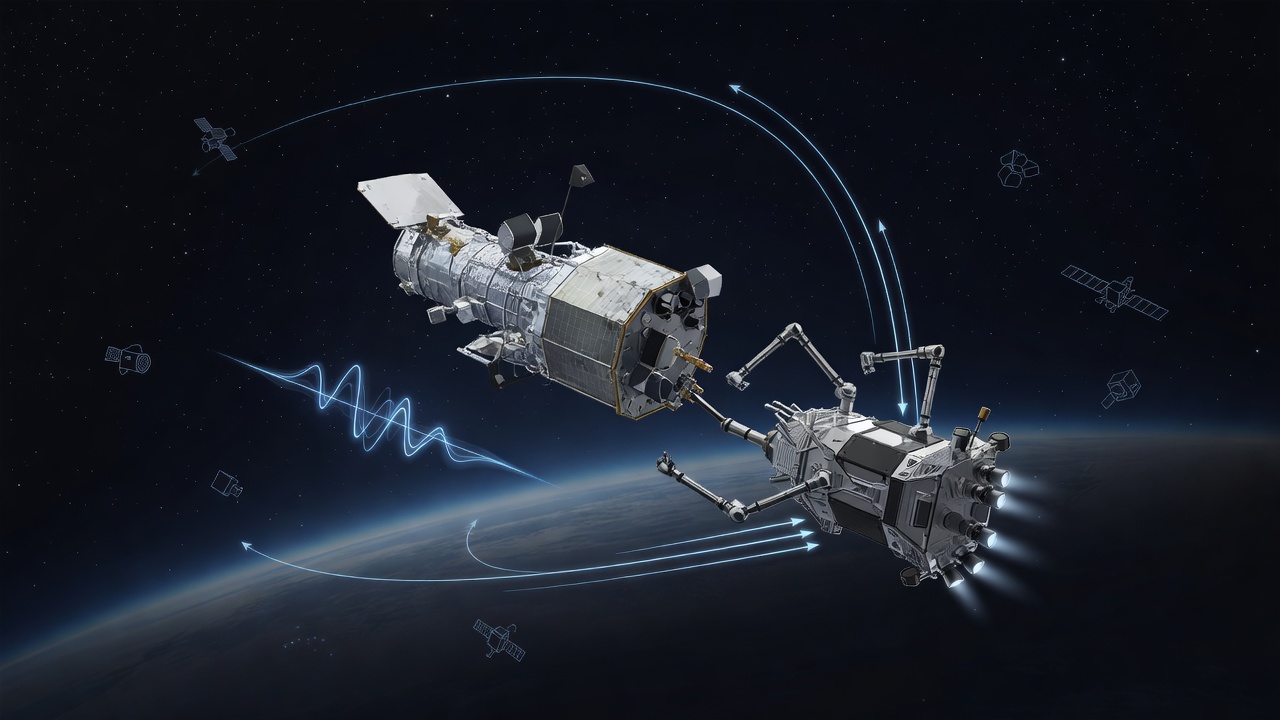
A small robotic spacecraft hurtled into orbit last week. Its target? A 22-year-old NASA telescope hurtling toward a fiery end in Earth’s atmosphere. The mission marks the first time a commercial vehicle will attempt to capture and reposition a government spacecraft never built for such an encounter. Success could reshape how agencies handle aging hardware in low Earth orbit. Failure might accelerate calls for better designs from the start.
The Neil Gehrels Swift Observatory launched in 2004. It carries instruments to detect and study gamma-ray bursts, the most energetic explosions in the universe. These events release in seconds the energy our sun will produce over its entire lifetime. Swift’s speed and agility let astronomers catch these fleeting phenomena and alert other telescopes. No other instrument matches its capabilities, according to researchers who rely on its data.
Yet solar activity has expanded Earth’s upper atmosphere. Drag from the thicker air has pulled Swift down from its original 373-mile altitude. The observatory now orbits at roughly 220 miles. Without intervention it could reenter uncontrollably by the end of 2026. BBC News reported the telescope’s scientific value and the risks of letting it burn up.
Engineers at Katalyst Space Technologies received a $30 million NASA contract in September 2025. The Arizona startup had less than a year to design, build and launch its solution. The company acquired Atomos Space in 2025 to gain flight heritage. Its LINK spacecraft, about the size of a refrigerator, carries three robotic arms, cameras, sensors and small thrusters. Ghonhee Lee, Katalyst’s chief executive, called the accelerated timeline extraordinary. “The team designed, built, tested, and integrated a robotic spacecraft capable of performing one of the most ambitious commercial servicing missions ever attempted,” he said in a company statement.
The mission launched July 3, 2026, aboard the final Northrop Grumman Pegasus XL rocket. Dropped from a modified aircraft over the Pacific near the Marshall Islands, the air-launched vehicle placed LINK on course to intercept Swift. The New York Times detailed the launch and the spacecraft’s refrigerator-size dimensions. Operators will spend weeks commissioning systems before rendezvous begins in about a month.
Once near the target, LINK will image Swift from every angle. The telescope has spent more than two decades in space. Its surfaces may have changed. “The Swift telescope was never designed to be caught in space and have its orbit changed,” Dr. Simeon Barber, a senior research fellow at the Open University, told the BBC. “So the rescue craft is going to approach it very slowly and attach itself to the telescope.”
The capture itself carries high risk. Three arms must secure the observatory without damage. Then comes the slow, careful boost. Over two to three months LINK’s thrusters will raise the pair back toward 373 miles. The process will be gradual. A sudden maneuver could stress the aging telescope. Barber described it as “a very slow, graceful lift.”
This effort breaks new ground. Previous servicing missions, such as those to the Hubble Space Telescope, involved astronauts or vehicles designed with docking ports. Swift offers no such features. If LINK succeeds, it will demonstrate commercial on-orbit servicing for unprepared satellites. NASA canceled its own Restore-L mission in 2024 after costs ballooned. The agency turned to industry instead.
Katalyst views the project as a stepping stone. The company plans a larger geostationary servicing vehicle called NEXUS for 2027. Lessons from LINK will reduce technical risks there. NASA official Shawn Domagal-Goldman noted the urgency when awarding the contract. “Given how quickly Swift’s orbit is decaying, we are in a race against the clock.”
Recent coverage highlights both promise and peril. PBS NewsHour reported the launch and its connection to intensified solar storms accelerating the decay. CBS News called the $30 million effort a “low-cost, high-risk gamble.” Scientists hope continued observations will reveal more about the early universe and stellar deaths that seed heavy elements across galaxies.
Dr. Barber expressed cautious optimism. “Nasa obviously thinks it’s worth a go. And the science community is hopeful about this because it’s an important telescope that enables us to study super high-energy phenomena that we have no other means to study.”
Yet many variables remain. LINK must survive its own systems checkout. It must match orbits with a moving, decaying target. The capture must hold. The orbit raise must not damage Swift’s instruments. Even small errors could doom the mission. If successful, attention may quickly turn to Hubble, which also faces eventual deorbiting challenges.
The broader implications stretch beyond one telescope. As constellations of thousands of satellites fill low Earth orbit, the ability to service, refuel or reposition them grows more valuable. Uncontrolled reentries already spark concern over debris and safety. Commercial solutions that extend asset lifetimes could alter economic calculations for satellite operators.
Swift’s story began with its 2004 launch. It has detected thousands of gamma-ray bursts. Its data helped link some bursts to collapsing massive stars and others to neutron star mergers. The observatory acts as a cosmic first responder, spotting events and directing follow-up observations. Losing it would leave a gap no current mission fully fills.
So the LINK team works methodically from its Broomfield, Colorado, control center. Commissioning proceeds. Images will soon stream back. Engineers will study every surface feature before committing to a grasp point. Then the arms extend. Contact. Thrust. A slow climb to safety.
Space has always demanded precision under unforgiving conditions. This time the stakes include not just scientific discovery but proof that private industry can handle delicate, high-value rescues. The coming weeks will test whether that bet pays off. And whether the universe’s most violent explosions will keep their vigilant watcher in the sky.


 WebProNews is an iEntry Publication