
Orbit’s Urgent Recall: Decoding NASA’s Landmark Medical Evacuation from Space
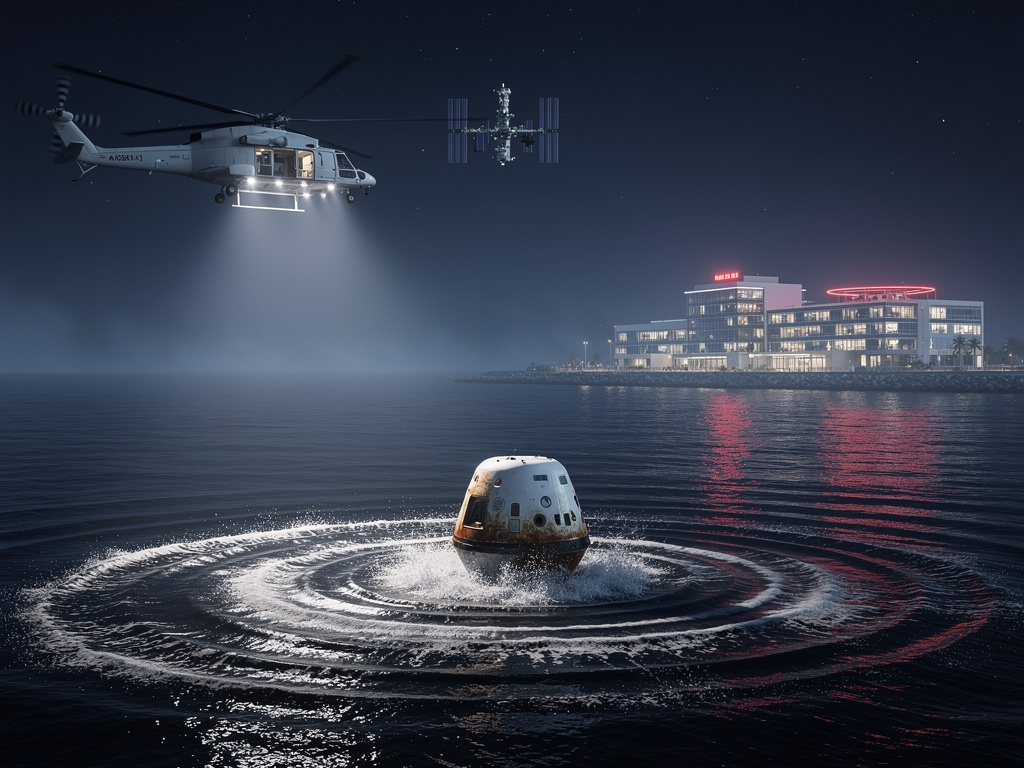
In the early hours of January 15, 2026, a SpaceX Crew Dragon capsule splashed down in the Pacific Ocean off the coast of San Diego, marking the end of a mission that had veered dramatically off course. What began as a routine stint aboard the International Space Station (ISS) for the Crew-11 team transformed into NASA’s first-ever medical evacuation from orbit, a decision that underscored the inherent risks of human spaceflight even in an era of advanced technology. The four astronauts—NASA’s Zena Cardman and Michael Fincke, Japan’s Kimiya Yui, and Russia’s Oleg Platonov—had launched in August 2025, expecting to spend months conducting experiments and maintaining the orbiting laboratory. Instead, a serious medical condition affecting one crew member prompted an early return, leaving the station with a skeleton crew and raising questions about protocols for health crises in space.
Details emerged slowly, with NASA officials emphasizing privacy and stability. The agency announced on January 8 that the mission would be cut short due to a “serious medical condition” that did not stem from operational injuries. According to reports from The Guardian, the crew spent 167 days in orbit before the evacuation was triggered. Upon splashdown, the astronauts were immediately helicoptered to a nearby hospital for overnight observation, a precautionary measure that highlighted the physical toll of re-entering Earth’s gravity after prolonged weightlessness. NASA Administrator Jared Isaacman, in a post-splashdown briefing, described the affected astronaut as being in “good spirits” and undergoing standard medical checks, though the exact nature of the condition remained undisclosed.
This event wasn’t just a logistical pivot; it represented a pivotal moment in space exploration history. For 25 years, the ISS has hosted continuous human presence without a mission being abbreviated for medical reasons alone. The decision to evacuate echoed past incidents, like the 1985 Soyuz T-13 mission where a cosmonaut’s illness led to an early return, but NASA’s protocols have evolved significantly since then. Insiders note that the choice of a “controlled medical evacuation” over an emergency deorbit allowed for a safer, more methodical descent, utilizing SpaceX’s reliable Dragon capsule.
The Precipitating Crisis and Immediate Response
The timeline of the incident began unfolding in early January, when one astronaut experienced symptoms that the onboard medical team deemed beyond their diagnostic capabilities. Posts on X, formerly Twitter, from space industry watchers like astronomer Jonathan McDowell captured the initial buzz, noting NASA’s description of the situation as requiring ground-based treatment due to limited equipment in orbit. This limitation is a known challenge in space medicine: while the ISS is equipped with basic diagnostic tools, complex issues often necessitate Earth-side expertise.
NASA’s response was swift yet measured. On January 14, the agency confirmed the early undocking, with the Crew Dragon separating from the ISS at 5:20 p.m. Eastern time. Coverage from The New York Times detailed how the four astronauts closed hatches and prepared for re-entry, a process that took less than 11 hours. The splashdown occurred under cover of night, with recovery teams from SpaceX and NASA deploying helicopters to transport the crew directly to medical facilities. This helicopter evacuation was not unprecedented—similar protocols were used in 2020 for SpaceX’s Demo-2 mission, as referenced in older X posts from Reuters Science News—but it gained new significance here as part of a health-driven return.
Industry experts point out that such evacuations test the interoperability of international partners. With crew from NASA, JAXA, and Roscosmos involved, coordination was seamless, but the incident left the ISS with only one American and two Russians aboard, prompting plans to accelerate the next crew launch. According to AP News, NASA and SpaceX aimed to move up the replacement mission to minimize disruptions to ongoing research.
Medical Realities of Long-Duration Spaceflight
Spaceflight exposes the human body to unique stresses, from microgravity-induced bone loss to radiation exposure, which can exacerbate underlying health issues. In this case, while NASA has not specified the condition, speculation among insiders draws parallels to known risks like cardiovascular strain or vision impairments from intracranial pressure changes. A post from NASA Watch on X shared a statement from astronaut Michael Fincke, who assured followers that “everyone on board is stable, safe,” emphasizing the crew’s well-being amid the “unexpected medical issue.”
The evacuation protocol draws from decades of medical research. NASA’s Human Research Program has long studied how to manage health emergencies in isolated environments, simulating scenarios where immediate evacuation isn’t feasible—much like potential Mars missions. Reports from BBC News highlighted the crew’s beaming smiles upon exiting the capsule, a testament to their resilience, but also a reminder of the psychological toll. Post-flight, astronauts undergo reconditioning at Johnson’s Space Center, involving physical therapy to rebuild muscle and balance after months in zero gravity.
This incident also spotlights advancements in telemedicine. During the mission, ground controllers likely consulted via video links, but as The New York Times noted in its coverage, some conditions demand in-person intervention. The decision to evacuate underscores a threshold where orbital capabilities fall short, prompting calls for enhanced onboard medical tech, such as advanced imaging devices compact enough for space.
Operational Ripples and Future Implications
The early return disrupted a slate of experiments, including studies on plant growth and materials science, which now face delays. With the ISS crew reduced, remaining astronauts must shoulder extra duties, a strain that NASA mitigates through automated systems and ground support. Fox News posts on X described the event as “evacuated from orbit,” capturing public fascination with the drama, while underscoring the agency’s prioritization of human life over schedules.
Financially, such evacuations carry costs. SpaceX’s involvement, with its Dragon capsule proving reliable, reinforces the public-private partnership model. Estimates suggest each Crew Dragon mission runs into hundreds of millions, and abbreviating one could lead to insurance claims or renegotiated contracts. Yet, as detailed in PBS News, the move was deemed necessary, with Isaacman affirming the astronaut’s stable condition post-landing.
Looking ahead, this evacuation could influence crew selection and training. NASA may intensify pre-flight health screenings or incorporate more robust contingency planning. International cooperation shone through, with Roscosmos and JAXA supporting the decision, but it also highlights vulnerabilities in an aging ISS, set for deorbit in 2030.
Technological Safeguards and Lessons Learned
SpaceX’s role was pivotal, with the Endeavour capsule executing a flawless descent. Named for its resilience, the vehicle parachuted into calm waters, as reported by The Guardian. Recovery operations, involving helicopters for rapid hospital transfer, demonstrated refined procedures honed from prior missions. An X post from The Launch Pad recalled past emergencies, like a 2024 ISS incident involving pressure issues, illustrating how protocols evolve.
Medical experts argue for investing in autonomous health systems. Innovations like AI-driven diagnostics could reduce evacuation needs, especially for deep-space ventures. Live Science’s coverage in Live Science noted the splashdown’s success, with astronauts emerging healthy, but stressed the unprecedented nature of the event.
This case also fuels debates on astronaut privacy versus public disclosure. NASA’s reticence on details respects HIPAA-like protections, yet transparency is key for taxpayer-funded programs. Posts on X from users like Ryan Caton summarized timelines, reflecting community efforts to piece together facts.
Broader Horizons in Human Space Exploration
As space agencies eye lunar and Martian outposts, this evacuation serves as a case study. The Artemis program, aiming for sustained Moon presence, must account for similar risks, potentially requiring on-site hospitals or rapid return vehicles. NASA’s partnerships with companies like SpaceX provide flexibility, but incidents like this reveal gaps in current frameworks.
The affected astronaut’s recovery will be monitored closely, with reconditioning at Houston’s Johnson Space Center. As AP News reported, the crew is expected back with families soon, starting evaluations that could inform future protocols. This event, while resolved positively, reminds us that space remains a frontier where human frailty meets technological ambition.
International ramifications extend to policy. With geopolitical tensions, seamless collaboration here bolsters confidence in joint ventures. USA Today’s take in USA Today emphasized the historic first, noting it’s the inaugural health-driven mission cut short on the ISS.
Echoes of Resilience in the Void
Reflecting on the crew’s 167 days, their work advanced science despite the abrupt end. Experiments on microgravity’s effects on biology continue via data relays, ensuring some continuity. Sky News updates on Sky News provided reassurances on the astronaut’s condition, aligning with NASA’s narrative.
Public sentiment, gauged from X discussions, mixes awe with concern, highlighting spaceflight’s allure and peril. As one post from Concerned Citizen vividly described the splashdown, it captured the spectacle of astronauts “crashing back to Earth” amid a medical crisis.
Ultimately, this evacuation reinforces NASA’s mantra: safety first. It paves the way for more resilient systems, ensuring that as humanity pushes boundaries, we do so with safeguards that honor the courage of those who venture into the stars. The Crew-11 team’s safe return, facilitated by helicopter to hospital, closes a chapter but opens discussions on fortifying health measures for the next generation of explorers.


 WebProNews is an iEntry Publication