
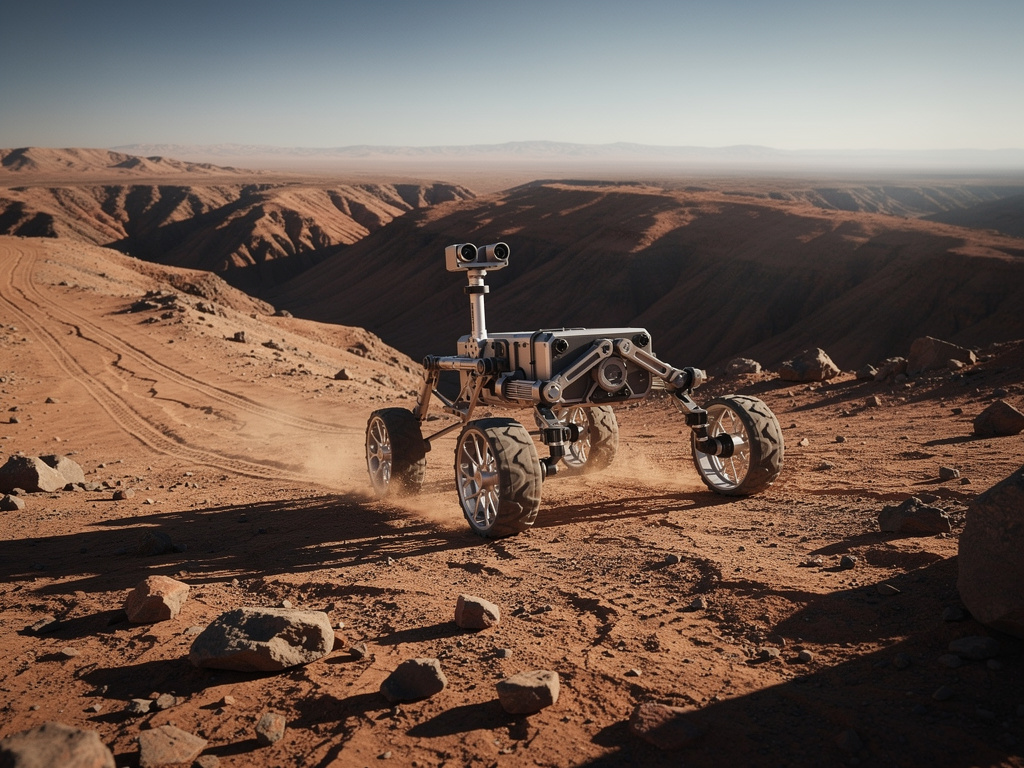
A compact four-wheeled prototype named ERNEST trundled across the Colorado Desert in Southern California last March. It covered 16 miles. It did so over 37 hours of driving time. Engineers trailed behind but stepped in only rarely.
That distance and pace mark a striking departure from the cautious crawl of NASA’s Mars rovers. Perseverance and Curiosity top out at roughly 0.06 mph when navigating tricky ground. ERNEST hit speeds up to 0.6 mph. The difference is an order of magnitude. One small prototype just rewrote expectations for robotic mobility on other worlds.
Developed at NASA’s Jet Propulsion Laboratory, the Exploration Rover for Navigating Extreme Sloped Terrain measures just 4 feet long. Its mesh wheels and active suspension set it apart from the six-wheeled rockers that have defined Mars exploration since Sojourner landed in 1997. Each wheel can lift independently. Powered joints and a gimbal allow the machine to shift gaits. It squirms. It wheel-walks. It climbs over obstacles that would strand its predecessors.
A clutch lets ERNEST toggle between active suspension for rough patches and passive mode to save power on smoother ground. Four steerable wheels mean it can drive in any direction, even sideways. These features emerged from years of iteration. The team started in 2022 with two smaller 2-foot prototypes. They tested 11 different suspension setups in lunar regolith simulant across varying slopes. Hardware for the current version wrapped up in September 2024.
But hardware alone wasn’t enough. The real advance lies in how ERNEST decides what to do. Engineers trained it with reinforcement learning inside JPL’s Dynamics and Real-Time Simulation Laboratory. Thousands of virtual hours in high-fidelity terrain models taught the rover to choose wheel placements quickly. The system moved from simulation to JPL’s Mars Yard obstacle course, packed with sand ripples, rubble, steps and steep inclines. Then came the desert.
The March 2026 campaign pushed the prototype across real, unforgiving ground. Tests ran at all hours. Dusk. Dawn. Full night. Long shadows mimicked conditions expected near the Moon’s poles. “This testing is helping us refine the mobility hardware and autonomy software to navigate extreme distances across a wide range of terrain and lighting conditions anticipated on the Moon,” said Issa Nesnas, a principal technologist at JPL who led the field testing (JPL).
The results speak for themselves. Sixteen miles. Thirty-seven hours of actual drive time spread over seven days. Minimal human overrides. For context, Perseverance’s record autonomous drive on Mars once reached 347.7 meters in a single day, according to earlier NASA updates. ERNEST covered far more ground with greater independence.
Hari Nayar, the JPL principal technologist leading the ERNEST team, framed the work as an evolution. “We started by postulating that we could do better in designing a planetary surface robotic mobility system,” he said. “While the rocker-bogie system has been very successful over the past 30 years, there’s been a lot of research in that time on mobility and understanding terrain interaction” (Gizmodo).
The rocker-bogie design has carried every NASA Mars rover. It kept wheels planted. It delivered Opportunity across 28 miles over 15 years. Yet it forces slow, conservative navigation. Terrain assessment from orbit remains imperfect. Communication delays to Mars stretch from four to 24 minutes. Rovers must pause often to let Earth controllers catch up. ERNEST’s onboard intelligence slashes that caution.
James Keane, a JPL planetary scientist focused on lunar missions, captured the excitement. “You could do a science road trip across the Moon — or Mars — with this vehicle” (JPL).
Such range would open regions long out of reach. Steep crater walls. Lava tubes. Permanently shadowed polar craters on the Moon that may hold water ice. Current rovers avoid those spots. A faster, more agile successor could visit them. And it could cover ground quickly enough to make the trips scientifically worthwhile before power or thermal limits kick in.
The project began with internal JPL research and development money. Support later came from NASA’s Mars Exploration Program and the Exploration Science Strategy and Integration Office. That progression signals growing agency interest. Nesnas’ team now aims to show the technology scales to a rover twice ERNEST’s size, one suited for an actual long-range lunar mission.
Yet prototypes rarely become flight hardware overnight. ERNEST still needs to prove it can survive launch stresses, vacuum, radiation and years of operation far from home. No specific mission has adopted the design. Timelines remain unclear. But the desert run provides concrete data. It demonstrates that higher speeds and smarter autonomy are achievable.
Recent coverage echoes this momentum. The Next Web highlighted how ERNEST’s 16 miles in roughly a week compares to Curiosity’s 21 miles over 14 years on Mars. The gap is stark. Yahoo Tech and other outlets noted the autonomy trained first in simulation then deployed to real terrain, underscoring the reinforcement-learning approach (Yahoo Tech).
Engineers continue integrating active suspension decisions with longer-range path planning. The goal is efficient routing. Tackle what can be tackled. Avoid what cannot. That combination could let future vehicles explore more while using less time and energy.
Perseverance itself has driven more than 26 miles on Mars as of mid-2026. Its pace, however, reflects the limits of proven but dated technology. ERNEST suggests those limits need not bind the next generation. A small testbed in the California desert has shown what smarter mobility looks like. The question now is how soon NASA will put that knowledge to work on the Moon or beyond.
But the implications stretch further. Commercial partners are lowering costs for lunar landers. Faster rovers could maximize science return during short surface windows. On Mars, they might reach sites too rugged for sample caching or human precursor missions. The 16-mile trek was just a test. Its lessons could shape every surface mission that follows.


 WebProNews is an iEntry Publication