
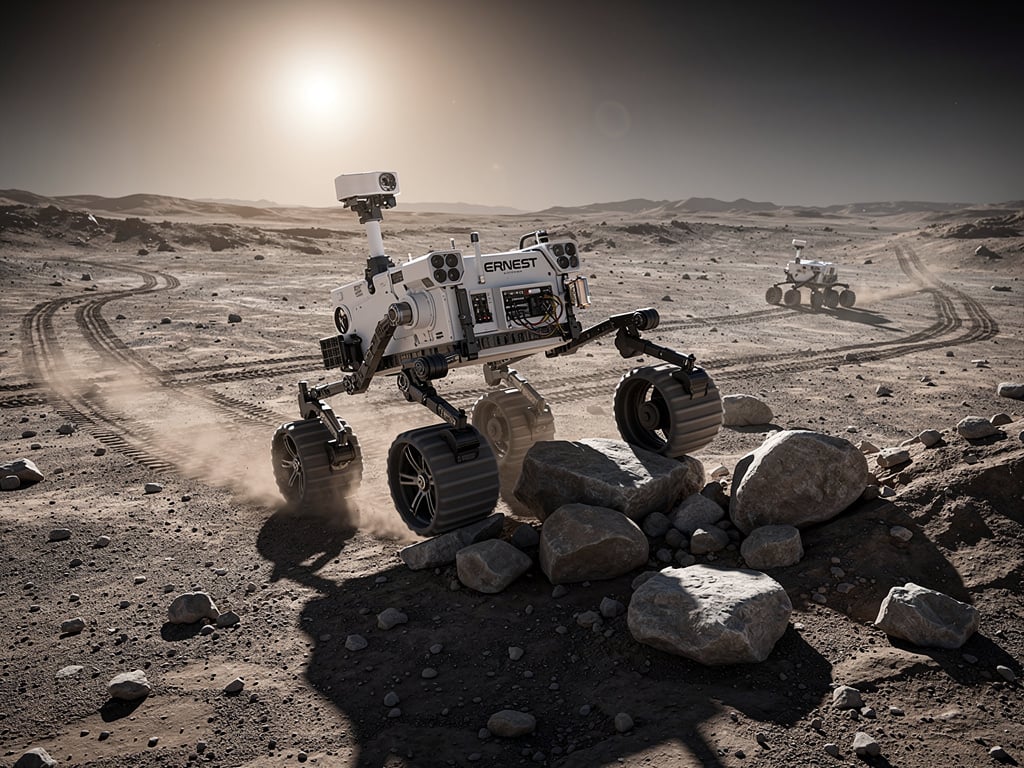
NASA has begun field tests of a new robotic vehicle designed to move more quickly across planetary surfaces while overcoming obstacles that would stop current rovers. The vehicle, called ERNEST, stands for Energetic Rover for Exploration over Slippery Terrain, and it represents a significant step forward in how future missions might explore the Moon, Mars, and other distant worlds.
The Engadget report details how engineers at NASA’s Jet Propulsion Laboratory have equipped the rover with advanced wheel mechanisms that allow each wheel to lift independently. This capability lets the vehicle raise its chassis to clear rocks, crevices, and loose soil that have historically slowed or trapped earlier rovers. Traditional designs rely on six wheels with limited suspension travel, forcing mission controllers to plot cautious routes around potential hazards. ERNEST takes a different approach by combining speed with adaptability, potentially allowing future missions to cover more ground in less time.
The rover’s development traces back to lessons learned from previous NASA missions. The Curiosity rover, which landed on Mars in 2012, travels at a top speed of about 0.1 miles per hour under ideal conditions. Perseverance, its successor, improved slightly on that figure but still faces the same fundamental limitations when encountering rough terrain. Mission teams spend considerable time planning paths that avoid steep slopes or large rocks, which reduces the overall scientific return. ERNEST aims to change that calculation by increasing both maximum speed and obstacle-clearing ability.
At the heart of the new rover sits a suspension system that gives each wheel its own actuator. This arrangement lets the vehicle perform what engineers call “wheel walking,” a motion where individual wheels lift and reposition while others maintain contact with the ground. The system also allows the rover to adjust its stance, spreading its wheels wider for stability on slopes or bringing them closer together to fit through narrow passages. During recent tests in California’s Mojave Desert, the prototype demonstrated its ability to climb over rocks nearly half its own height while maintaining forward momentum.
Speed forms another key element of the design. Current Mars rovers average roughly 100 meters per day, a pace dictated by both power limitations and the need for careful navigation. ERNEST’s engineers targeted a tenfold increase in traversal speed, which could translate into dramatically more productive missions. Faster movement means more time spent at science targets rather than driving between them. The rover achieves this partly through more efficient motors and partly through software that predicts terrain challenges before the vehicle encounters them.
The testing program has involved multiple phases, beginning with laboratory work on individual components before moving to full-scale field trials. Engineers constructed a testbed that simulates various planetary surface conditions, including loose sand, rocky outcrops, and inclined slopes. During one demonstration, the rover approached a boulder field that would have required Perseverance to spend days finding an alternate route. ERNEST simply adjusted its wheel positions, lifted its body, and drove over the obstacles in minutes.
Power management presented particular challenges during development. Lifting heavy wheels requires substantial energy, and planetary missions operate under strict power budgets. The team addressed this by developing a system that uses energy recovery during descent phases, similar to regenerative braking in electric cars. When the rover lowers itself after climbing an obstacle, the actuators capture some of that gravitational energy and store it in the batteries. This approach helps offset the power demands of the active suspension system.
Software plays an equally important role in ERNEST’s capabilities. The rover employs advanced terrain analysis algorithms that create three-dimensional maps of the surrounding landscape in real time. These maps feed into path-planning software that calculates the most efficient way to overcome obstacles while conserving energy. The system can choose between driving around a rock, climbing over it, or using the wheel-lifting mechanism to step across gaps. This decision-making happens autonomously, reducing the need for constant human intervention.
Communication delays between Earth and Mars make autonomous operation essential for future missions. Radio signals take between four and twenty-four minutes to travel between the planets, depending on their relative positions. During that time, a rover must handle unexpected situations without guidance from mission control. ERNEST’s software includes fail-safe mechanisms that allow it to stop and request assistance if it encounters conditions beyond its programmed capabilities.
The rover’s design also considers the harsh environmental conditions found on other planets. Mars experiences temperature swings of more than 100 degrees Celsius between day and night. Dust storms can coat solar panels and mechanical joints. The ERNEST team incorporated materials and sealing techniques that should help the rover withstand these challenges. Each wheel assembly features multiple layers of protection against abrasive dust particles that have damaged previous vehicles.
Scientists involved in the project see particular value in the rover’s ability to access areas previously considered too risky. Many high-priority science targets sit in craters, on steep slopes, or near rocky outcrops where water may have once flowed. Current rovers can only observe these locations from a distance using their instruments. A vehicle that can physically reach these sites could collect samples, analyze rock layers, and search for signs of ancient microbial life with greater precision.
The testing program has not been without setbacks. Early versions of the wheel-lifting mechanism proved too heavy, affecting the rover’s center of gravity and stability. Engineers addressed this by redesigning the actuators with lighter materials while maintaining the necessary strength. Software bugs caused the rover to occasionally lift wheels at inappropriate times, leading to several near-tip-over incidents during initial trials. The team refined the control algorithms through hundreds of iterations, gradually improving the vehicle’s balance and decision-making capabilities.
Collaboration between different NASA centers has strengthened the project. The Jet Propulsion Laboratory in California leads the overall effort, while engineers at Glenn Research Center in Ohio contributed expertise on high-efficiency motors. Goddard Space Flight Center provided advanced sensors for terrain mapping. This distributed approach reflects how modern space missions increasingly draw on specialized knowledge from across the agency.
Looking ahead, NASA plans to integrate lessons from ERNEST into multiple future missions. The technology could appear in lunar rovers supporting Artemis program astronauts, in Mars sample return vehicles, or in probes sent to explore icy moons like Europa and Enceladus. Each environment presents unique challenges, but the core concept of active wheel positioning offers advantages across different planetary surfaces.
The rover’s development cost remains modest compared to full mission budgets. By focusing on a single prototype for testing rather than building flight hardware immediately, NASA can refine the technology before committing major resources. This approach mirrors successful programs like the Mars Helicopter Ingenuity, which proved its worth as a technology demonstrator before influencing future aerial vehicles for planetary exploration.
Engineers continue to collect data from the desert tests, measuring power consumption, wheel slippage, and component wear under realistic conditions. These measurements will inform the next generation of designs, potentially leading to even more capable vehicles. Some concepts under consideration include adding articulated legs that could provide additional climbing ability or incorporating wheels that change shape depending on terrain.
The broader implications for space exploration appear substantial. Faster, more agile rovers could dramatically increase the pace of scientific discovery on other worlds. Instead of spending most of their operational life driving cautiously between targets, future vehicles might spend more time conducting detailed investigations. This shift could accelerate our understanding of planetary geology, climate history, and the potential for past or present life beyond Earth.
Public interest in the project has grown as videos of the rover climbing obstacles circulate online. The sight of a robotic vehicle lifting its wheels to step over large rocks captures the imagination in ways that static images of traditional rovers rarely achieve. This visibility helps build support for continued investment in robotic exploration programs.
As testing progresses, the ERNEST team faces decisions about how to balance capability with complexity. Each additional feature increases mass, power requirements, and potential failure points. The sweet spot lies in providing enough adaptability to make meaningful improvements in performance without creating a vehicle so complex that it becomes unreliable. Finding that balance requires careful engineering judgment informed by extensive testing data.
The desert trials have already yielded valuable insights that extend beyond this specific rover. Techniques developed for terrain analysis and autonomous path planning will likely find applications in other robotic systems, both in space and on Earth. Mining operations, disaster response robots, and agricultural vehicles could all benefit from similar approaches to obstacle negotiation and adaptive mobility.
NASA has scheduled additional test campaigns in increasingly challenging environments, including steeper slopes and finer-grained soils that simulate lunar regolith. These tests will help determine the limits of the current design and identify areas needing further refinement. The agency also plans to demonstrate the rover’s capabilities to potential mission planners, showing how the technology could enhance specific exploration objectives.
The ERNEST project demonstrates how incremental advances in robotics can open new possibilities for space exploration. By addressing the fundamental limitations of speed and mobility that have constrained previous rovers, NASA is preparing for a new era of more dynamic planetary surface operations. The lessons learned here will influence vehicle designs for decades to come, shaping how humanity explores the solar system.
Future missions may combine multiple robotic platforms working together, with fast scouts like ERNEST identifying promising targets for slower, more specialized vehicles to investigate in detail. This coordinated approach could maximize scientific return while reducing risks to any single platform. The active suspension technology developed for ERNEST could also appear in stationary landers, allowing them to adjust their position after touchdown to reach better science targets.
The ongoing tests continue to refine both hardware and software components. Engineers monitor every aspect of performance, from motor temperatures to battery efficiency to the accuracy of terrain predictions. This data feeds back into design improvements that will make subsequent versions more capable and reliable. The iterative nature of the development process ensures that when the technology eventually flies to another planet, it will have been thoroughly proven under conditions as close to reality as possible on Earth.
As NASA prepares for increasingly ambitious missions to the Moon and Mars, vehicles like ERNEST will play a vital role in expanding our reach across alien landscapes. The ability to move faster and overcome obstacles more effectively translates directly into more science, more discoveries, and a deeper understanding of our place in the universe. The desert tests represent just the beginning of what promises to be a transformative period in robotic space exploration.


 WebProNews is an iEntry Publication