
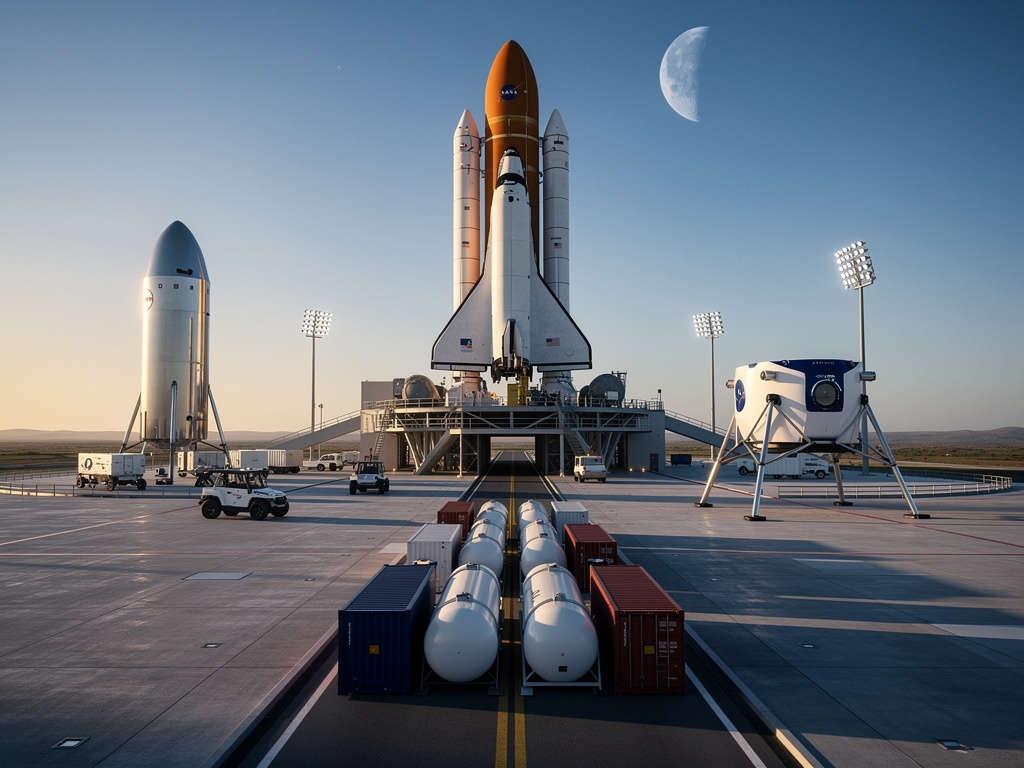
After years of delays, budget overruns, and political whiplash, NASA’s Artemis program has reached an odd inflection point. The Space Launch System rocket works. The Orion capsule works. Artemis I circled the Moon uncrewed in 2022. Artemis II, which will carry astronauts around the Moon without landing, is on track for later this year. The foundational hardware — the big rocket and the crew vehicle — has been tested and validated.
But here’s the problem: the parts that actually put boots on lunar soil remain stubbornly behind schedule, technically immature, and in some cases, barely past the PowerPoint stage.
As Ars Technica reported, the growing gap between the flight-proven elements of Artemis and the still-developing lunar landers has become the program’s defining tension. NASA has spent the better part of two decades and tens of billions of dollars getting SLS and Orion to operational status. The agency now faces the uncomfortable reality that the vehicles designed to carry astronauts from lunar orbit to the surface — the entire reason Artemis exists — are the weakest links in the chain.
Two companies hold the contracts for those landers: SpaceX and Blue Origin. Neither has delivered a flight-ready vehicle. And the timelines for both keep stretching.
SpaceX’s Human Landing System, a variant of its Starship vehicle, was selected by NASA in April 2021 under a $2.89 billion contract for the Artemis III mission. The idea was ambitious from the start: use the largest and most powerful rocket ever built, one still deep in development, as the means to land astronauts on the Moon. Starship would launch to orbit, refuel via a series of tanker flights, then travel to lunar orbit to dock with Orion and ferry crew to the surface.
On paper, it’s elegant. In practice, it requires solving several problems simultaneously — none of them trivial. Starship must demonstrate reliable orbital flight. It must prove that propellant transfer works in microgravity, a technique never attempted at the scale SpaceX envisions. It must execute a precision landing on the Moon using engines originally designed for Earth return. And the crewed variant must include life support, airlocks, and surface EVA capability that SpaceX has never built before.
SpaceX has made progress. Starship’s integrated flight test program has advanced through multiple launches from Boca Chica, Texas, with each iteration getting closer to full mission profile. The vehicle has reached orbit. It has attempted booster catch-backs with the “chopstick” mechanism at the launch tower. But orbital refueling remains undemonstrated in any meaningful way, and the lunar-specific variant of Starship hasn’t flown at all.
According to Ars Technica, NASA officials have acknowledged that the timeline for Artemis III — originally targeting 2025, then slipping to 2026 and beyond — is effectively paced by Starship’s development. The rocket and capsule are ready. The lander is not. This inversion of the traditional development bottleneck has created an unusual dynamic within the agency, where schedule confidence for the headline mission rests almost entirely on a commercial partner’s separate vehicle program.
Blue Origin’s situation is different in character but similar in outcome. The company won a $3.4 billion contract in May 2023 to build the Blue Moon lander for Artemis V, giving NASA a second provider and reducing single-source risk. Blue Moon uses a more conventional lander architecture — a single-stage vehicle powered by the BE-7 engine, designed to descend from the Near Rectilinear Halo Orbit where the Gateway station will eventually reside.
The BE-7 has been in development for years. Blue Origin has conducted hotfire tests. But the engine has not flown, and the lander itself remains in the manufacturing and integration phase. Blue Origin’s track record on timelines has been, to put it diplomatically, inconsistent. The company’s New Glenn orbital rocket, originally expected to fly years earlier, only recently reached orbit. The BE-4 engine that powers it was delivered to United Launch Alliance’s Vulcan rocket well behind schedule.
None of this means failure is inevitable. It means the schedule is soft.
The broader context matters here. NASA’s Artemis program doesn’t exist in a vacuum — it operates under constant political and budgetary pressure. Every administration since Obama has reshaped the agency’s human spaceflight priorities to some degree. The Trump administration revived the Moon as the near-term destination in 2017 under Space Policy Directive 1. The Biden administration kept Artemis alive but adjusted timelines and added the second lander contract. Now, with shifting political winds and ongoing budget negotiations in Congress, the program faces the perennial question of whether funding will remain stable enough to see these landers through to completion.
The Government Accountability Office has repeatedly flagged the lander programs as high-risk items within Artemis. In its most recent assessments, the GAO noted that both SpaceX and Blue Origin face significant technical hurdles and that NASA’s oversight mechanisms for these commercial contracts are still maturing. The fixed-price contract structure, which shifts cost risk to the companies, also means NASA has limited leverage if a provider falls behind — short of canceling the contract entirely, which would set the program back years.
There’s a strategic logic to NASA’s approach. By contracting with commercial providers rather than building landers in-house, the agency aimed to reduce costs and accelerate development by tapping into private investment and innovation. SpaceX is pouring its own capital into Starship development at a rate that dwarfs the NASA contract value. Blue Origin, backed by Jeff Bezos’s personal fortune, has similarly invested heavily in New Glenn and Blue Moon infrastructure. The theory is that commercial incentives align with NASA’s goals — these companies want these vehicles to work for their own business reasons, not just to satisfy a government contract.
That theory has proven correct in low Earth orbit. SpaceX’s Crew Dragon now routinely ferries astronauts to the International Space Station, a capability developed under NASA’s Commercial Crew Program. But the Moon is a fundamentally harder problem. The distances are greater. The margins for error are thinner. And the regulatory and safety requirements for landing humans on another world go far beyond anything the commercial cargo or crew programs have demanded.
So where does this leave the timeline? Artemis II, the crewed flyby, remains the near-term priority and appears on solid footing. Artemis III, the first landing, is officially listed for no earlier than 2027, though many in the industry consider even that optimistic given Starship’s development pace. Artemis IV would involve the Gateway station and potentially a second Starship landing. Artemis V, using Blue Origin’s Blue Moon, is notionally in the late 2020s — a date that carries enormous uncertainty.
The irony is thick. NASA spent over $23 billion developing SLS and more than $20 billion on Orion. These programs were criticized for years as over-budget, behind schedule, and emblematic of the old cost-plus contracting model’s worst tendencies. And yet they’re the pieces that work now. The commercial landers, procured under the newer, leaner fixed-price model that was supposed to be faster and cheaper, are the ones lagging.
This isn’t an indictment of the commercial model itself. It’s a reflection of the sheer difficulty of what’s being attempted. Landing humans on the Moon is hard. It was hard in 1969 with the resources of a Cold War superpower focused on a single goal. It’s hard now with a fraction of that budget and a far more complex mission architecture involving multiple vehicles, orbital rendezvous, and international partnerships.
Industry watchers have noted that NASA may need to consider interim solutions or mission restructuring if the landers continue to slip. One possibility, discussed in aerospace circles, is flying additional Artemis II-style missions to keep the astronaut corps sharp and maintain public interest while waiting for lander readiness. Another is accelerating Gateway development to provide a useful orbital platform even before landing capability is available.
But these are workarounds, not solutions. The fundamental challenge remains: NASA has a rocket and a capsule that can get astronauts to the Moon’s vicinity, and no proven way to get them to the surface.
The next twelve to eighteen months will be telling. SpaceX’s Starship flight test cadence is accelerating, and an orbital refueling demonstration — even a partial one — would significantly boost confidence in the Artemis III timeline. Blue Origin’s progress on BE-7 qualification and lander integration will signal whether Artemis V has a realistic path. And Congress’s appetite for sustained Artemis funding, in a political environment increasingly focused on deficit reduction and competing priorities, will determine whether the program retains the resources it needs.
For now, the Artemis program presents a paradox. Its most expensive and historically troubled components have matured into reliable hardware. Its newer, commercially developed components — the ones that define mission success — remain works in progress. The rocket works. The capsule works. The landers? Not yet.
And until they do, the Moon waits.


 WebProNews is an iEntry Publication