
Racing Toward Lunar Glory: Artemis II’s Historic Speed Quest Nears Ignition
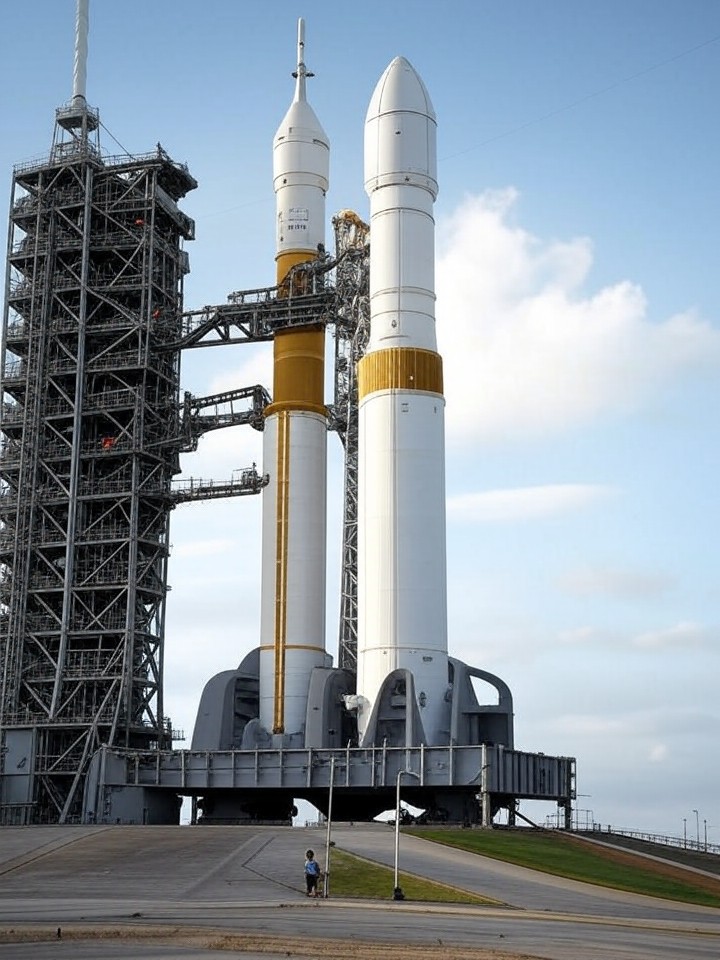
In the predawn chill of Florida’s Space Coast, a colossal machine lumbered into position, marking a pivotal moment in humanity’s return to deep space exploration. NASA’s Space Launch System (SLS) rocket, stacked with the Orion spacecraft for the Artemis II mission, completed its slow crawl to Launch Complex 39B at Kennedy Space Center on January 17, 2026. This 322-foot-tall behemoth, weighing in at 5.75 million pounds when fully fueled, is poised to propel four astronauts on what could become the fastest crewed journey in history, eclipsing records set during the Apollo era more than half a century ago.
The mission’s potential to shatter speed barriers stems from its ambitious trajectory: a slingshot around the moon that will hurl the Orion capsule back toward Earth at velocities exceeding 24,500 miles per hour during atmospheric re-entry. That’s faster than the 24,791 mph achieved by Apollo 10 in 1969, according to historical data from Wikipedia’s entry on human spaceflight. Engineers at NASA have calculated that Artemis II’s re-entry speed could reach up to 25,000 mph, making it a landmark in velocity for human travelers. This isn’t just about bragging rights; the extreme speeds test the limits of heat shield technology and spacecraft durability, critical for future lunar landings.
As the rocket settled onto the pad, teams from Boeing, Northrop Grumman, and Aerojet Rocketdyne—key contractors for the SLS—began a series of rigorous checks. These include wet dress rehearsals, where the rocket is fueled and countdown procedures simulated without ignition. Such preparations are essential, given the SLS’s history of delays; originally slated for 2016, the program has faced technical hurdles and budget overruns, pushing the Artemis II launch to no earlier than February 7, 2026.
Engineering Marvels Under Scrutiny
The SLS core stage, powered by four RS-25 engines repurposed from the space shuttle program, represents a fusion of legacy hardware and modern innovation. Each engine gulps down 700 gallons of liquid hydrogen and oxygen per second, generating over 2 million pounds of thrust at liftoff. Paired with twin solid rocket boosters, the system delivers 8.8 million pounds of total thrust, dwarfing the Saturn V’s output and enabling the high-velocity lunar orbit insertion.
Industry insiders note that this power is necessary for the mission’s free-return trajectory, which loops around the moon without entering orbit, minimizing fuel needs but maximizing speed on the return leg. “The physics demand it,” said a propulsion expert familiar with the program, who spoke on condition of anonymity. “To escape Earth’s gravity well and skim the moon’s far side, you’re building kinetic energy that peaks during re-entry.” This approach, while efficient, amplifies risks like thermal stress on Orion’s avionics and life support systems.
Recent updates from Spaceflight Now highlight the rocket’s arrival at the pad as a morale booster for NASA’s workforce, coming amid scrutiny over the program’s $23 billion-plus cost. Yet, the mission’s scientific payoff is immense: Artemis II will carry astronauts Reid Wiseman, Victor Glover, Christina Koch, and Jeremy Hansen on a 10-day voyage, testing human endurance in deep space radiation environments far beyond low Earth orbit.
Beyond speed records, Artemis II serves as a proving ground for technologies that will enable sustained lunar presence. The Orion spacecraft, built by Lockheed Martin, features advanced solar arrays capable of generating 11.2 kilowatts of power, sufficient for life support and communication over 685,000 miles. Data from this flight will inform Artemis III, targeted for a 2027 lunar landing, potentially with SpaceX’s Starship as the human landing system.
Delays have plagued the program, with the latest stemming from battery issues in the Orion capsule and software glitches in the European Service Module provided by Airbus. NASA officials, in a press briefing covered by The Guardian, emphasized that these setbacks are par for the course in pioneering spaceflight. “We’re not rushing; we’re methodically verifying every system,” said NASA Administrator Bill Nelson.
The international flavor of Artemis II underscores broader geopolitical stakes. Canadian astronaut Jeremy Hansen’s inclusion via the Artemis Accords—a U.S.-led pact with over 30 nations—signals collaborative efforts against rivals like China’s advancing lunar program. Beijing’s Tianwen-2 mission, launched in 2025 and detailed in Wikipedia’s 2025 spaceflight overview, aims for asteroid sample return by 2027, heightening the competitive drive.
Velocity’s Double-Edged Sword
Achieving such blistering speeds requires meticulous orbital mechanics. Artemis II’s path involves a translunar injection burn shortly after launch, propelling Orion to a maximum altitude of about 3,000 miles before lunar gravity assists in the slingshot. On return, the capsule will endure temperatures up to 5,000 degrees Fahrenheit, protected by an ablative heat shield made of Avcoat material.
Comparisons to Apollo are inevitable. While Apollo 10 holds the current record, as noted in historical accounts from IFLScience, Artemis II’s higher velocity is partly due to a more distant lunar flyby, allowing greater acceleration from Earth’s gravity well. “It’s like dropping a stone from a taller building,” explained a trajectory specialist at NASA’s Jet Propulsion Laboratory.
Safety remains paramount. The mission includes multiple abort scenarios, from pad emergencies to in-flight contingencies. Lessons from Apollo 13’s near-disaster have informed redundancies in oxygen systems and power distribution, ensuring crew survival even if primary systems fail.
Public sentiment, gauged from recent posts on X (formerly Twitter), reflects excitement mixed with impatience. Users have celebrated the rollout as a step toward reclaiming U.S. leadership in space, with one viral thread from a science enthusiast highlighting Artemis II’s potential to inspire a new generation, echoing the Apollo moonshots.
Meanwhile, commercial players watch closely. SpaceX’s Starship, which could ferry Artemis III astronauts to the lunar surface, recently achieved its fifth test flight in 2026, per updates from Next Spaceflight. Elon Musk’s company aims to lower costs dramatically, contrasting with SLS’s per-launch price tag of around $4 billion.
Critics argue the SLS is an outdated “jobs program” for congressional districts, but proponents counter that its reliability is unmatched for crewed missions. A recent deal transferring SLS production oversight to AE Industrial Partners, as reported by Spaceflight Now, could streamline operations without compromising safety.
Broader Implications for Space Ambitions
Artemis II’s success would validate NASA’s strategy of blending government and private sector capabilities. The program’s Lunar Gateway—a planned orbital outpost—will support future missions, with modules launching as early as 2028. This infrastructure aims to facilitate resource utilization on the moon, such as extracting water ice for fuel.
Economically, the mission spurs innovation in materials science and robotics. For instance, the Orion’s environmental control systems incorporate filters capable of recycling 98% of onboard water, a technology with applications in arid regions on Earth.
Internationally, Artemis fosters alliances. Japan’s JAXA and Europe’s ESA contribute key components, strengthening ties amid global tensions. A NASA events page, accessible via NASA’s official site, lists upcoming briefings that underscore this cooperation.
As launch day approaches, weather patterns and final certifications loom large. Florida’s unpredictable climate could delay liftoff, but contingency windows extend through mid-February. Teams are also monitoring space debris, a growing concern highlighted by the Shenzhou 20 capsule’s issues in 2025, as per Next Spaceflight reports.
The crew, undergoing final simulations at Johnson’s Space Center, embodies diversity: Glover as the first Black astronaut to leave low Earth orbit, Koch as the first woman on a lunar mission. Their training, detailed in NASA’s 2026 news releases, includes zero-gravity flights and psychological preparation for isolation.
Looking ahead, Artemis II paves the way for Mars ambitions by the 2030s. The data on radiation exposure and human performance will inform habitat designs for red planet outposts.
Challenges and Triumphs Ahead
Not all is smooth sailing. Budget battles in Congress threaten funding, with some lawmakers pushing for more reliance on commercial rockets like Falcon Heavy. Yet, NASA’s track record with uncrewed Artemis I in 2022—successfully orbiting the moon—bolsters confidence.
Industry analysts predict that a successful Artemis II could accelerate private investment in space tourism and mining. Companies like AstroForge, despite a 2025 mission failure noted in Wikipedia’s spaceflight logs, continue pursuing asteroid resources.
Ultimately, as the SLS stands sentinel on the pad, Artemis II represents more than speed—it’s a testament to human ingenuity, pushing boundaries that once seemed insurmountable. With the world watching, this mission could redefine our reach into the cosmos, one record-breaking velocity at a time.
In the coming weeks, final integrations will determine if February’s launch window holds. For now, the rocket’s presence at 39B is a beacon of progress, inching humanity closer to the stars.


 WebProNews is an iEntry Publication