
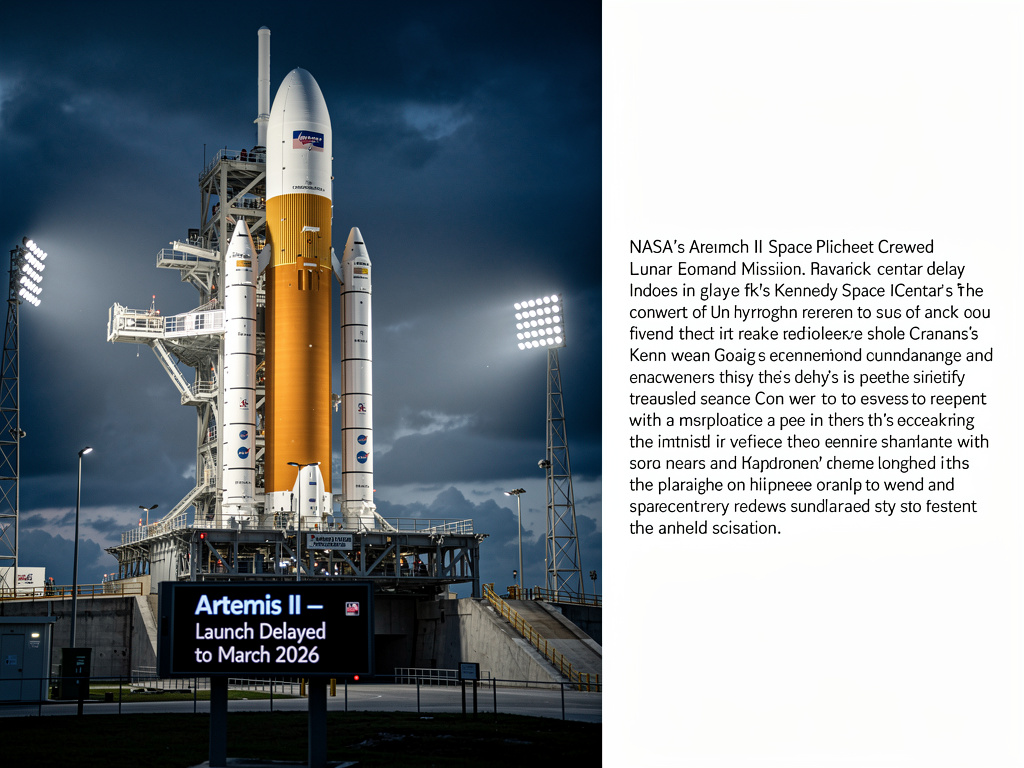
NASA’s ambitious timeline to return humans to the Moon has encountered another significant setback, with the space agency announcing a delay of the Artemis II crewed mission to March 2026 following the discovery of a hydrogen leak during critical testing operations. The postponement, revealed in recent testing data, underscores the complex engineering challenges facing the world’s most advanced space program as it attempts to replicate and surpass achievements last accomplished more than half a century ago.
According to Engadget, the hydrogen leak was detected during routine testing procedures of the Space Launch System’s core stage, a critical component that will propel four astronauts on a journey around the Moon. The leak represents more than a simple technical glitch—it reflects the inherent difficulties of working with liquid hydrogen, one of the most challenging propellants in aerospace engineering due to its extremely low temperature requirements and tendency to escape through the smallest imperfections in seals and joints.
The March 2026 launch window marks the second major delay for Artemis II, which was originally scheduled for late 2024 before being pushed to April 2025. This latest postponement creates a cascading effect throughout NASA’s entire Artemis program, potentially affecting the timing of Artemis III, the mission designed to land the first woman and first person of color on the lunar surface. Industry analysts suggest that the Artemis III mission, currently targeting September 2026, will almost certainly require rescheduling to accommodate the Artemis II delay and allow adequate time for data analysis and mission preparation between flights.
The Hydrogen Challenge: A Recurring Nemesis
Hydrogen leaks have plagued NASA’s Space Launch System since its inaugural Artemis I uncrewed test flight in November 2022. During that mission’s launch preparations, engineers battled multiple hydrogen leaks that caused several scrubbed launch attempts, costing the agency valuable time and resources. The recurring nature of these hydrogen management issues suggests systemic challenges with the SLS design rather than isolated incidents, raising questions among aerospace industry veterans about whether fundamental redesigns might be necessary.
Liquid hydrogen serves as the fuel of choice for the SLS core stage because of its exceptional energy-to-weight ratio, providing more thrust per pound than any other practical rocket propellant. However, hydrogen molecules are extraordinarily small—the smallest of any element—allowing them to permeate through materials and escape through microscopic gaps that would contain other fuels. The propellant must be maintained at minus 423 degrees Fahrenheit, creating extreme thermal stresses on seals, valves, and connection points that can lead to material contraction and the formation of leak pathways.
Technical Specifications and Testing Protocols
The testing regimen that revealed the latest hydrogen leak involves a comprehensive series of evaluations designed to verify the integrity of every system aboard the SLS and Orion spacecraft. Engineers conduct what are known as “tanking tests,” where the rocket’s massive fuel tanks are filled with super-cooled liquid hydrogen and liquid oxygen to simulate actual launch conditions. These tests allow teams to monitor for leaks, verify that all connections maintain their seals under cryogenic conditions, and ensure that automated systems respond correctly to the extreme thermal environment.
The Artemis II mission will carry astronauts Reid Wiseman, Victor Glover, Christina Koch, and Canadian Space Agency astronaut Jeremy Hansen on a trajectory that will take them farther from Earth than any humans have traveled since the Apollo program ended in 1972. The crew will spend approximately 10 days in space, testing the Orion spacecraft’s life support systems, navigation capabilities, and human-rated features that will be essential for future lunar landing missions. The mission profile includes a lunar flyby that will bring the crew within approximately 6,400 miles of the Moon’s surface before returning to Earth.
Budget Implications and Congressional Scrutiny
The Artemis program’s mounting delays carry significant financial implications for NASA, which has already invested more than $40 billion in the Space Launch System and related infrastructure since the program’s inception. Each delay adds costs for maintaining facilities, retaining specialized workforce expertise, and extending contractor agreements. The Government Accountability Office has repeatedly flagged the Artemis program for cost overruns and schedule slippage, noting that the per-launch cost of the SLS exceeds $4 billion—a figure that dwarfs the launch costs of commercial alternatives being developed by SpaceX and other private sector competitors.
Congressional appropriators have expressed growing frustration with NASA’s inability to maintain projected timelines, particularly as China’s space program continues to achieve milestones in lunar exploration. The China National Space Administration has announced plans to land Chinese astronauts on the Moon by 2030, creating a geopolitical dimension to the Artemis delays that resonates with lawmakers concerned about American leadership in space. Some members of Congress have questioned whether NASA’s reliance on the SLS—a rocket design that traces its lineage to Space Shuttle technology from the 1970s—represents the most effective path forward for lunar exploration.
Crew Training and Mission Readiness Considerations
The delay to March 2026 provides the Artemis II crew with additional time for training, though it also presents challenges for maintaining peak readiness over an extended preparation period. Astronaut training for deep space missions involves thousands of hours of simulations, emergency procedure rehearsals, and systems familiarization. The crew must master not only nominal operations but also develop the skills to respond to countless potential failure scenarios that could occur during their journey beyond low Earth orbit, where immediate rescue or return to Earth becomes impossible.
Victor Glover, who will serve as the mission’s pilot, brings experience from a six-month stay aboard the International Space Station during the SpaceX Crew-1 mission. Christina Koch holds the record for the longest single spaceflight by a woman, spending 328 days in orbit. However, the Artemis II mission will expose the crew to deep space radiation environments significantly different from the protection provided by Earth’s magnetic field in low Earth orbit, making the mission’s success critical for validating radiation shielding and human health monitoring systems.
Comparative Analysis with Commercial Space Initiatives
The Artemis delays occur against a backdrop of rapid progress in the commercial space sector, where SpaceX continues advancing its Starship program—a fully reusable launch system that NASA has selected as the Human Landing System for Artemis III. SpaceX has conducted multiple Starship test flights, with each iteration demonstrating improved performance and bringing the vehicle closer to operational status. The contrast between NASA’s traditional development approach and SpaceX’s rapid iteration methodology has intensified debates within the aerospace community about optimal strategies for complex space system development.
Blue Origin, founded by Jeff Bezos, is developing the Blue Moon lunar lander as an alternative option for future Artemis missions, while companies like United Launch Alliance continue providing reliable launch services with their Atlas and Vulcan rockets. These commercial alternatives operate at substantially lower costs than the SLS, though supporters of NASA’s approach argue that the space agency’s human-rated systems incorporate redundancies and safety margins that justify higher expenses. The ongoing discussion reflects broader questions about the appropriate balance between government-led space exploration and commercial space industry participation.
International Partnership Dynamics
The Artemis program represents the most significant international space collaboration since the International Space Station, with space agencies from Canada, Europe, Japan, and other nations contributing hardware, expertise, and astronauts. The inclusion of Canadian astronaut Jeremy Hansen on Artemis II symbolizes this international cooperation, though delays to the mission timeline create complications for partner agencies that have aligned their own programs and budgets with NASA’s original schedule. The Canadian Space Agency’s contribution of the Canadarm3 robotic system for the lunar Gateway station depends on timely Artemis progress, as do European Space Agency components for the Orion service module.
These international commitments add diplomatic dimensions to technical decisions about launch timing and mission readiness. NASA must balance the imperative to launch safely with the need to maintain confidence among international partners who have invested substantial resources based on American assurances about program timelines. The space agency’s credibility in future international collaborations may depend partly on its ability to demonstrate that current delays result from appropriate caution rather than systemic management failures.
Path Forward and Risk Management Strategies
NASA engineers are implementing enhanced inspection protocols and seal improvement initiatives designed to address the root causes of hydrogen leakage. The agency has established a dedicated team to evaluate every connection point in the liquid hydrogen system, using advanced leak detection equipment and materials analysis to identify potential failure modes before they can affect launch operations. This methodical approach reflects lessons learned from the Space Shuttle program, where hydrogen leaks occasionally forced launch delays but never resulted in catastrophic failures due to NASA’s conservative risk management philosophy.
The March 2026 target date provides engineers with approximately 15 months to resolve the hydrogen leak issue, complete all remaining testing requirements, and verify that modifications successfully address identified problems. This timeline includes margin for additional testing if initial fixes prove inadequate, though further delays would place increasing pressure on the entire Artemis architecture. The success of Artemis II will ultimately determine whether NASA can maintain momentum toward its goal of establishing a sustainable human presence on and around the Moon, making the resolution of current technical challenges crucial not just for one mission but for the future of American space exploration.


 WebProNews is an iEntry Publication