
Reviving Lunar Ambitions: NASA’s Artemis II Gears Up for Historic Flight
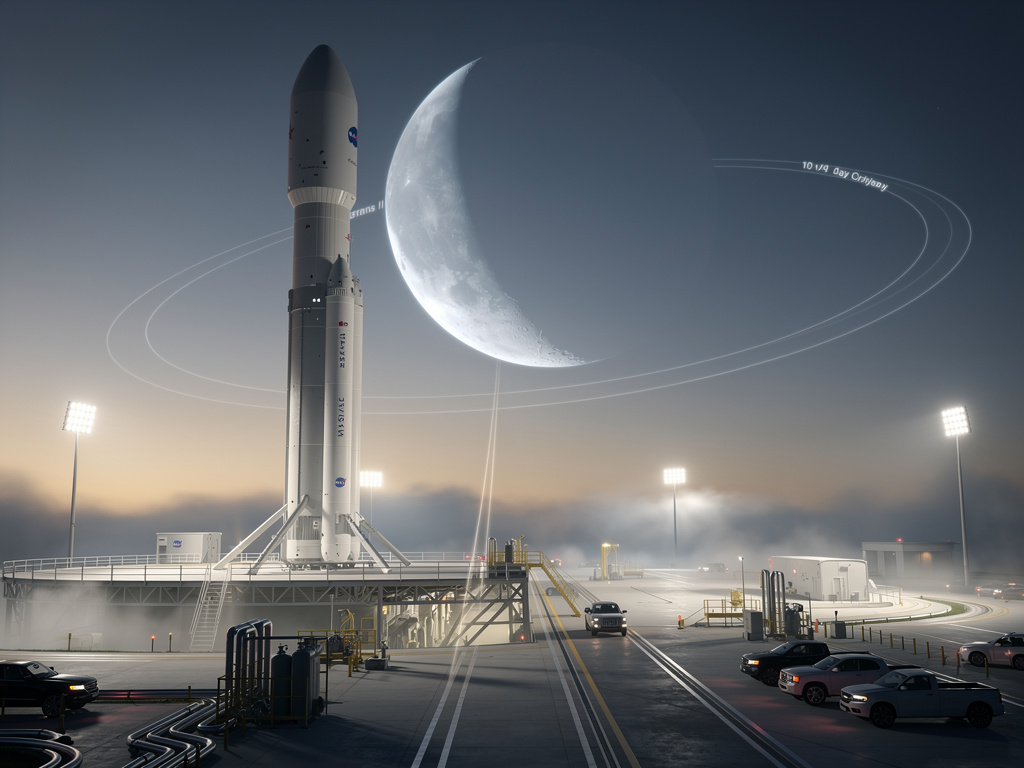
As NASA edges closer to launching its first crewed mission to the moon in over half a century, anticipation is building around the Artemis II expedition. This 10-day journey will send four astronauts on a loop around the moon, testing critical systems for future landings. The agency’s recent release of a cinematic trailer has amplified the excitement, offering a glimpse into the high-stakes venture that could redefine human space exploration. Drawing from real-time updates, the mission is targeted for an early 2026 launch, with the rocket’s rollout to the launch pad imminent.
The trailer, shared by NASA, depicts the Space Launch System (SLS) rocket thundering off from Kennedy Space Center, the Orion spacecraft navigating deep space, and the crew’s return with a fiery reentry. It’s not just promotional flair; it underscores the engineering feats involved. According to details from Digital Trends, the video highlights the mission’s role in paving the way for Artemis III, which aims to land astronauts on the lunar surface. This visual narrative captures the essence of a program that’s been in development for years, facing delays but now accelerating toward fruition.
Industry experts note that Artemis II represents a pivotal step in NASA’s broader strategy to establish a sustainable presence near the moon. The mission will validate the Orion spacecraft’s life support, navigation, and communication systems in the harsh environment of deep space. Posts on X from NASA enthusiasts and officials alike buzz with details about the evening launch window in February, emphasizing the no-daylight requirement for both launch and splashdown, which adds a layer of operational complexity.
Technical Milestones and Preparations
Recent web searches reveal that the SLS rocket, paired with the Orion capsule, is undergoing final checks. NASA’s own site reports that the four-mile crawl from the Vehicle Assembly Building to Launch Pad 39B could begin as early as January 17, a process that takes up to 12 hours on the massive crawler-transporter. This rollout is a critical milestone, allowing teams to conduct integrated system tests and fueling rehearsals. Lori Glaze, acting associate administrator for NASA’s Exploration Systems Development Mission Directorate, emphasized in a statement that crew safety remains paramount, with engineers troubleshooting items like propulsion and avionics in the lead-up.
The crew lineup adds historic significance: NASA astronauts Reid Wiseman, Victor Glover, Christina Koch, and Canadian Space Agency’s Jeremy Hansen. Glover will be the first person of color to venture to the moon, Koch the first woman, and Hansen the first non-American. As detailed in Wikipedia, the mission’s free-return trajectory will propel them farther from Earth than any previous human flight, reaching speeds of 25,000 miles per hour on reentry. This isn’t just a joyride; it’s a rigorous test of the SLS Block 1 rocket, originally conceived for other purposes but repurposed under the Artemis umbrella.
From European Space Agency contributions, as noted on their site, the service module for Orion provides propulsion, power, and thermal control—key elements sourced internationally to bolster the program’s collaborative nature. ESA highlights that Artemis II will mark the return of humans to lunar vicinity since Apollo 17 in 1972, bridging decades of technological advancement with lessons from unmanned Artemis I.
Behind-the-Scenes Buzz and Public Engagement
Social media platforms, particularly X, are alight with real-time sentiments. Users are sharing animations and timelines, with one post from NASA itself unveiling a detailed animation of the launch sequence, flyby, and return. This has garnered hundreds of thousands of views, reflecting public enthusiasm. Another thread discusses the installation of RS-25 engines and crew seating protocols, indicating that astronauts will strap in over three hours before liftoff, allowing for multiple launch attempts within a six-day window if needed.
News outlets are amplifying these developments. ABC News reports on the Trump administration’s push for a long-term lunar presence, tying into current political backing for the program. Meanwhile, Live Science details the imminent rollout, noting that final preparations are underway despite potential weather delays. These sources paint a picture of a mission on the cusp, with teams working tirelessly to meet the February window.
Public engagement extends beyond trailers; NASA is inviting people to submit names to fly around the moon on a flash drive aboard Orion, as covered in recent USA Today updates. This initiative, open until a cutoff date, fosters a sense of global participation, echoing the inspirational ethos of past space races.
Historical Context and Evolution
Artemis II’s roots trace back to the canceled Asteroid Redirect Mission, rebranded as Exploration Mission-2 before integrating into the Artemis framework in 2017. NASA’s official page outlines how the program evolved to focus on lunar exploration, incorporating the powerful SLS and Orion for deep space capabilities. Delays have pushed the timeline from an initial 2019 target to 2026, but each postponement has allowed for refinements, such as enhanced simulations of exhaust plumes at launch, as simulated by NASA Ames.
The mission’s objectives include testing optical laser communications and studying the deep space environment, which will inform future endeavors like lunar geology analysis and resource utilization from polar ice. X posts from space analysts highlight key talking points: this will be the farthest crewed mission ever, validating systems for Artemis III’s surface landing.
Comparisons to Apollo are inevitable, yet Artemis diverges with its emphasis on diversity and international partnership. The inclusion of a Canadian astronaut underscores the program’s collaborative spirit, potentially setting precedents for Mars missions.
Challenges and Innovations in Deep Space
Engineers face formidable challenges, from ensuring the spacecraft withstands radiation to managing reentry heat. Recent NASA podcasts, like the Curious Universe series, delve into the teamwork behind Artemis II, featuring insights from facilities across the country. These episodes reveal problem-solving in areas like life support and navigation, crucial for the 10-day orbit that won’t include a landing but will loop around the moon’s far side.
Innovations abound, including the European-built service module that integrates seamlessly with American hardware. NASA’s mission update notes ongoing troubleshooting, with rollout dates flexible to accommodate technical needs. This cautious approach mirrors the agency’s post-shuttle era focus on safety.
On X, discussions speculate on launch dates between February and April, with some users analyzing weather criteria and mission timelines from NASA’s press kit. The kit provides granular details, such as countdown sequences and flight milestones, offering insiders a roadmap of what’s to come.
Implications for Future Exploration
Beyond Artemis II, the program eyes sustainable lunar outposts, potentially extracting water ice for fuel and life support. This could revolutionize space travel, reducing reliance on Earth-supplied resources. Industry insiders see parallels with private sector efforts, like SpaceX’s Mars ambitions, though Artemis maintains a government-led, methodical pace.
The trailer’s release, as spotlighted in Digital Trends, serves as a rallying cry, blending stunning visuals with educational content to inspire the next generation. It illustrates the free-return trajectory, a gravity-assisted path that ensures safe return even if propulsion fails—a safety net harking back to Apollo 13.
Global media, including Gulf News, encapsulate the mission as a bridge from robotic precursors to human lunar returns, emphasizing its 10-day duration and international crew.
Economic and Strategic Dimensions
Economically, Artemis II bolsters the space industry, creating jobs and spurring technological spin-offs. The SLS alone involves thousands of contractors, from Boeing to Northrop Grumman, injecting billions into the economy. Strategic implications include maintaining U.S. leadership in space amid competition from China, which has its own lunar plans.
Live updates from BBC News capture the excitement, with mission managers affirming readiness as the rocket nears the pad. This phase includes wet dress rehearsals, simulating countdowns with propellants to iron out kinks.
X sentiment reflects optimism, with posts praising the diversity of the crew and the mission’s role in deep space science. One thread outlines studying lunar geology remotely, testing tools for future surface missions.
Voices from the Crew and Mission Control
The astronauts themselves have shared insights in press conferences, expressing confidence in the hardware. Reid Wiseman, the commander, has highlighted the mission’s inspirational value, while Victor Glover emphasizes inclusivity. Their training, rigorous and ongoing, prepares them for contingencies in an environment unforgiving of errors.
Mission control teams at Johnson Space Center are fine-tuning protocols, as per recent briefings. USA Today notes the public name submission as a way to democratize space, potentially carrying millions of names on this historic flight.
As rollout approaches, the focus sharpens on weather and technical readiness. NASA’s updates stress that while targets are set, flexibility ensures success.
Toward a New Era in Space
Artemis II isn’t merely a mission; it’s a cornerstone for humanity’s expansion into the cosmos. By validating technologies in real deep space conditions, it sets the stage for landings, habitats, and beyond. The trailer’s cinematic flair, combined with factual mission details, bridges public interest with technical depth.
International partnerships, like those with ESA and CSA, amplify the program’s reach, fostering shared knowledge. This collaboration could extend to future Mars endeavors, pooling resources for grander goals.
In the broader scheme, Artemis II revives the spirit of exploration that defined the 20th century, now infused with 21st-century innovation. As the rocket inches toward the pad, the world watches, poised for a leap back to the moon.


 WebProNews is an iEntry Publication