
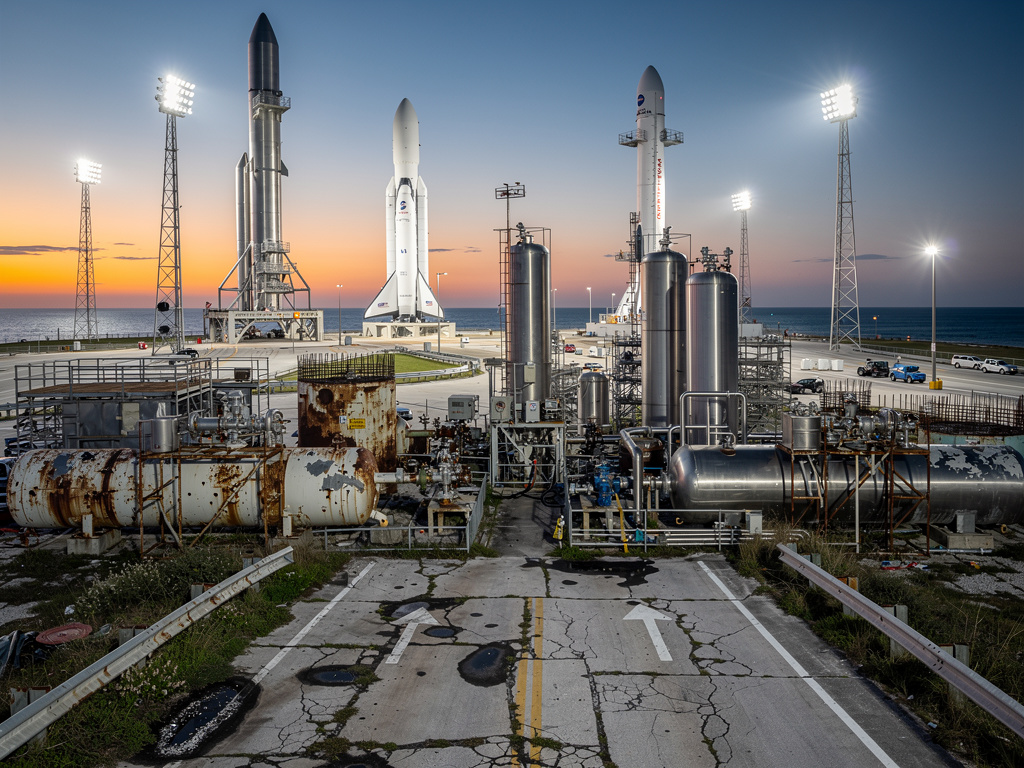
Kennedy Space Center has long stood as America’s premier gateway to orbit. Its pads have sent astronauts to the moon and probes across the solar system. Yet a fresh government audit paints a troubling picture. The facilities that once defined U.S. space power now strain under the weight of an explosion in commercial activity.
The NASA Office of Inspector General report, released this week, delivers a blunt assessment. Infrastructure built in the 1960s shows its age. Demand from vehicles like SpaceX’s Starship and Blue Origin’s New Glenn threatens to overwhelm roads, gas lines and power systems. And the money to fix it keeps shrinking.
SpaceX told NASA it intends to fly Starship every eight days from Launch Complex 39A. The goal centers on building propellant depots in orbit. The report notes in a footnote that at least 15 Starships would be needed just to supply one lunar lander. Across its Florida sites, SpaceX projects as many as 120 Starship launches a year. Blue Origin forecasts the same cadence for New Glenn by 2035. Add in test firings and other operations. The total could surpass the number of days in a year by late 2028 or 2029.
That’s not sustainable. Not with the current setup.
Roads and bridges span 231 miles across Kennedy and the neighboring Cape Canaveral Space Force Station. They handle heavy traffic from massive rockets and support equipment. Electricity comes through a distribution network installed six decades ago. Then there’s the gaseous nitrogen pipeline. It proved inadequate during the Artemis I campaign in 2022. Problems linger.
“The system cannot simultaneously support launches of Blue Origin’s New Glenn launch vehicle at Space Launch Complex 36 and United Launch Alliance’s Vulcan Centaur launch vehicle at Space Launch Complex 41,” the inspector general report states. Blue Origin officials described the constraint as a major scheduling headache ahead of the New Glenn-1 mission in January 2025. They worry future Space Launch System flights could trigger one- to two-month blackout periods.
A new nitrogen system would cost $25 million. It remains unfunded. Budgets for construction and maintenance at Kennedy have fallen between 11 and 47 percent since 2021 after inflation. Laws make it tough for NASA to accept large cash contributions from commercial partners for shared projects. The agency finds itself squeezed.
Launch pads tell part of the story. NASA controls just a few at Kennedy itself. Complex 39A serves SpaceX for Falcon rockets and will soon host Starship. Complex 39B supports the Space Launch System, which rolled out for Artemis II earlier this year and targets Artemis III in 2027. Upgrades there include new liquid hydrogen tanks, fire suppression piping and a flame trench refresh. Complex 39C sits idle due to proximity. A small site called Complex 48 awaits tenants.
Blue Origin operates from pads 36A and 36B on Cape Canaveral property. The company recently began rebuilding one pad after a New Glenn static-fire explosion in May, according to a Reuters report last week. It aims to resume launches before year’s end. Interest has surfaced in a third pad north of NASA’s complexes. Space for such additions stays limited. One candidate location sits in protected wetlands. That means years of federal and local reviews.
“Space for additional launch pads at Kennedy is also limited and may require extensive time and resources to develop a launch pad that can support super heavy-lift launch vehicles,” the inspector general document warns.
Recent construction offers some hope. SpaceX continues work on its massive Gigabay facility at Kennedy. The structure will stand 380 feet tall with more than 815,000 square feet of workspace. It supports both Starship and Super Heavy processing for Florida operations. The WFTV report from May captured crews erecting the giant building. FAA environmental reviews for Starship at 39A wrapped up earlier this year. Yet those private investments don’t solve the shared infrastructure headaches the government must address.
The OIG offers three recommendations. One calls for a study on heavy vehicle traffic effects. Another pushes for better coordination with the Space Force on range scheduling. The third urges NASA to explore new funding models. Kennedy’s director concurred with the findings. Action remains pending.
Eric Berger of Ars Technica, who first covered the report on June 22, captured the stakes. Commercial super heavy operations sit at the start of what looks like steep growth. NASA races China toward a lunar return. Tight budgets collide with rising launch tempos. Something has to give.
Discussions on X in recent days echo the tension. Users point to the shift from occasional government missions to something closer to an industrial port. Heavy traffic, shared commodities and recovery operations all compete for the same resources. One post from Monday highlighted the report’s core warning about dated facilities unable to meet partner demands.
Yet progress continues in pockets. Tower segments and launch mounts have arrived at 39A. Teams test hold-down clamps. Starship hardware moves across the site. Blue Origin pushes to recover from its pad setback. The activity signals confidence from the companies. The infrastructure underneath it may not share that optimism.
Analysts have tracked this mismatch for years. Master plans for Kennedy stretch 30 years into the future. They call for right-sizing facilities amid commercial growth. Partnerships help on roads and some upgrades. Still the core commodities and pad availability lag the projected cadence. Super heavy vehicles demand more than Falcon 9 ever did. Flame trenches, deluge systems, power draw and transport all scale up.
The inspector general didn’t mince words. NASA’s launch infrastructure remains vital for the agency’s most complex missions. It is also dated and lacks capacity. Without changes the spaceport that carried Apollo could throttle the next generation of exploration and commerce. Fixes require money, time and coordination across agencies and companies. The report lays out the problems. Now comes the harder part of acting on them before the overload hits.
Recent coverage from Orlando Sentinel in January noted plans that could yield up to 120 combined launches annually from the Space Coast. That figure matches the projections cited in the OIG document. Landings would double the disruption. The conversation has shifted from if this growth happens to how the ground can handle it.
Kennedy’s teams have adapted before. They rebuilt after shuttle retirement. They accommodated Falcon Heavy and Crew Dragon. The current challenge feels different in scale and speed. Private operators move faster than government budgeting cycles. Wetlands and environmental rules add friction. Aging pipes and wires don’t upgrade themselves.
So the audit lands at a pivotal moment. Artemis marches forward even as commercial ambitions surge. China watches closely. The United States holds an edge in launch cadence and innovation. Protecting that edge means shoring up the physical foundation at the Cape. The numbers don’t lie. The infrastructure does need attention. And soon.


 WebProNews is an iEntry Publication