
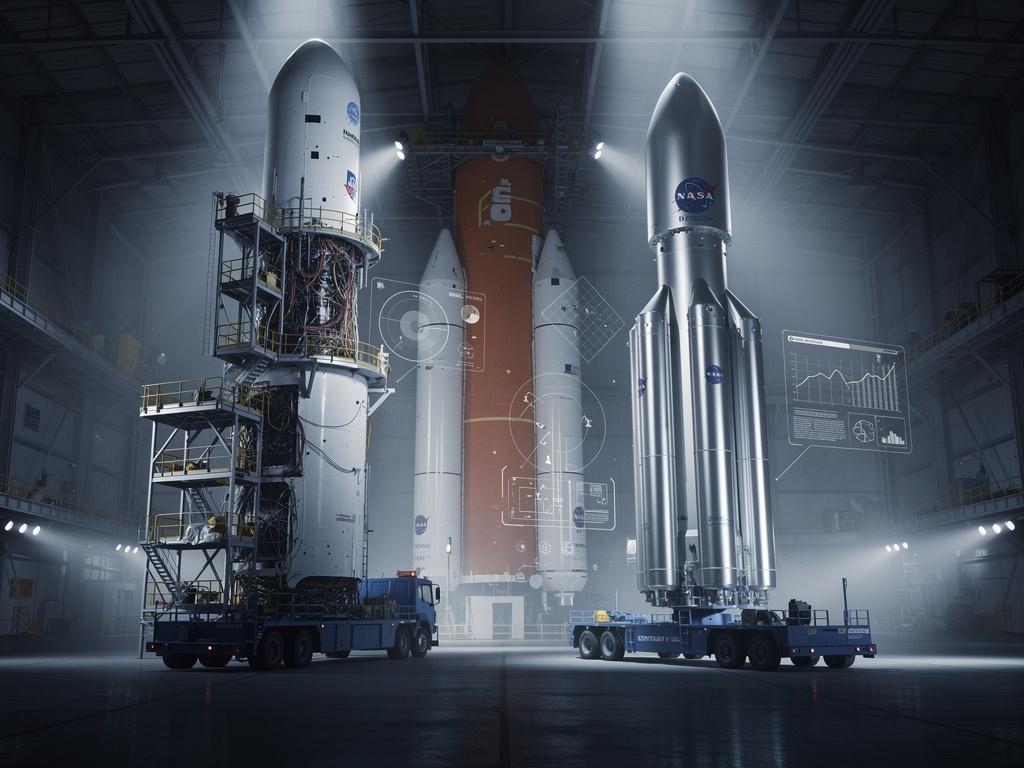
NASA has initiated a quiet but significant internal review that could reshape the architecture of its Space Launch System (SLS), the massive rocket central to the Artemis moon program. Facing mounting delays and escalating costs with the Boeing-managed Exploration Upper Stage (EUS), the space agency is evaluating the feasibility of swapping out the troubled component for the Centaur V, a commercially developed upper stage used by United Launch Alliance (ULA) on its new Vulcan rocket. This potential pivot, reported by Bloomberg, signals a growing lack of confidence in the current development trajectory of the SLS Block 1B configuration and highlights the widening rift between traditional cost-plus contracting and the operational realities of modern aerospace.
The study, conducted by a specialized team at NASA’s Marshall Space Flight Center in Alabama, remains in a preliminary phase. However, the mere existence of such an assessment underscores the severity of the production crisis facing the EUS. Boeing, the prime contractor for the SLS core and upper stages, has struggled to meet schedule targets at the Michoud Assembly Facility in New Orleans. The EUS is intended to replace the Interim Cryogenic Propulsion Stage (ICPS)—a modified Delta IV stage used on Artemis I—to provide the lift capacity necessary for sending heavier payloads, including the Gateway lunar space station modules, to the moon. Yet, persistent quality control issues and supply chain hurdles have pushed the EUS readiness date dangerously close to the end of the decade, threatening the timeline for Artemis IV.
The Financial and Temporal Cost of Continued Delays
The Exploration Upper Stage was designed to be the powerhouse that evolves the SLS from its initial Block 1 configuration into the Block 1B heavy-lift vehicle. This upgrade is essential for co-manifested payloads, allowing NASA to launch Orion crews alongside large infrastructure components. However, the program has been plagued by setbacks. According to a recent report by the NASA Office of Inspector General (OIG), the costs for the SLS Block 1B development have ballooned significantly, with the EUS portion alone accounting for billions in expenditures with little flight-ready hardware to show for it. The OIG projected that the Block 1B might not be ready until 2028, years behind the initial schedule.
This timeline creates a logistical bottleneck for the Artemis campaign. NASA requires a more capable launcher to assemble the lunar Gateway and sustain a human presence on the lunar surface. If the EUS slips further, the agency faces a choice: delay the return to the moon or find an alternative propulsion solution. The investigation into ULA’s Centaur V suggests that agency leadership is looking for an off-ramp that preserves the SLS core while bypassing the specific component that has become a program stumbling block. By looking at existing hardware, NASA attempts to mitigate the risk of a clean-sheet design that has failed to mature at the expected pace.
United Launch Alliance and the Centaur V Value Proposition
The Centaur V, manufactured by United Launch Alliance—a joint venture between Boeing and Lockheed Martin—represents a modernized iteration of one of the most successful upper stages in aerospace history. It recently flew successfully atop ULA’s Vulcan rocket during its certification missions. Unlike the EUS, which is still largely a paper rocket struggling through the manufacturing phase, the Centaur V is operational hardware. SpaceNews notes that ULA has ramped up production of the Vulcan and its upper stage to meet Pentagon launch demands, creating an active production line that NASA could theoretically tap into.
Integrating the Centaur V onto the SLS would not be a trivial engineering task. The SLS core stage has a diameter of 8.4 meters, while the Centaur V is designed for the 5.4-meter diameter Vulcan. This mismatch would require a specialized interstage adapter and significant aerodynamic modeling. Furthermore, the Centaur V utilizes stainless steel balloon tanks, a distinct structural architecture compared to the orthogrid aluminum-lithium construction of the EUS. Despite these integration hurdles, the allure of a “hot” production line is difficult to ignore. Using a commercial stage could shift the procurement model from a cost-plus development contract to a fixed-price purchase of finished hardware, aligning with NASA’s broader strategy to reduce operational costs.
Boeing’s Industrial Struggles and the Quality Control Crisis
The potential removal of the EUS from the Artemis architecture would represent a substantial blow to Boeing’s defense and space division, which is already reeling from challenges across its portfolio. From the Starliner spacecraft’s thruster issues to the commercial aviation division’s 737 MAX fallout, the aerospace giant is under intense scrutiny regarding its quality management systems. At the Michoud Assembly Facility, observers have noted that the welding and assembly of the massive SLS tanks have proven more difficult and time-consuming than anticipated. Ars Technica reported earlier this year on the scathing assessments regarding workmanship and quality control procedures at the facility, which have directly contributed to the EUS delays.
A decision to switch to the Centaur V would effectively transfer work from Boeing’s direct government contracts to the ULA joint venture. While Boeing retains a 50% stake in ULA, the loss of the EUS prime contract would signal a reduction in NASA’s reliance on Boeing’s internal engineering capabilities for deep space exploration. It would also raise questions about the future of the workforce at Michoud, which has been politically protected as a hub of high-tech manufacturing in the South. The political optics of cancelling a major component of the “Senate Launch System” are complex, but the imperative to launch Artemis IV before the end of the decade may force NASA’s hand.
Technical Feasibility and Human-Rating Requirements
One of the primary obstacles to adopting the Centaur V is the stringent requirement for human-rating. The SLS is designed to carry the Orion crew capsule, meaning every component must meet higher safety margins and redundancy standards than typical satellite launchers. The Centaur V is currently certified for high-value national security payloads, but human certification involves a different tier of risk analysis, particularly regarding software, avionics, and structural factors. NASA would need to validate that the Centaur V can withstand the specific vibration and acoustic environments of an SLS launch, which differ from those of the Vulcan rocket.
Additionally, performance trade-offs must be calculated. The EUS was designed with four RL10 engines to push 40 metric tons to the moon. The standard Centaur V typically flies with two RL10 engines. While highly efficient, NASA engineers must determine if the Centaur V provides sufficient impulse to meet the trans-lunar injection requirements for the heavy Gateway modules. If the performance falls short, the swap might require additional modifications or a reduction in payload mass, potentially complicating the mission architecture for Artemis IV and V.
The Broader Industry Implications of a Commercial Swap
This study arrives at a moment when the launch industry is bifurcating between traditional government-directed designs and commercial, rapid-iteration vehicles. NASA’s willingness to consider a commercial upper stage for its flagship rocket suggests a softening of the rigid “Not Invented Here” syndrome that has historically plagued the agency. It mirrors the approach taken with the Human Landing System, where NASA contracted SpaceX’s Starship and Blue Origin’s Blue Moon landers under fixed-price service agreements. By potentially integrating ULA hardware into the SLS, NASA is attempting to hybridize the vehicle—keeping the political stability of the SLS core while injecting commercial efficiency into the upper stage.
If the switch proceeds, it could serve as a precedent for future Artemis upgrades. It places pressure on legacy contractors to deliver on time or face replacement by commercially available alternatives. For Lockheed Martin, the other half of the ULA joint venture, this move would be advantageous, increasing the flight rate of the Vulcan production line and amortizing the costs of the Centaur V across both government and commercial sectors. For the taxpayer, while the integration costs would be non-trivial, the move could cap the endless cost growth associated with the EUS development.
Navigating the Political Landscape of Artemis
Ultimately, the decision will be as political as it is technical. The SLS program has long enjoyed bipartisan support in Congress due to its wide distribution of suppliers and jobs across all 50 states. The EUS specifically has received earmarked funding to ensure its development. NASA leadership will need to navigate these waters carefully. If the agency can demonstrate that switching to Centaur V is the only viable path to keeping the Artemis program on schedule and preventing China from reaching the lunar south pole first, Congress may acquiesce to the change.
The investigation into the Centaur V remains an exploratory measure, but it is a telling symptom of the SLS program’s health. With the Starship system making rapid progress in South Texas, the pressure on the SLS to perform is higher than ever. NASA cannot afford a multi-year hiatus between Artemis III and IV caused by a single upper stage. Whether the solution is a redoubled effort on the EUS or a radical surgery to transplant a ULA heart into the Boeing rocket, the agency is acknowledging that the status quo is no longer sustainable.


 WebProNews is an iEntry Publication