
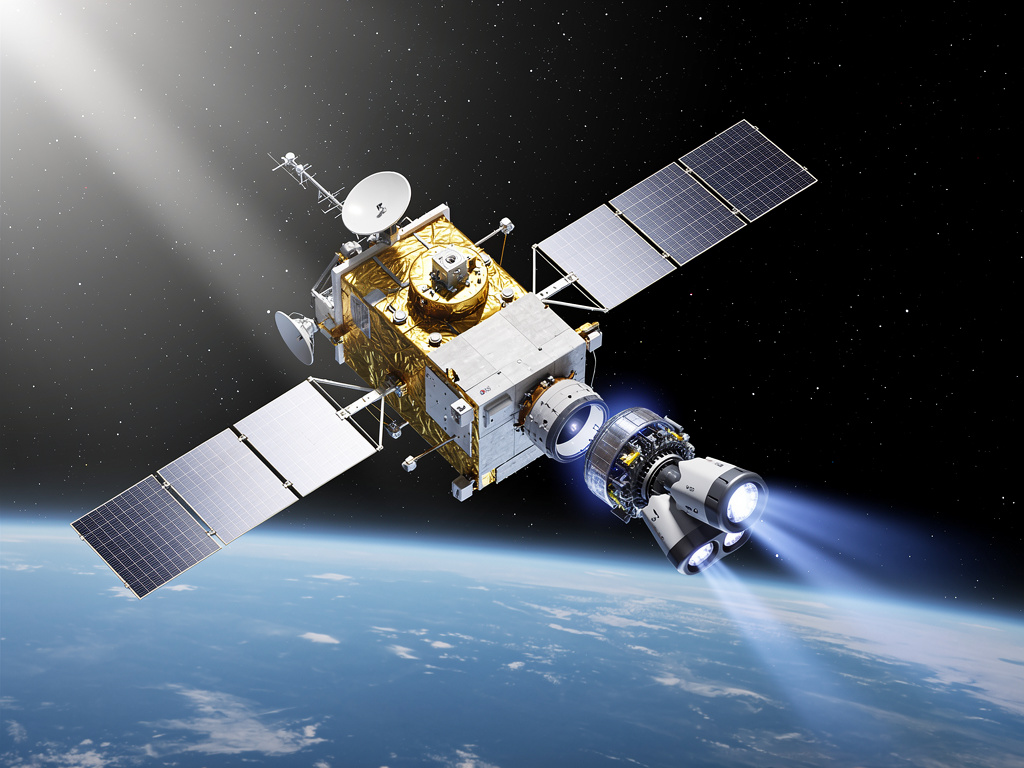
NASA’s Swift observatory, a versatile space telescope designed to hunt for gamma-ray bursts and other high-energy cosmic events, faces an uncertain future as its orbit gradually decays. The agency has scheduled a dedicated booster mission for later this month that aims to attach a small propulsion module to the spacecraft and raise its altitude, potentially extending its operational life by several years. This technical rescue operation represents a creative solution to an increasingly common problem for aging satellites that were not originally designed with refueling or reboosting capabilities in mind.
The Swift Gamma-Ray Burst Mission launched in November 2004 atop a Delta II rocket from Cape Canaveral. Built through a collaboration between NASA, the Italian Space Agency, and the UK Space Agency, the observatory carries three main instruments: the Burst Alert Telescope, the X-ray Telescope, and the Ultraviolet/Optical Telescope. Together these tools allow Swift to rapidly respond to sudden energetic events across the electromagnetic spectrum. Over its two decades in orbit, the spacecraft has detected more than 1,700 gamma-ray bursts while also contributing to studies of supernovae, black holes, and other extreme phenomena.
According to information available from Engadget’s coverage of the upcoming mission, Swift currently orbits at an altitude where atmospheric drag has become significant. Without intervention, projections suggest the telescope could reenter Earth’s atmosphere sometime in the late 2020s or early 2030s. While that might seem distant, the gradual loss of altitude already affects observational efficiency and increases collision risks with space debris. The booster mission seeks to counteract this orbital decay by providing a controlled thrust that will lift Swift to a more stable higher orbit.
The rescue vehicle itself consists of a small satellite equipped with propulsion systems and docking mechanisms specifically engineered for this task. Rather than attempting complex refueling operations, the booster will physically attach to Swift and use its own fuel reserves to perform the orbit-raising maneuvers. This approach draws on techniques developed for other satellite servicing concepts but represents one of the first times NASA has applied such methods to an operational astrophysics mission. Engineers have spent months testing the attachment protocols in ground facilities to ensure the procedure can be completed without damaging the sensitive instruments aboard Swift.
Mission planners selected a launch window toward the end of this month that aligns with favorable solar and orbital conditions. The booster spacecraft will ride to orbit aboard a dedicated rocket, likely a smaller class vehicle given the modest size of the propulsion module. Once in space, the rescue craft will conduct a series of rendezvous burns to close the distance with Swift, which continues its normal scientific operations during the approach. Ground controllers will monitor both vehicles closely throughout the procedure, maintaining constant communication through NASA’s Deep Space Network.
The technical challenges involved in this operation are substantial. Swift was never designed to receive visitors, meaning it lacks standardized docking ports or grapple fixtures. The booster team had to develop custom attachment hardware that can securely clamp onto structural elements of the telescope without interfering with its solar panels, antennas, or optical instruments. Precision navigation is equally critical, as any misalignment during the final approach could result in a collision that damages both spacecraft. Autonomous guidance systems will handle much of the close-range maneuvering, with human operators ready to intervene if unexpected situations arise.
Success would bring multiple benefits to the astronomical community. Swift’s unique ability to quickly slew toward new targets makes it an essential partner for other observatories, including ground-based telescopes and more recent additions to NASA’s fleet like the James Webb Space Telescope. The observatory has played key roles in multi-messenger astronomy, helping coordinate observations when gravitational wave detectors identify potential cosmic events. Extending its service life would preserve this coordination capability while also allowing continued study of transient phenomena that occur unpredictably across the sky.
Financial considerations also factor into the decision to attempt this rescue. Building and launching a replacement gamma-ray burst mission would cost hundreds of millions of dollars and require several years of development time. By contrast, the booster mission represents a more economical path to maintaining Swift’s capabilities. The approach also demonstrates a commitment to sustainable space operations, showing how existing assets can be maintained rather than simply abandoned when their orbits decay. This philosophy aligns with broader NASA goals around orbital debris mitigation and responsible spacecraft management.
The concept of satellite servicing has gained momentum in recent years through both government and commercial efforts. Companies like Northrop Grumman have successfully extended the lives of commercial communications satellites using dedicated servicing vehicles. NASA’s own OSAM-1 mission, though facing delays, aims to demonstrate more advanced refueling and assembly capabilities. The Swift booster project builds on these experiences while adapting them to the specific requirements of a scientific observatory rather than a communications platform. Each successful servicing operation helps refine techniques that could eventually be applied to more complex missions, including potential future visits to telescopes in higher orbits.
Public interest in the mission reflects growing awareness of space sustainability issues. As orbital congestion increases, finding ways to maintain rather than replace spacecraft becomes increasingly attractive. The Swift rescue also carries symbolic weight, representing humanity’s determination to preserve tools that expand our understanding of the universe. The telescope has contributed to thousands of scientific papers and inspired countless students to pursue careers in astronomy and engineering. Giving it a second chance at discovery resonates with many who follow space activities.
Engineers have prepared contingency plans in case the initial attachment attempt encounters difficulties. The booster carries redundant systems designed to handle various failure modes, from communication blackouts to unexpected attitude changes on either spacecraft. If the primary docking location proves inaccessible, alternative attachment points have been identified and modeled. The mission timeline includes several days of proximity operations to fully assess the situation before committing to the final connection sequence. Once attached, the combined spacecraft will undergo extensive testing to verify that Swift’s instruments remain properly aligned and functional after the thrust maneuvers.
The orbit-raising process itself will occur gradually over multiple burns to minimize stress on Swift’s structure. Each firing of the booster’s engines will incrementally increase the telescope’s altitude while carefully managing its orientation to maintain power generation and thermal balance. The target orbit will place Swift high enough to reduce atmospheric drag to negligible levels for at least the next decade, assuming nominal solar activity. This extension would allow the mission to potentially overlap with several new observatories currently in development, creating opportunities for joint observations that could yield fresh scientific insights.
Swift’s scientific accomplishments provide strong justification for the investment in its preservation. The observatory discovered the most distant gamma-ray burst known at the time, helped characterize the afterglow of these powerful explosions, and contributed to understanding the connection between some gamma-ray bursts and supernovae. Its X-ray and ultraviolet instruments have surveyed thousands of objects, producing valuable catalogs that astronomers continue to mine for new discoveries. The spacecraft’s rapid response capability means it can be redirected within minutes of receiving an alert from other detectors, a feature few other missions can match.
Beyond its primary gamma-ray burst hunting role, Swift has demonstrated remarkable flexibility. When not pursuing new bursts, the telescope conducts surveys and target-of-opportunity observations requested by the broader astronomical community. This versatility has made it one of NASA’s most productive astrophysics missions despite its relatively modest size and cost. The data archives from Swift continue to support new research years after the observations were originally made, suggesting that additional data collected in coming years would find similar long-term use.
The upcoming booster launch also carries implications for how future missions are designed. Engineers increasingly consider end-of-life disposal and potential servicing during the initial planning phases. Modular architectures that allow component replacement or refueling could become more common as the economics of space operations evolve. The Swift example shows that even missions launched without servicing in mind might still benefit from creative engineering solutions developed later in their lifetimes. This adaptability could influence everything from commercial Earth observation satellites to deep space probes.
International partners in the Swift mission have expressed strong support for the booster attempt. The Italian and British space agencies contributed key instruments and continue to participate in science operations. Their ongoing involvement underscores the collaborative nature of the observatory’s success and the shared benefits that would come from its extended operation. Coordination between multiple countries adds another layer of complexity to the mission but also demonstrates how international partnerships can tackle challenging technical problems.
As the launch date approaches, teams at NASA centers and contractor facilities are conducting final tests and simulations. The mission control center that has guided Swift for twenty years stands ready to incorporate the new booster into its operational procedures. Software updates have been prepared to allow the combined spacecraft to operate as a single unit after attachment. The entire procedure represents a significant departure from routine satellite operations, requiring careful rehearsal and clear communication protocols across all participating organizations.
The broader context of this mission includes growing concerns about orbital sustainability. With thousands of active satellites and even more pieces of debris currently in orbit, managing the space environment has become a priority for spacefaring nations. Extending the life of existing spacecraft reduces the need for new launches while also preventing the creation of additional debris that would result from an uncontrolled reentry. The Swift booster project serves as a practical demonstration of these principles applied to a high-value scientific asset.
Scientists who rely on Swift for their research have welcomed news of the planned intervention. Many have developed observing programs that specifically incorporate the telescope’s unique capabilities, and the prospect of losing access to those tools had created uncertainty in long-term planning. The additional years of operation would allow completion of ongoing studies while also enabling responses to new astronomical discoveries that emerge in the coming decade. This continuity matters particularly for time-domain astronomy, which depends on consistent monitoring of variable sources over extended periods.
The technology developed for this specific rescue may find applications beyond Swift. Components and procedures refined during the mission could transfer to other servicing concepts currently under consideration. NASA has expressed interest in maintaining other aging observatories, though each presents unique challenges based on their design and orbital environment. The experience gained from attaching a propulsion module to Swift will inform decisions about which future missions might benefit from similar interventions.
Weather conditions at the launch site and along the ascent corridor will play a key role in determining the exact liftoff time within the available window. Teams are also monitoring solar activity, as increased geomagnetic storms could affect both the approach phase and the subsequent orbit-raising burns. The mission incorporates margin for such variables, with flexible scheduling that allows adjustments based on real-time space weather data.
This attempt to save Swift comes at a time when public and scientific appreciation for long-duration space missions has grown. The Hubble Space Telescope famously received multiple servicing visits that dramatically extended its productive lifetime. While Swift operates in a different orbital regime and requires a different technical approach, the underlying motivation remains similar: preserving valuable scientific capabilities through human ingenuity and engineering skill. The upcoming mission carries forward that tradition in a new form suited to the realities of low Earth orbit operations in the 2020s.
Engineers emphasize that the booster represents a one-time solution rather than a permanent fix. Once attached, the propulsion module will eventually exhaust its fuel, though the higher orbit should provide many years of operations before drag again becomes a factor. Future concepts might include more permanent servicing platforms capable of multiple visits, but for now this dedicated rescue vehicle offers the most practical path forward for Swift.
As teams make final preparations for launch, anticipation builds within both the space operations and astronomy communities. The mission offers a compelling narrative of problem-solving in space, showing how creative thinking can overcome design limitations that once seemed insurmountable. For an observatory that has already exceeded its original expectations by such a wide margin, this latest chapter could write several more years of discovery into its legacy. The coming weeks will determine whether Swift receives the orbital boost it needs to continue its vigil of the high-energy universe from a safer vantage point above the atmosphere.


 WebProNews is an iEntry Publication