
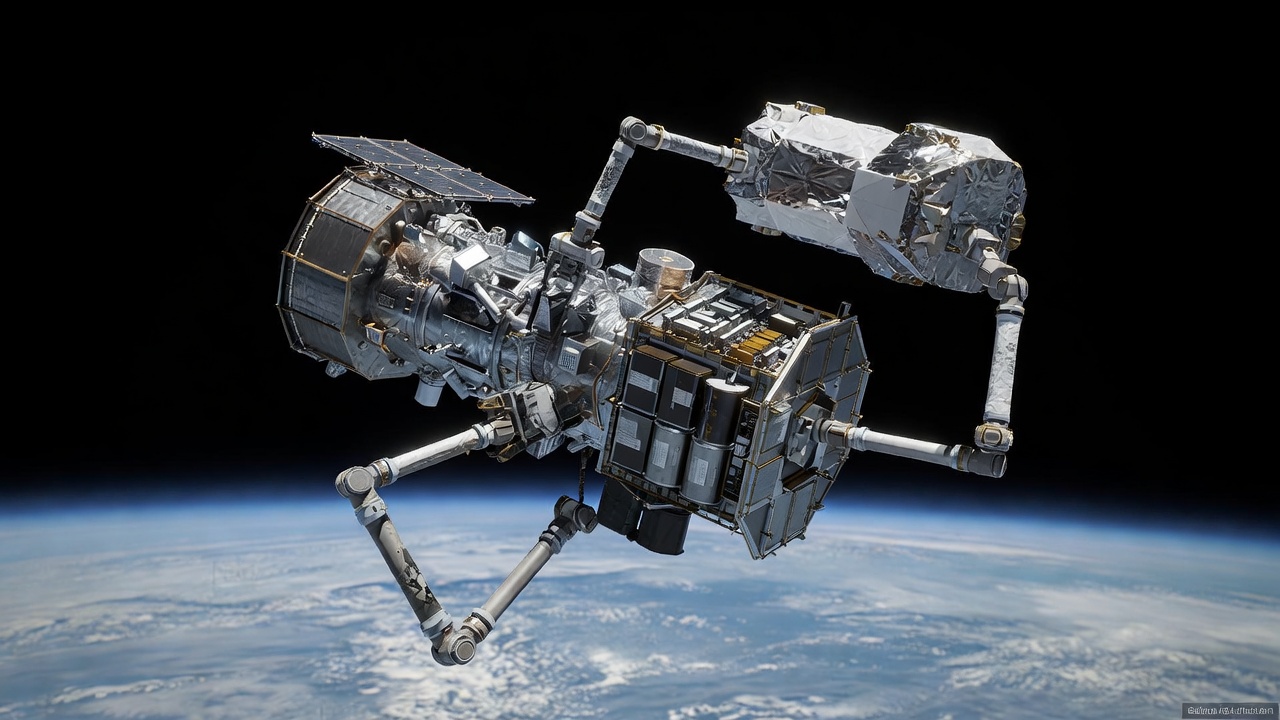
NASA has approved a robotic servicing mission to extend the operational life of the Neil Gehrels Swift Observatory, a space telescope that has provided critical data on cosmic explosions and high-energy phenomena since its launch in 2004. The agency selected Katalyst Space Technologies to carry out the ambitious project, which will involve an autonomous spacecraft rendezvousing with Swift in low Earth orbit, grappling the aging observatory, and installing fresh batteries along with upgraded electronics.
The decision marks a significant step forward for on-orbit satellite maintenance. Swift, originally designed for a two-year mission, has far exceeded expectations by detecting thousands of gamma-ray bursts, X-ray sources, and other transient events. Its instruments have helped astronomers map the locations of distant explosions, study the behavior of black holes, and even contribute to the detection of gravitational wave events when combined with ground-based observatories. Yet the telescope’s power system has deteriorated over more than two decades in space. Lithium-ion batteries that once stored energy from its solar arrays now hold only a fraction of their original capacity, forcing operators to impose strict power-management protocols that limit simultaneous observations.
Engineers at NASA’s Goddard Space Flight Center identified the battery degradation as the primary threat to continued operations. Rather than allow the observatory to go silent, agency officials chose to pursue a servicing demonstration under the On-Orbit Servicing, Assembly, and Manufacturing (OSAM) program. Katalyst Space Technologies emerged as the prime contractor after a competitive bidding process that evaluated technical proposals, cost estimates, and flight heritage. The Colorado-based company specializes in robotic manipulators and docking systems intended for satellite refueling and repair.
Under the terms of the contract, Katalyst will design and build a dedicated servicing vehicle roughly the size of a small car. The spacecraft will carry a set of replacement battery modules, new command and data handling electronics, and a suite of cameras and sensors for close-proximity operations. Once launched aboard a Falcon 9 rocket from Cape Canaveral, the servicer will spend several months maneuvering into the same orbital plane as Swift before initiating a careful approach. Autonomous guidance software, developed in partnership with Blue Canyon Technologies, will handle the final meters of closure to avoid any risk of collision.
The capture phase represents one of the most delicate parts of the mission. Swift was not built with servicing in mind, so it lacks standardized grapple fixtures or refueling ports. Katalyst engineers spent months studying archived engineering drawings and high-resolution images to identify suitable handholds on the observatory’s structure. Their solution involves a custom end-effector mounted on a seven-degree-of-freedom robotic arm. The end-effector will clamp onto a reinforced section of Swift’s optical bench, after which the servicer will stabilize the combined stack using a set of reaction wheels and thrusters.
With the two spacecraft locked together, the robotic arm will remove protective panels and extract the old battery pack. Technicians on the ground will monitor the procedure through live video feeds, although the majority of commands will execute autonomously to reduce communication delays. The new batteries, based on advanced cell chemistry with higher energy density and improved thermal characteristics, will slide into the same physical slots occupied by the originals. Electrical connectors have been redesigned with spring-loaded contacts that tolerate slight misalignments, ensuring reliable power transfer once the installation is complete.
In addition to the power upgrade, the mission includes replacement of the onboard computer that has begun showing occasional memory errors. The new processor unit features radiation-hardened components and runs updated flight software that incorporates lessons learned from more than twenty years of Swift operations. Engineers expect the refreshed avionics to improve data throughput and allow more flexible scheduling of target-of-opportunity observations when new astronomical events occur.
The entire servicing operation is scheduled to last approximately ten days while the vehicles remain mated. During that period, ground controllers will perform functional tests on each instrument to verify that the gamma-ray burst detector, X-ray telescope, and ultraviolet/optical telescope all return to full performance. If any anomalies appear, the robotic arm can reposition components or install secondary adapters carried as contingency hardware.
Once the work is finished, the servicer will release Swift and perform a separation burn to increase its orbital altitude, reducing the chance of future conjunctions. The observatory itself should regain the ability to point at multiple targets per orbit without power restrictions. Mission planners anticipate at least five additional years of science observations, and possibly a decade if the new components perform as modeled.
This project builds on earlier NASA demonstrations of robotic servicing. The OSAM-1 mission, originally planned to refuel Landsat 7, provided valuable data on autonomous rendezvous even after its scope was reduced. Similarly, the Restore-L project developed tools for satellite repair that have been adapted for the Swift effort. Katalyst incorporated several of those proven mechanisms while introducing innovations such as lighter composite materials and machine-vision algorithms trained on synthetic images of Swift’s unique geometry.
Financial details of the contract have not been disclosed, but industry analysts estimate the total cost at around $180 million, including launch services and two years of post-servicing operations support. That figure represents a fraction of the expense required to build and launch an entirely new gamma-ray observatory. By extending Swift’s life, NASA obtains continued access to a unique dataset that complements newer missions such as the James Webb Space Telescope and the upcoming Nancy Grace Roman Space Telescope. Swift’s wide-field instruments remain unmatched for detecting sudden flares from distant quasars and magnetars, events that other telescopes can then study in greater detail once alerted.
The scientific community has expressed strong support for the servicing plan. Researchers who rely on Swift data to coordinate multi-messenger astronomy campaigns view the mission as essential for maintaining coverage of transient phenomena. Gamma-ray bursts, in particular, serve as cosmic beacons that reveal conditions in the early universe, and any gap in Swift’s monitoring capability would hinder follow-up observations by ground-based telescopes and neutrino detectors.
Beyond the direct benefits to Swift, the project advances broader goals for satellite sustainability. As orbital debris concerns mount, the ability to repair rather than replace spacecraft offers a practical path toward reducing future collision risks. Successful completion of the Katalyst mission would demonstrate that even vehicles without built-in servicing interfaces can be rescued, potentially changing how future satellites are designed. Manufacturers might incorporate modest grapple points or modular electronics bays at marginal cost if they know robotic repair vehicles could one day visit them.
Katalyst has assembled a diverse team for the effort, drawing talent from previous NASA missions as well as commercial satellite operators. The company’s CEO noted that the project represents the first time a commercial firm will lead an end-to-end robotic installation on an operating NASA astrophysics spacecraft. Previous servicing activities, such as the Hubble Space Telescope visits, relied exclusively on crewed shuttles. This time, all actions will be performed by machines under ground supervision, lowering risk to human life and allowing operations outside the limited launch windows imposed by crewed flights.
Integration and testing will take place at a dedicated facility in Colorado, where engineers will subject the servicer to thermal vacuum, vibration, and electromagnetic compatibility trials that replicate launch and space conditions. A high-fidelity mockup of Swift’s aft section will allow operators to practice capture and battery swap procedures repeatedly until every motion is optimized. Software simulations running on supercomputers will validate the guidance algorithms against thousands of possible approach scenarios, including sensor failures and unexpected attitude changes by the target.
Public outreach forms another component of the mission. NASA plans to release raw video of the rendezvous and repair as soon as it is received on the ground, giving students and amateur astronomers an inside look at orbital operations. Educational materials will highlight the engineering challenges of working in microgravity and the scientific discoveries enabled by long-term observation of the high-energy sky.
If all proceeds according to schedule, the servicing spacecraft could launch as early as 2028. Swift would then continue its watch for cosmic fireworks well into the 2030s, providing an uninterrupted record of transient events that informs models of stellar evolution, black hole accretion, and the behavior of matter under extreme conditions. The data gathered during those extra years may help answer fundamental questions about the origin of heavy elements forged in neutron star mergers and the mechanisms that accelerate particles to near-light speeds in relativistic jets.
The selection of Katalyst also signals growing confidence in the commercial space sector’s ability to deliver complex orbital services. While NASA retains overall mission responsibility and will provide oversight during critical phases, the agency is increasingly comfortable assigning detailed design and execution to industry partners. This approach mirrors the strategy used for cargo and crew transport to the International Space Station and could serve as a template for future telescope maintenance or even assembly of large structures in orbit.
Challenges remain. The precise alignment of electrical connectors in weightlessness demands sub-millimeter accuracy, and any debris generated during panel removal could pose hazards to both vehicles. Communication blackouts during portions of each orbit require the servicer to carry sufficient onboard intelligence to pause operations safely if commands are delayed. Budget constraints could still affect the timeline, although current indications suggest the project enjoys solid backing within NASA’s astrophysics division.
Engineers emphasize that the mission is as much about learning as it is about repair. Every action performed on Swift will generate telemetry and imagery that inform the design of future servicers. Lessons about material fatigue, connector durability, and robotic dexterity in thermal extremes will shape hardware for the next generation of on-orbit maintenance vehicles. In that sense, the Swift project functions as both a rescue operation and a technology pathfinder.
For the thousands of scientists who have used Swift data over the past two decades, the robotic visit offers reassurance that their work can continue without interruption. The observatory’s burst alert system has become an integral part of global astronomy infrastructure, triggering rapid responses from telescopes on every continent. Losing that capability would create a noticeable gap in coverage until a successor mission reaches orbit. By choosing to service rather than retire the spacecraft, NASA has opted to preserve a proven asset while investing in the infrastructure needed to keep other satellites healthy in the decades ahead.
The Katalyst team now enters the detailed design phase, translating concept studies into flight hardware. If the mission succeeds, it will join the short list of robotic repairs performed beyond Earth’s atmosphere and open new possibilities for extending the productive lives of other aging but valuable spacecraft. For an observatory that has already rewritten textbooks on high-energy astrophysics, an on-orbit battery transplant may be the step that allows it to keep writing new chapters for years to come.


 WebProNews is an iEntry Publication