
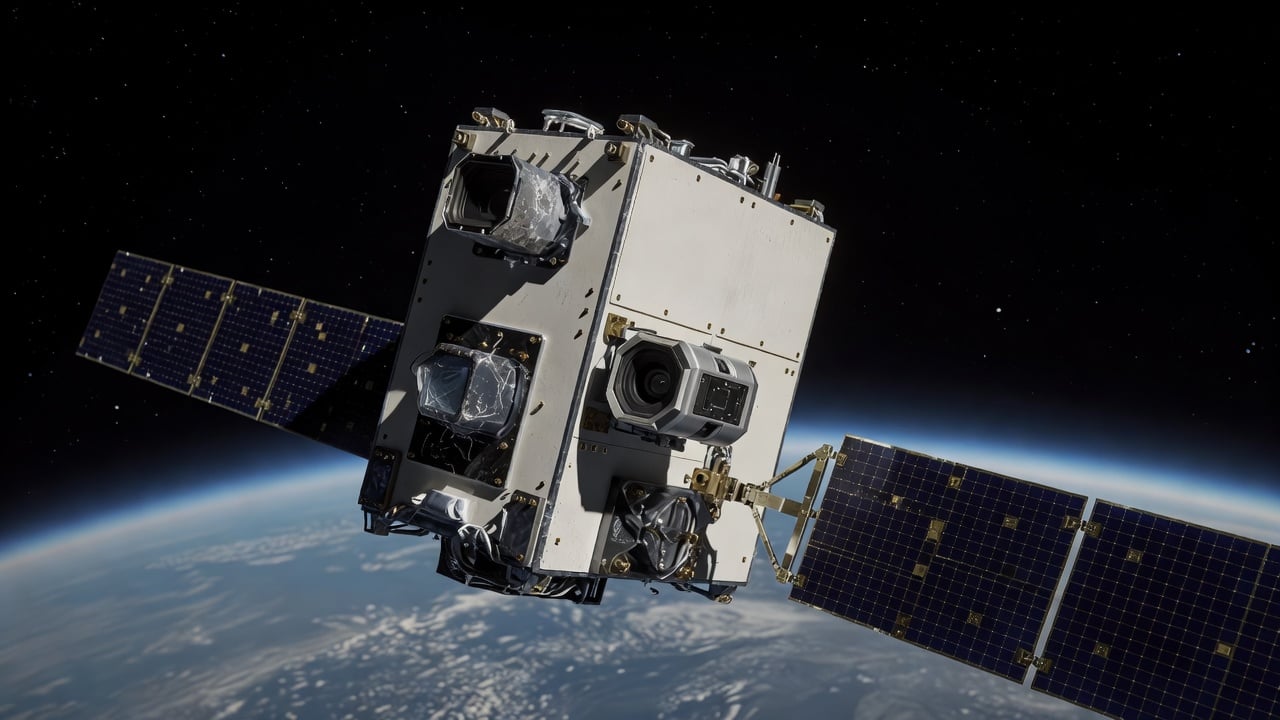
In September 2004, NASA faced an urgent problem with one of its most productive scientific instruments. The Swift Gamma-Ray Burst Explorer, a satellite designed to chase some of the universe’s most violent events, had suffered a failure in its onboard star tracker. Without accurate pointing information, the observatory risked losing its ability to rapidly slew toward new cosmic explosions and collect the high-energy data astronomers depended on. Traditional recovery methods would have required months of engineering work and significant funding that simply was not available. Instead, a small team turned to an innovative hardware solution developed by a company that had not even existed a few years earlier.
The satellite, which had launched only a few months before, carried three star trackers meant to determine its orientation by matching patterns of stars against an internal catalog. One unit had already failed shortly after launch. When the second began showing signs of serious trouble, engineers realized the third could not handle the workload alone. Swift’s ability to localize gamma-ray bursts within seconds and swing its X-ray and ultraviolet telescopes into position depended entirely on precise attitude knowledge. Losing that capability would have crippled a mission that was already delivering groundbreaking results on black holes, supernovae, and the afterglows of the most energetic events in the cosmos.
Katalyst Space Technologies stepped in with an unexpected approach. The company, founded by a group of engineers who had previously worked on military satellite programs, had been developing compact, radiation-hardened star trackers that could be produced quickly and at lower cost than traditional models. Rather than waiting for a full redesign or a shuttle mission that would never come, NASA approved a plan to upload new software and integrate one of Katalyst’s miniature trackers through a creative command sequence. The process involved transmitting updated firmware to the spacecraft while carefully managing power and thermal constraints. Within weeks, the new hardware was effectively brought online, restoring full pointing accuracy.
The success of this operation revealed how smaller, more agile suppliers could support flagship science missions when conventional contractors faced budget or schedule limitations. Katalyst’s tracker used modern CMOS sensors instead of the older CCD technology common in space hardware at the time. These sensors offered better performance in low-light conditions while consuming less power and surviving higher radiation doses. Because the company had already qualified its design for other government programs, NASA could move forward without starting a lengthy certification process from scratch. The entire intervention cost a fraction of what a new dedicated satellite or major hardware overhaul would have required.
Swift had been built under the NASA Explorer program, which emphasizes rapid development and focused science goals. The observatory’s primary task was to detect and study gamma-ray bursts, flashes of high-energy radiation that can outshine entire galaxies for brief moments. These events often signal the birth of black holes or the merger of compact objects. By catching them in the act and relaying precise coordinates to ground-based telescopes, Swift enabled multi-wavelength campaigns that transformed astronomers’ understanding of the early universe and the life cycles of massive stars. The satellite also contributed to studies of comets, pulsars, and even the mysterious bright flares coming from distant supermassive black holes.
When the second star tracker began to degrade, project managers calculated that the mission might end within days if nothing changed. The operations team at Goddard Space Flight Center coordinated with engineers at Penn State University, who managed the science instruments, and with Katalyst’s specialists. They devised a way to bypass the faulty unit by feeding data from the new tracker directly into the attitude control software. Commands had to be timed perfectly to avoid overloading the spacecraft’s limited computer resources. Each step was simulated on the ground using an engineering model before being sent to orbit. The process tested the limits of what could be accomplished through software patches and late-stage hardware integration on an active observatory.
Once the new tracker locked onto the star field, Swift resumed its normal survey pattern. Within hours it detected another gamma-ray burst and swung its narrow-field telescopes into position with the same speed and precision it had shown at launch. The scientific output continued without interruption. Over the following years, the observatory would go on to detect thousands more bursts, produce a detailed map of the sky in hard X-rays, and support observations that linked gamma-ray bursts to supernovae explosions. Its extended lifetime also allowed it to observe the electromagnetic counterparts of gravitational wave events once those discoveries began in 2017.
The partnership between NASA and Katalyst highlighted a shift in how space agencies approach risk and innovation. Rather than relying exclusively on large aerospace firms with decades of heritage hardware, project teams started evaluating smaller vendors who could deliver specialized components on compressed schedules. Katalyst had developed its star tracker technology partly through Small Business Innovation Research contracts before offering it for the Swift recovery. The experience gave the company credibility that later helped it secure additional contracts for other NASA and Department of Defense missions.
Engineers involved in the rescue noted that the new tracker performed better than the original units in several respects. Its wider field of view reduced the chance of losing lock during rapid slews, and its radiation tolerance exceeded expectations based on ground testing. These advantages came from design choices that prioritized modern electronics over the conservative approaches that had dominated space hardware for previous decades. The success encouraged other missions to consider similar last-minute upgrades when components showed signs of premature failure.
Swift’s continued operation also provided practical lessons for spacecraft design. Future observatories began incorporating more redundant sensors and modular interfaces that would allow easier replacement or augmentation while in orbit. Although physical swaps remain impossible without servicing vehicles, the ability to integrate new data sources through software has become a standard contingency tool. The incident demonstrated that a spacecraft’s effective lifetime can be extended significantly when engineers treat the onboard computer and communication systems as flexible platforms rather than fixed configurations.
Years after the intervention, Swift remains active, though it now operates with a different mix of instruments than it had at launch. Some detectors have degraded, and fuel for orbital adjustments is limited, yet the core pointing system continues to function thanks to the hardware and software adjustments made in 2004. The observatory has outlived its planned two-year prime mission by more than a decade and a half, returning data that scientists still use to study transient phenomena and test theoretical models of extreme astrophysics.
The episode also illustrated the value of maintaining a diverse industrial base for space components. When one supplier’s product begins to fail, having alternative sources ready can prevent the loss of irreplaceable scientific capability. Katalyst’s willingness to adapt its design for Swift’s specific interfaces showed how smaller firms can respond more nimbly than traditional contractors bound by extensive bureaucracy. At the same time, NASA’s decision to trust an unproven solution on an operating satellite required confidence in both the technology and the people behind it.
Today, the broader community of space scientists and engineers views the Swift recovery as an example of effective problem solving under pressure. The mission’s data archive continues to support new research, and its example has influenced how other projects prepare for component failures. Rather than accepting that a single hardware fault will end a multi-million-dollar investment, teams now explore creative workarounds that combine existing infrastructure with fresh contributions from specialized vendors.
The collaboration between a major government science agency and a startup company demonstrated that agility and technical ingenuity can sometimes achieve more than massive budgets. Swift’s star tracker crisis could have marked the premature end of a highly productive observatory. Instead, it became the starting point for an extended career that has enriched human knowledge of the violent universe. The satellite still scans the sky each day, ready to alert astronomers the moment another distant cataclysm flares into view. Its continued success stands as evidence that timely technical intervention, supported by flexible partnerships, can preserve and even enhance the scientific return from space missions long after their original hardware begins to show its age.


 WebProNews is an iEntry Publication