
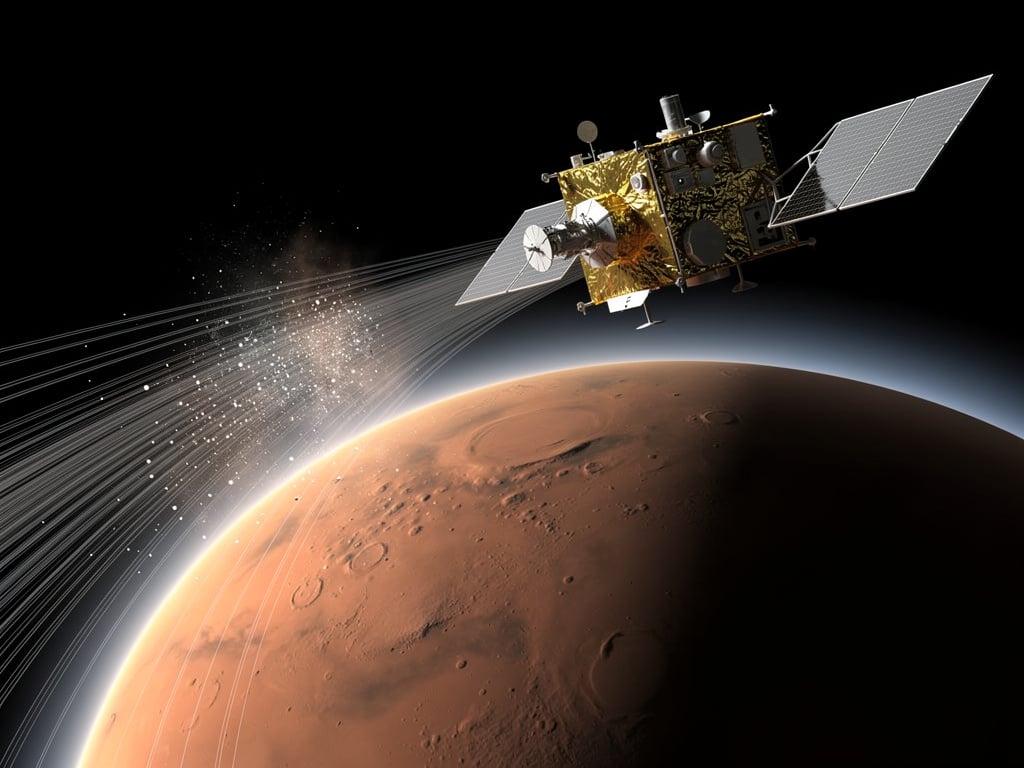
NASA has officially ended operations for its Mars Atmosphere and Volatile Evolution spacecraft, known as MAVEN, after more than a decade of continuous service studying the Red Planet. The spacecraft, which launched in 2013 and entered orbit around Mars in September 2014, has provided scientists with an unprecedented look at how the Martian atmosphere interacts with solar wind and how it has changed over billions of years. Mission managers at the Jet Propulsion Laboratory confirmed the spacecraft’s instruments were powered down following a final series of commands sent from Earth, marking the close of a productive era in Mars exploration.
The decision to conclude the MAVEN mission came after the spacecraft experienced increasing difficulties maintaining its orientation and power levels. Engineers had been monitoring a gradual decline in the performance of its reaction wheels, which help control the spacecraft’s pointing. When two of the four wheels began showing signs of excessive friction, the team switched to a backup system that relied on thrusters. This alternative method consumed more fuel than anticipated, accelerating the depletion of MAVEN’s remaining propellant reserves. Rather than risk an uncontrolled end to the mission that might interfere with other spacecraft orbiting Mars, NASA chose to conduct an orderly shutdown while the vehicle still responded reliably to commands.
Throughout its operational life, MAVEN gathered data that transformed our understanding of Mars’ climate history. The spacecraft carried nine scientific instruments designed to measure the composition, structure, and variability of the upper atmosphere. These tools detected how solar particles strip away atmospheric gases, a process that has slowly transformed the planet from a potentially habitable world with liquid water on its surface to the cold, dry desert seen today. By examining the rate at which Mars loses its atmosphere to space, researchers could reconstruct conditions from the planet’s distant past when it may have supported rivers, lakes, and possibly microbial life.
One of the mission’s most significant contributions involved measurements of water loss from the Martian atmosphere. MAVEN’s instruments revealed that hydrogen and oxygen atoms escape into space at rates that align with the disappearance of ancient oceans. The data showed that solar storms greatly accelerate this atmospheric escape, with major solar events capable of stripping away thousands of tons of gas in a single day. Such findings, reported regularly through updates on the Slashdot science section, helped establish a timeline showing that most of Mars’ atmosphere was lost during the first few hundred million years after the planet formed.
The spacecraft also functioned as a valuable relay for data from rovers on the Martian surface. When other orbiters were unavailable, MAVEN could receive information from vehicles like Perseverance and Curiosity and forward it back to Earth. This support role extended the operational life of surface missions and ensured a steady flow of scientific returns even during periods when primary relay spacecraft experienced technical issues. The dual purpose of atmospheric research and communications support demonstrated how a single mission could serve multiple objectives within NASA’s broader Mars program.
MAVEN’s observations extended beyond the planet itself to include interactions between the Martian atmosphere and the solar wind. The spacecraft mapped the bow shock where solar particles first encounter the planet’s thin atmosphere, as well as the magnetotail that stretches behind Mars for thousands of kilometers. These measurements provided insights into how unmagnetized planets defend themselves against the erosive effects of stellar winds. The findings have implications not only for Mars but for understanding atmospheric evolution on other rocky worlds around different types of stars.
Scientists used MAVEN data to study seasonal variations in the Martian atmosphere. During southern summer, when the planet is closest to the Sun, increased solar heating drives stronger atmospheric escape. Dust storms that occasionally engulf the entire planet also affect upper atmospheric conditions, creating complex interactions that the spacecraft documented in detail. These long-term observations, spanning more than four Martian years, revealed patterns that shorter missions could never have captured.
The mission’s success stemmed partly from its innovative orbital design. MAVEN flies in a highly elliptical path that takes it from within 150 kilometers of the surface to more than 6,000 kilometers away. This profile allows instruments to sample different layers of the atmosphere during each orbit. The spacecraft performs periodic deep dips into the upper atmosphere to collect direct measurements of density and composition at altitudes where other orbiters cannot safely operate. These maneuvers required precise navigation but yielded unique scientific returns.
As the mission progressed, the team adapted to changing conditions around Mars. The Sun reached solar maximum during MAVEN’s extended operations, providing opportunities to study how increased solar activity affects atmospheric loss. The spacecraft recorded several coronal mass ejections that slammed into Mars, compressing the planet’s ionosphere and dramatically increasing escape rates. Such events offered natural laboratories for understanding the mechanisms that shaped Mars’ climate over geological time.
MAVEN also contributed to studies of auroras on Mars. Unlike Earth, Mars lacks a global magnetic field to guide charged particles toward the poles. Instead, the spacecraft detected diffuse auroras caused by solar electrons impacting the atmosphere across wide regions. These observations helped explain mysterious nightside glows detected by earlier missions and added to our knowledge of how energy moves through the Martian environment.
The spacecraft’s imaging ultraviolet spectrograph produced stunning views of hydrogen and oxygen coronas surrounding Mars. These glowing halos extend far into space and represent the outer boundary where atmospheric gases begin their journey into interplanetary space. The instrument also captured images of carbon dioxide emissions that trace the structure of the upper atmosphere during different seasons. These visual records complemented the numerical data collected by other sensors.
Engineering teams at Lockheed Martin, which built the spacecraft, and at the University of Colorado’s Laboratory for Atmospheric and Space Physics, which operates the mission, worked together to maximize MAVEN’s scientific output. The operations team developed new techniques for managing power during periods when the spacecraft passed through Mars’ shadow. They also refined pointing strategies to protect sensitive instruments from dust impacts during regional storms. These adaptations allowed the mission to continue long after its primary objectives had been achieved.
The end of MAVEN operations leaves a gap in continuous monitoring of Mars’ upper atmosphere. While other spacecraft like the European Space Agency’s Trace Gas Orbiter and China’s Tianwen-1 probe remain active, none carry the specific combination of instruments that made MAVEN uniquely suited to studying atmospheric escape. NASA plans to incorporate some of MAVEN’s measurement objectives into future missions, but the immediate loss of real-time data collection represents a significant change for the research community.
Scientists will continue analyzing the vast archive of information collected during the mission’s 10 years and 8 months in orbit. The dataset includes more than 35 terabytes of observations covering multiple solar cycles and thousands of orbits. This information will fuel research papers and doctoral theses for decades to come. Teams have already begun planning new ways to combine MAVEN measurements with data from surface rovers and laboratory experiments simulating Martian conditions.
The spacecraft itself will remain in orbit around Mars for thousands of years. Its final trajectory was designed to avoid collision with the planet or interference with other operational spacecraft. Eventually, atmospheric drag will cause MAVEN to spiral inward, but this process is expected to take centuries. The long-term presence of the inactive vehicle serves as a reminder of humanity’s growing collection of artificial objects throughout the solar system.
MAVEN’s legacy extends to the next generation of Mars explorers. The mission provided critical data for planning future human missions by characterizing radiation levels and atmospheric conditions that astronauts would encounter. Understanding the current rate of atmospheric loss helps engineers design better habitats and life support systems for long-duration stays on the surface. The spacecraft’s findings also inform strategies for potential terraforming efforts, should such ambitious projects ever become feasible.
Public engagement played an important role throughout the mission. The MAVEN team collaborated with educators to develop classroom activities based on real spacecraft data. Students could analyze actual measurements of atmospheric composition or track changes in solar activity. These resources reached thousands of schools across multiple countries and helped build interest in planetary science among young people.
The conclusion of the MAVEN mission coincides with an active period in Mars exploration. NASA’s Perseverance rover continues its search for ancient life signs while collecting samples for eventual return to Earth. The Ingenuity helicopter, which completed its technology demonstration, provided valuable aerial perspectives before ending operations. International partners including the United Arab Emirates and China maintain orbiters that complement American efforts. Together these missions create a comprehensive picture of Mars as a dynamic world with an atmosphere that continues to evolve.
Looking forward, NASA is developing concepts for new atmospheric probes that could build upon MAVEN’s discoveries. These might include multiple small satellites working in coordination to create three-dimensional maps of atmospheric escape or landers equipped with instruments to measure gas exchange between the surface and atmosphere. The knowledge gained from MAVEN will guide the design of these future investigations, ensuring they target the most important scientific questions.
The successful completion of the MAVEN mission demonstrates the value of focused scientific objectives combined with flexible engineering. What began as a two-year primary mission extended more than five times longer thanks to careful resource management and adaptive operations. The spacecraft exceeded its design specifications in almost every category, delivering high-quality data until the very end. Its contributions will remain central to our understanding of planetary atmospheres for many years ahead.
As researchers review the final datasets transmitted during the mission’s closing weeks, they express both satisfaction with the results achieved and anticipation for what comes next. The story of Mars’ lost atmosphere, pieced together through MAVEN’s persistent observations, stands as one of the major scientific accomplishments of the early 21st century. That knowledge will inform not only our view of the Red Planet but our broader perspective on how terrestrial worlds develop and change throughout the galaxy. The spacecraft may have fallen silent, but the scientific conversation it started will continue for generations.


 WebProNews is an iEntry Publication