
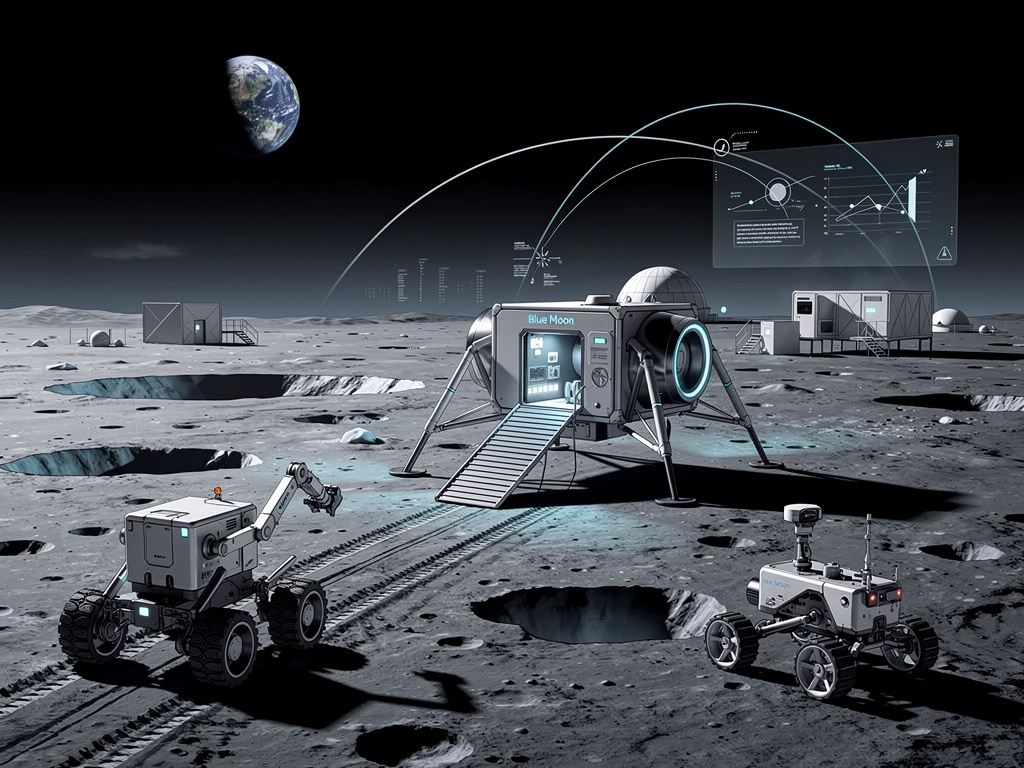
NASA has picked Jeff Bezos’ Blue Origin to ferry the first crew-carrying lunar rovers to the moon’s south pole. The selection marks a concrete step in the agency’s plan for a permanent outpost. It also hands one of the most visible early contracts in the new Moon Base initiative to a company that has spent years positioning itself as a long-term lunar player.
The deal, announced May 26 during a headquarters briefing, gives Blue Origin an initial $188 million to prepare its uncrewed Blue Moon Mark 1 lander, known as Endurance. An option worth another $280.4 million covers two follow-on task orders. Those funds will support delivery of two Lunar Terrain Vehicles, or LTVs, developed separately by Astrolab and Lunar Outpost. GeekWire first reported the award.
Astrolab receives $219 million for its CLV-1 rover. Lunar Outpost gets $220 million for the Pegasus. Both vehicles weigh less than one metric ton when folded for flight. They blend Apollo-era mobility with modern Mars-rover autonomy. Top speed reaches 10 kilometers per hour. Crewed range sits at 10 kilometers per trip. Uncrewed, the rovers can cover up to 200 kilometers. NASA officials described them as a practical mix between the 1970s lunar roving vehicle and more sophisticated robotic explorers.
“We need them to be on the surface, doing things that basically prospect the surface,” said Carlos Garcia-Galan, NASA’s Moon Base program manager. He added that the vehicles represent “a mix between the Apollo lunar roving vehicle and the Mars-style rover.” Those words, captured in real time at the briefing, underscore the shift from short visits to sustained operations.
The first rover delivery must occur before the Artemis 4 crewed landing, currently targeted for 2028. Endurance itself could launch as soon as this fall on Blue Origin’s New Glenn rocket. That mission, now labeled Moon Base 1, will carry science payloads including stereo cameras to study plume-surface interactions and a laser retroreflector array. A second Blue Moon Mark 1 flight in 2027 will deliver NASA’s VIPER rover to hunt for water ice. SpaceNews detailed the full set of awards and timelines.
But Endurance is only one piece. Firefly Aerospace won a $75 million task through NASA’s Jet Propulsion Laboratory to deliver four rocket-powered MoonFall drones. Those small vehicles will scout shadowed craters and extend communications. Intuitive Machines remains eligible for later cargo work even though it did not receive one of the initial rover or drone contracts.
The announcements fit inside a three-phase architecture laid out by NASA. Phase One, running through 2029, focuses on access, resource scouting, and technology demonstrations. Up to 25 missions are planned, including 21 landings. Phase Two, from 2029 to 2032, brings early habitation, expanded power systems, and larger cargo deliveries. Phase Three, beginning in 2032, aims for sustained human presence with habitats, in-situ resource utilization, and routine logistics measured in tons rather than kilograms. NASA’s own overview of the phased approach frames the rovers and landers as foundational.
Administrator Jared Isaacman struck an ambitious tone. “America is returning to the moon,” he said. “We are working alongside our many international and commercial partners to leverage the incredible capabilities from commercial industry to build a moon base for all we hope to accomplish in this endeavor.” He later described the south pole outpost as a training ground for Mars. “We want to be in an environment where we can learn the skills, so that astronauts can go and plant the Stars and Stripes on Mars someday.”
Dave Limp, Blue Origin’s chief executive, responded quickly on social media. “Since the beginning, Blue Origin has been committed to Lunar Permanence,” he wrote. “Thank you for sharing that vision. We’re ready to make it a reality.” The company has already completed thermal vacuum testing of Endurance at NASA’s Johnson Space Center. Those tests wrapped up in early May. NASA confirmed the test completion.
Recent coverage shows the award caught immediate market attention. Lunar-focused stocks moved after the news broke. Industry observers noted that the contract reinforces Blue Origin’s position against SpaceX in the human landing system competition. Mark 2 of Blue Moon, the crewed variant, remains in development for later Artemis flights. Lori Glaze, NASA’s associate administrator for human spaceflight, said teams are advancing trade studies on both Blue Origin and SpaceX lander concepts. “We’re already moving forward pretty strongly with both,” she said.
Yet challenges remain. Blue Origin has never landed on the moon. Its first Mark 1 mission will serve as a pathfinder. Precise cryogenic propulsion, autonomous guidance, and soft landing in the south pole’s uneven terrain all must prove out. The rovers themselves face a harsh environment: extreme cold during lunar night, abrasive dust, and limited solar power in shadowed regions. The MoonFall drones add another layer of complexity. They must hop, navigate, and return data from areas rovers cannot easily reach.
Still, the pace has accelerated. NASA renamed its early south pole missions under the Moon Base banner. Moon Base 1, 2, and 3 now anchor the opening sequence. Astrobotic’s Griffin lander will fly on a Falcon Heavy later this year for Moon Base 2. Intuitive Machines’ Nova-C will handle Moon Base 3 with international payloads. These flights build the logistical foundation before humans return in force.
Analysts see the contracts as more than hardware buys. They signal NASA’s willingness to let commercial providers shoulder development risk and cost. Blue Origin funds much of the Mark 1 demonstration itself. Astrolab and Lunar Outpost carry their own investment into rover design. That model echoes the commercial cargo and crew programs that revived American access to low Earth orbit.
Isaacman pointed to history. The agency is “leveraging the NASA playbook from the 1960s, figuring out what works and what doesn’t in this epic science of survival.” Garcia-Galan described the future base as covering hundreds of square miles. Different assets—power stations, habitats, rovers, drones—will accumulate over time. Water ice at the south pole remains the strategic prize. It can supply drinking water, oxygen, and rocket propellant. Mastering those resources prepares crews for longer stays and eventual trips to Mars.
The Washington Post noted the contract puts Blue Origin at the center of early lunar base activity. Reuters highlighted the competitive field that also includes Astrobotic and Intuitive Machines for future cargo. The New York Times framed the rovers as 21st-century successors to the Apollo buggies. Each outlet captured a different angle. Together they show broad interest in a program that has moved from concept to contracted hardware in months.
Blue Origin’s Kent, Washington headquarters sits a short drive from NASA’s nearby facilities. Local engineers have worked on the lander for years. The company’s New Glenn rocket, still preparing for its debut, will carry Endurance. Success on that first flight would validate both the lander and the heavy-lift booster. Failure would delay the entire south pole campaign.
For now the momentum sits with the new awards. Two distinct rover designs. A proven cargo lander in final testing. Drones ready to hop across crater rims. And a clear schedule that stretches from this fall into the early 2030s. The Moon Base is no longer a drawing on a screen. It has contractors, budgets, and flight dates. Blue Origin just received one of the first tangible pieces of that future.


 WebProNews is an iEntry Publication