
Echoes of the Space Age: NASA’s Demolition of Iconic Test Towers Signals a New Era in Rocketry
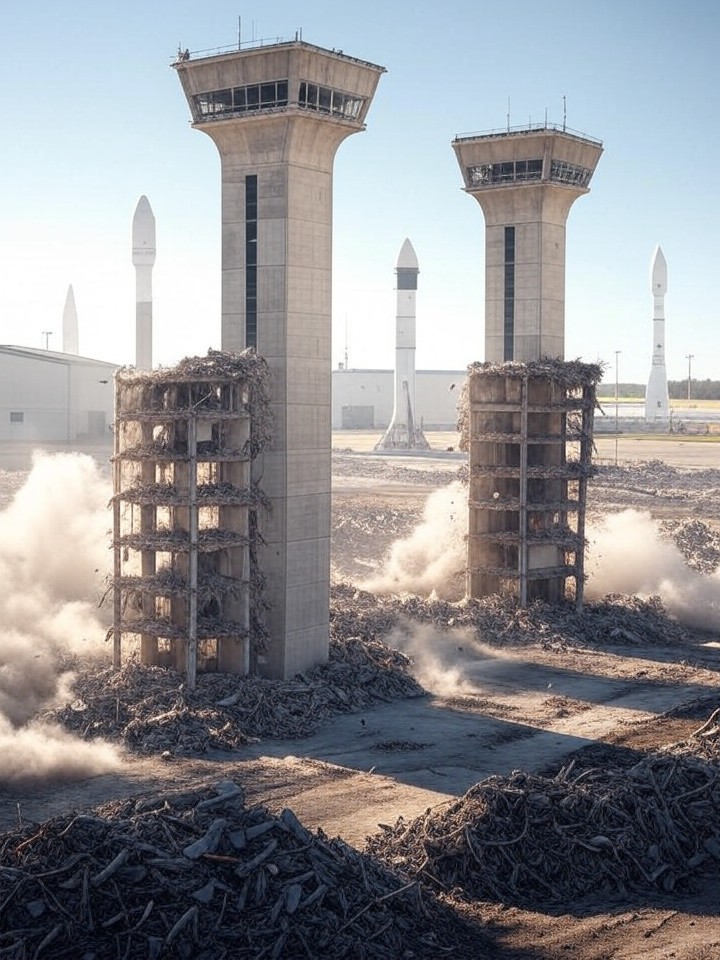
In the early morning light of January 10, 2026, a series of controlled explosions reverberated through the grounds of NASA’s Marshall Space Flight Center in Huntsville, Alabama. What followed was the dramatic collapse of two towering structures that had stood as sentinels of America’s space ambitions for over six decades. The Dynamic Test Stand and the Propulsion and Structural Test Facility, often called the T-Tower, crumbled in a matter of seconds, marking the end of an era defined by the Saturn V rocket and the Space Shuttle program. This demolition, executed with precision by specialized crews, was not merely a housekeeping measure but a strategic pivot as NASA accelerates its Artemis program, aiming to return humans to the Moon and beyond.
These facilities, built in the 1960s, were engineering marvels of their time. The Dynamic Test Stand, rising 360 feet tall, was once the tallest structure in northern Alabama, designed to simulate the violent vibrations and stresses that rockets endure during launch. Engineers used it to test fully assembled Saturn V rockets, the behemoths that propelled Apollo astronauts to the Moon. Later, it played a crucial role in integrating components for the Space Shuttle, ensuring that orbiters, external tanks, and solid rocket boosters could withstand the rigors of spaceflight. The T-Tower, meanwhile, focused on propulsion systems, hosting static fire tests for engines that powered historic missions.
The decision to demolish these icons came after years of deliberation, driven by practical necessities. NASA officials cited safety concerns, as the aging structures had become hazards, with rust and structural fatigue posing risks to personnel. Moreover, the land they occupied is prime real estate for modern testing needs, particularly as the agency ramps up development for the Space Launch System (SLS) rocket central to Artemis. By clearing the site, Marshall can repurpose the area for new facilities that support advanced propulsion technologies, including those for future Mars missions.
Preserving History Amid Progress
The demolition process itself was a feat of engineering, involving careful placement of explosives to ensure a controlled implosion. According to reports from NASA, crews began preparations in mid-December 2025, starting with the Neutral Buoyancy Simulator—a massive pool used for astronaut training that was decommissioned in 1997. The test stands followed, with the implosions timed for just after sunrise on January 10 to minimize disruption. Local residents in Huntsville reported hearing the blasts from miles away, a sonic reminder of the site’s storied past.
Industry experts view this as a bittersweet milestone. “These towers weren’t just steel and concrete; they were the backbone of America’s dominance in space,” said a former NASA engineer who worked on Shuttle tests in the 1980s. Yet, the move aligns with broader efforts to modernize NASA’s infrastructure. The agency has been archiving artifacts from the sites, including components now housed in museums like the U.S. Space & Rocket Center in Huntsville. Digital recreations and oral histories are also being compiled to preserve the knowledge embedded in these facilities.
Critics, however, argue that demolishing such landmarks erodes tangible connections to space history. Preservation groups lobbied for alternatives, suggesting adaptive reuse, but NASA countered that maintenance costs—estimated in the millions annually—outweighed the benefits. As one official noted in a briefing, the focus must shift to future capabilities, especially with Artemis II’s crewed lunar orbit mission on the horizon.
Engineering Legacies and Technical Insights
Delving deeper into the technical roles of these towers reveals their ingenuity. The Dynamic Test Stand, constructed in 1964, featured a massive shake table capable of simulating launch vibrations up to 1.5 million pounds of force. It was here that engineers identified and resolved issues with the Saturn V’s pogo oscillations—dangerous vibrations that could have doomed the Apollo program. Data from these tests informed designs that ensured the rocket’s stability during its thunderous ascents.
The T-Tower, officially Test Stand 4693, specialized in structural and propulsion evaluations. It hosted firings of the F-1 engines, the most powerful single-chamber liquid-fueled engines ever built, each producing 1.5 million pounds of thrust. Post-Apollo, it adapted for Shuttle main engine tests, contributing to over 135 missions. As detailed in coverage from Gizmodo, one of its last uses was as a drop tower for microgravity experiments in the early 2000s, underscoring its versatility.
From an insider’s perspective, these facilities embodied the iterative nature of aerospace engineering. Test data from the stands influenced everything from material selections to vibration dampening techniques still used today. For instance, lessons learned from Saturn V tests directly informed the SLS’s core stage design, which draws on Shuttle-era heritage while incorporating modern composites and avionics.
Strategic Shifts in NASA’s Vision
The timing of the demolition coincides with heightened activity in NASA’s Artemis campaign. Just days before the implosions, the agency announced final preparations for rolling out the SLS rocket and Orion spacecraft to the launch pad at Kennedy Space Center, as reported by NASA’s own updates. This mission, Artemis II, will send four astronauts around the Moon in late 2026, a precursor to lunar landings.
By removing outdated infrastructure, Marshall is freeing up resources for cutting-edge projects. Plans include new test beds for hypersonic propulsion and in-space manufacturing, areas critical for sustained human presence on the Moon and Mars. Budget allocations reflect this priority: NASA’s 2026 fiscal request emphasizes infrastructure modernization, with funds redirected from legacy maintenance to innovation.
Industry observers note parallels with private sector moves. SpaceX, for example, has demolished older pads at Cape Canaveral to build Starship facilities, as seen in posts on X highlighting similar transitions. This reflects a broader trend where space agencies and companies prioritize agility over nostalgia, ensuring facilities evolve with technological demands.
Community Impact and Economic Ripples
In Huntsville, known as “Rocket City,” the demolition stirred mixed emotions. Local media, including WHNT.com, captured residents’ reactions, with some viewing it as a loss of heritage while others see opportunities for job creation in new construction. The event drew spectators, and videos of the blasts circulated widely on social platforms, amassing thousands of views.
Economically, Marshall remains a powerhouse, employing over 6,000 and contributing billions to Alabama’s economy. The demolition is part of a larger revitalization effort, with NASA investing in sustainable buildings and green technologies. Partnerships with companies like Boeing and Lockheed Martin, which built SLS components, will benefit from streamlined operations at the center.
Looking ahead, the cleared site could host simulations for nuclear thermal propulsion, a game-changer for deep-space travel. Insiders speculate this aligns with NASA’s long-term goals, potentially accelerating timelines for Mars missions by the 2030s.
Global Context and Competitive Pressures
NASA’s actions occur against a backdrop of intensifying international competition. China’s Chang’e program has achieved lunar sample returns, while India’s Chandrayaan missions advance rapidly. By modernizing, NASA aims to maintain its edge, as emphasized in analyses from The Register, which highlighted the demolition as a step toward Artemis ramp-up.
Collaborations with allies, such as the European Space Agency’s contributions to Orion, underscore the need for efficient infrastructure. The test stands’ removal eliminates bottlenecks, allowing faster iteration on SLS Block 1B upgrades, which promise greater payload capacity.
For aerospace professionals, this signals a shift toward digital twins and virtual testing, reducing reliance on physical structures. Software simulations, powered by AI, can now replicate many of the stands’ functions, cutting costs and timelines.
Reflections on Innovation’s Cost
The rubble from the towers serves as a metaphor for progress’s inevitable trade-offs. As collectSPACE documented, these structures witnessed triumphs like Apollo 11 and tragedies like Challenger, embedding them in collective memory.
Yet, NASA’s forward momentum demands such changes. Archivists are digitizing blueprints and test logs, ensuring the knowledge endures. Educational programs at Marshall now incorporate virtual reality tours of the old stands, inspiring the next generation.
In conversations with veterans, there’s a sense of closure. “We built the future on those towers,” one retiree reflected. “Now, it’s time to build anew.” This sentiment captures the essence of space exploration: honoring the past while boldly charting new paths.
Emerging Technologies and Future Horizons
As the dust settles, attention turns to what replaces the towers. NASA hints at advanced test rigs for reusable engines, drawing from Shuttle lessons but incorporating additive manufacturing. This could revolutionize how rockets are built and tested, with implications for commercial ventures like Blue Origin’s New Glenn.
Integration with Artemis extends to habitat testing and resource utilization, areas where Marshall leads. The demolition frees bandwidth for these pursuits, potentially accelerating crewed Mars concepts.
Ultimately, this event underscores NASA’s adaptability, balancing heritage with ambition in an era of rapid advancement. As the agency eyes the stars, the fallen towers remind us that every leap forward requires leaving something behind.


 WebProNews is an iEntry Publication