
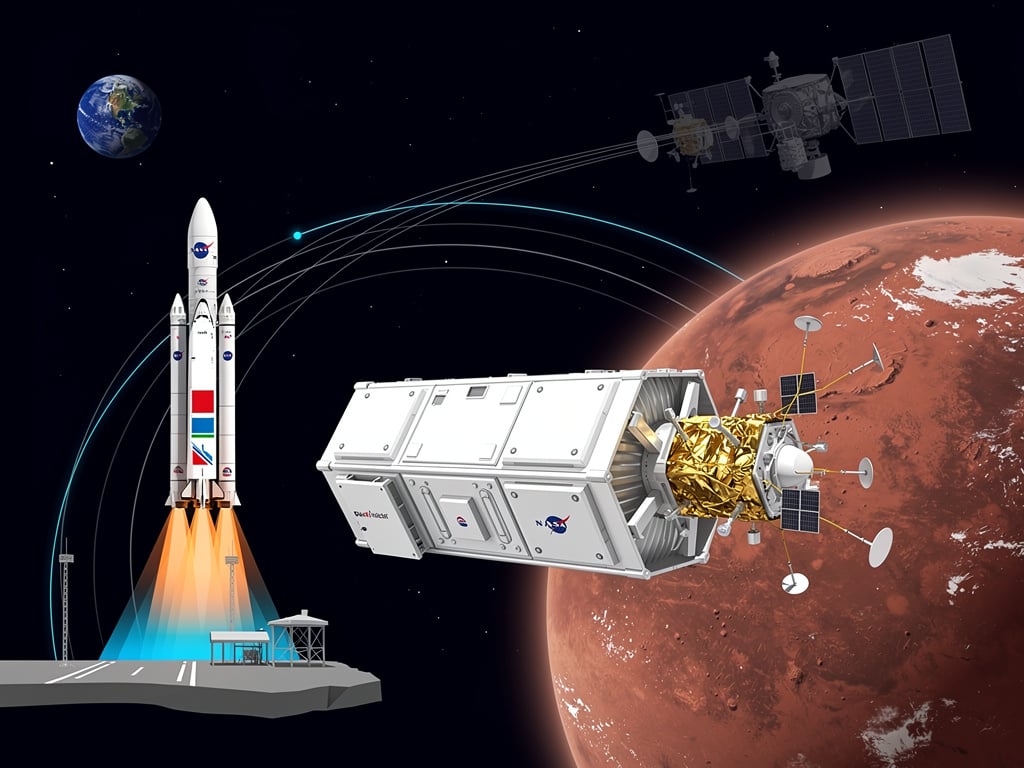
NASA has struck a deal with Relativity Space to carry a suite of atmospheric sensors to the Red Planet. The agency supplies the science hardware. The company, still without an orbital launch to its name, will build the spacecraft, provide the rocket and handle the journey.
From MAVEN's End to a New Model
This arrangement comes days after NASA declared the end of its long-running MAVEN orbiter. The spacecraft, which studied the Martian atmosphere and relayed data for surface missions, fell silent last December. Six months of recovery attempts produced nothing. Officials confirmed its loss earlier this month. (CBS News)
MAVEN operated more than a decade. It delivered insights into how Mars lost its ancient atmosphere. Its departure leaves a gap in orbital coverage. NASA now turns to commercial partners to fill it. And fast.
The new mission targets a 2028 launch. Aeolus carries four instruments from NASA’s Ames Research Center. They will deliver the first daily, global maps of Martian winds, temperatures, dust and clouds. Such data matters for future landings. Better models reduce risks during entry, descent and touchdown. They matter even more when humans arrive.
“Public-private partnerships like this are a force multiplier for science,” NASA Administrator Jared Isaacman said at the June 17 announcement event held at Relativity Space. “By pairing NASA’s world-class instruments with commercial innovation and investment, we can deliver more science, more often, and reduce the time it takes to get essential data into the hands of researchers preparing for future human missions to Mars.” (NASA)
Relativity Space will manage spacecraft development, launch and cruise operations. NASA handles the payload and science operations for at least one Martian year after arrival. The deal uses a six-year reimbursable Space Act Agreement. It marks the first of its kind for this scale of Mars mission.
Dr. Eugene Tu, director of NASA Ames, welcomed the arrangement. “Aeolus reflects how innovative collaboration accelerates science and strengthens the foundation needed for one day landing humans on Mars.”
The instruments include the Doppler Wind and Temperature Sounder for ozone, a Thermal Limb Sounder, a Surface Radiometric Sensor Package and a Wide-Field Context Camera. Partnerships with GATS and Xiomas Technologies support two of them. Together they promise vertical profiles, surface energy measurements and daily imaging.
Yet questions linger. Relativity Space has yet to reach orbit with its Terran 1 rocket. The company pivoted to larger Terran R designs after that test flight. Its acquisition last year by a group including former Google CEO Eric Schmidt brought new resources. Still, no successful orbital mission exists. The firm must now deliver a deep-space spacecraft on schedule.
This approach echoes NASA’s Commercial Lunar Payload Services program. But Mars presents steeper challenges. The trip takes months. Communication lags. Entry into Mars orbit demands precision. Failure would mean years of lost science.
Industry studies back the strategy. NASA commissioned a dozen of them in 2024. Companies examined payload delivery, communications relays and imaging from Mars orbit. Results looked promising enough for further investment. The fiscal 2026 budget includes $200 million to begin Commercial Mars Payload Services, modeled on the lunar effort. (The Space Review)
A separate effort seeks a dedicated Mars Telecommunications Network orbiter. NASA reserved room for a small science payload up to 20 kilograms. The volume allowance measures 55 by 55 by 45 centimeters. Power stays under 60 watts. Data rates range from 200 to 1,000 megabits per day. Blue Origin’s Blue Ring platform features in early concepts. Rocket Lab also eyes relay orbiters. (SpaceNews)
But the Relativity deal stands apart. It pairs NASA instruments directly with a single commercial provider for the full stack. No government-built orbiter bus. No traditional prime contractor in the old sense. The company owns the risk. And the reward.
Critics point to the timeline. A 2028 launch window leaves little margin for delays. MAVEN’s recent loss underscores how even proven systems can fail far from home. Relativity must prove its propulsion, navigation and thermal systems work across interplanetary distances.
Supporters see momentum. Isaacman’s leadership has emphasized speed. Commercial partners have lowered costs on the lunar side. Extending that record to Mars could open more frequent missions. Data from Aeolus would feed directly into models used for sample return concepts or crewed landing site selection.
So the bet is clear. NASA keeps what it does best: the science instruments and data pipeline. Commercial industry supplies the ride. Success would validate years of policy shifts toward fixed-price contracts and shared risk. Failure would invite tough questions about readiness.
Either way, the model has taken hold. More announcements may follow. Blue Origin, SpaceX and others watch closely. The race to provide reliable Mars infrastructure has begun in earnest.
Recent coverage highlights the competitive angle. HotHardware noted how the selection sets up a contest with SpaceX on interplanetary capabilities. (HotHardware)
The Register first reported specifics of the payload riding a commercial orbiter from a rocket company yet to reach orbit. (The Register)
Expect updates as integration begins at Ames. The instruments must survive launch loads, the long cruise and Mars orbit insertion. Relativity must prove it can handle all three. The stakes extend beyond one mission. They touch the pace of American exploration at the Red Planet for the next decade.


 WebProNews is an iEntry Publication