
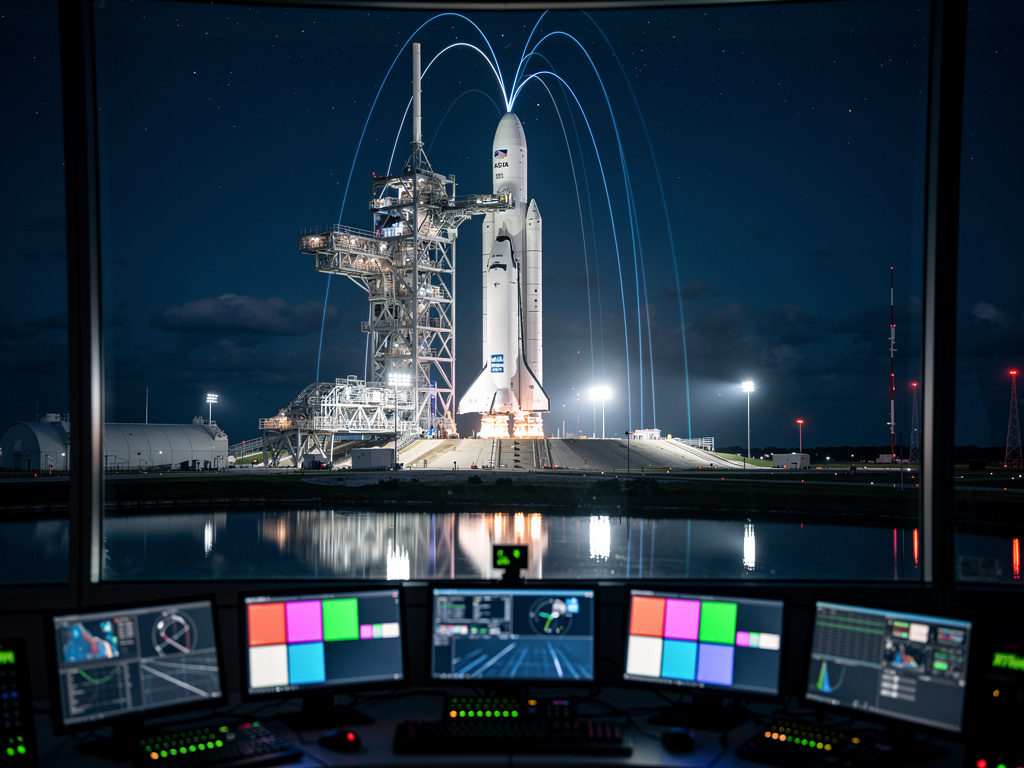
Over the weekend, NASA astronauts donned their orange flight suits and climbed aboard the Orion spacecraft for a pivotal dress rehearsal, simulating the launch sequence for the Artemis 2 mission slated for February. This exercise, conducted at Kennedy Space Center in Florida, marked a significant milestone in preparations for what will be the first crewed lunar orbit since the Apollo era. The four-member crew—comprising NASA’s Reid Wiseman, Victor Glover, Christina Koch, and Canadian Space Agency’s Jeremy Hansen—practiced every step from suiting up to boarding the capsule, ensuring that ground teams and flight hardware are synchronized for the real event.
The rehearsal unfolded under the cover of night, mimicking the potential conditions of an actual launch window. According to reports from Futurism, the astronauts departed the Neil A. Armstrong Operations and Checkout Building, waved to assembled media and staff, and proceeded to the launch pad where the Space Launch System (SLS) rocket awaits final integration. This dry run tested not just human elements but also the intricate interplay of software, communications, and emergency protocols, all critical for a mission that will loop around the moon without landing.
Beyond the spectacle, this event underscores NASA’s methodical approach to mitigating risks in human spaceflight. Industry experts note that such rehearsals are indispensable for identifying procedural glitches before they become mission-threatening. For Artemis 2, which aims to validate the Orion capsule’s life-support systems and deep-space navigation, every detail counts—from the fit of pressure suits to the timing of hatch closures.
Rehearsing for Lunar Glory: Inside the Artemis 2 Preparations
The Artemis program’s broader ambitions extend far beyond this single mission, positioning it as a cornerstone for sustained human presence on the moon and eventual Mars exploration. Drawing from updates on NASA’s official site, the crew’s walkthrough included a simulated countdown, allowing engineers to verify interfaces between the Orion spacecraft and the SLS rocket. This comes amid ongoing tests of the rocket’s core stage, which has faced delays due to manufacturing complexities at Boeing facilities.
Public sentiment on platforms like X reflects growing excitement, with users sharing images and commentary on the astronauts’ poised demeanor during the rehearsal. Posts highlight the historic inclusion of the first woman and first person of color on a lunar mission, amplifying the program’s diversity narrative. However, challenges persist: budget constraints and technical hurdles have pushed the timeline from an initial 2024 target to no earlier than 2026, as per recent congressional reviews.
For insiders in the aerospace sector, the rehearsal’s success is a bellwether for contractor performance. Lockheed Martin, prime contractor for Orion, has invested heavily in upgrades to the capsule’s heat shield following anomalies in the uncrewed Artemis 1 flight. Analysts point out that seamless integration here could accelerate preparations for Artemis 3, which plans a lunar landing with SpaceX’s Starship involvement.
Technical Hurdles and Triumphs in Moon Mission Readiness
Delving deeper, the dress rehearsal incorporated lessons from prior tests, including the “wet dress rehearsals” for Artemis 1, where fuel loading simulations exposed leaks in hydrogen lines. CBS News detailed how the crew practiced emergency egress procedures, a nod to safety protocols refined after historical incidents like the Challenger disaster. This level of preparedness is vital, given the mission’s 10-day duration and exposure to radiation beyond Earth’s magnetosphere.
On the innovation front, the suits worn during the rehearsal—advanced variants of the Orion Crew Survival System—feature improved mobility and life-support redundancy. These aren’t the extravehicular activity suits for moonwalks but are designed for launch and re-entry stresses. Industry observers compare them favorably to those used in SpaceX’s Crew Dragon missions, noting NASA’s emphasis on modularity for future evolutions.
Moreover, international collaboration shines through with Hansen’s participation, symbolizing Canada’s contributions via the Canadarm robotics. This partnership extends to data-sharing with the European Space Agency for Orion’s service module, highlighting a multinational effort to distribute costs and expertise.
Strategic Implications for NASA’s Lunar Agenda
As the February launch window approaches, the rehearsal’s outcomes will inform final adjustments to the flight plan. Space.com captured vivid imagery of the nighttime simulation, emphasizing how lighting and weather simulations prepare teams for variable conditions. Insiders speculate that any anomalies detected could prompt minor delays, but NASA’s track record suggests resilience, as seen in the successful resolution of Artemis 1’s engine issues.
The mission’s trajectory—a free-return loop around the moon—serves as a proving ground for technologies like optical navigation systems, which use star trackers to maintain course without constant ground input. This autonomy is crucial for longer-duration voyages, where communication lags could span minutes.
Economically, Artemis 2 represents a boon for Florida’s space coast, generating jobs and tourism. Local economies anticipate a surge similar to Apollo launches, with Kennedy Space Center visitor numbers already climbing in anticipation.
Pushing Boundaries: Crew Training and Psychological Prep
Training regimens for the Artemis 2 crew have been rigorous, encompassing centrifuge simulations for g-forces and isolation exercises to mimic cabin confinement. Space.com’s live updates chronicle how these astronauts, selected in 2023, have bonded through joint sessions, fostering the teamwork essential for high-stakes operations.
Psychological resilience is another focal point, with NASA incorporating virtual reality for stress management. Veterans like Wiseman, a former International Space Station commander, bring invaluable experience, mentoring newcomers on coping with isolation and decision-making under pressure.
Looking ahead, the rehearsal paves the way for integrated testing with the full SLS stack. Aerospace Global News reports that the rocket is now fully assembled, undergoing vibration and acoustic checks to ensure it withstands launch rigors.
Global Competition and Collaborative Horizons
In the wider arena of space exploration, Artemis 2’s progress occurs against a backdrop of intensifying rivalry, particularly with China’s Chang’e program aiming for lunar south pole landings by 2030. NASA’s strategy emphasizes alliances, contrasting with more unilateral approaches elsewhere, and this rehearsal demonstrates the program’s momentum.
Volunteer initiatives, such as those inviting amateur radio operators to track the spacecraft, as mentioned in Space.com, democratize participation, potentially yielding supplementary data for mission control.
Financially, the program’s $93 billion price tag through 2025 draws scrutiny, but proponents argue it yields dividends in technological spin-offs, from advanced materials to medical imaging.
Innovations Driving the Next Lunar Era
Key innovations spotlighted in the rehearsal include Orion’s automated docking system, tested in simulations for future lunar gateway interactions. This modular outpost, a collaboration with international partners, will serve as a staging point for surface missions.
Environmental considerations also factor in, with NASA prioritizing sustainable practices like propellant efficiency to minimize orbital debris. The SLS’s reusable elements, though limited, represent steps toward greener spaceflight.
For aerospace executives, the rehearsal’s data will refine risk models, influencing insurance and investment in private ventures like Blue Origin’s lunar lander contributions.
Human Elements in High-Stakes Spaceflight
At its core, Artemis 2 is a human story. India Today highlighted the crew’s precision during the drill, a testament to months of preparation that began with basic flight training and escalated to full-mission simulations.
Diversity in the crew lineup—Koch as the first woman on a lunar mission and Glover as the first Black astronaut—signals NASA’s commitment to inclusivity, inspiring global audiences and broadening talent pools.
As rehearsals continue, with more slated before launch, the focus remains on iterative improvements, ensuring Artemis 2 not only succeeds but sets a precedent for the program’s longevity.
Future Trajectories: From Rehearsal to Reality
Anticipation builds as NASA eyes the mission’s scientific payloads, including radiation sensors to study space weather impacts on human health. These insights will inform Mars mission planning, where exposure durations extend to years.
Industry partnerships, such as with Northrop Grumman for propulsion modules, underscore the collaborative model driving progress. The rehearsal validated these integrations, boosting confidence in the supply chain.
Ultimately, this dress rehearsal encapsulates NASA’s evolution from Apollo’s sprint to Artemis’s marathon, blending heritage with cutting-edge tech for a new era of exploration.
Legacy and Forward Momentum in Lunar Pursuits
Reflecting on historical parallels, the Artemis program’s phased approach mirrors Apollo’s testing cadence, yet incorporates modern computing for predictive analytics. Rocket City Now notes that while no specific February date is set, the rehearsal edges the mission closer to fruition.
Public engagement, fueled by social media buzz on X, where users discuss everything from suit designs to launch timelines, amplifies awareness and support.
In closing, as Artemis 2 transitions from simulation to execution, it heralds a renaissance in human spaceflight, promising discoveries that could redefine our place in the cosmos.


 WebProNews is an iEntry Publication