
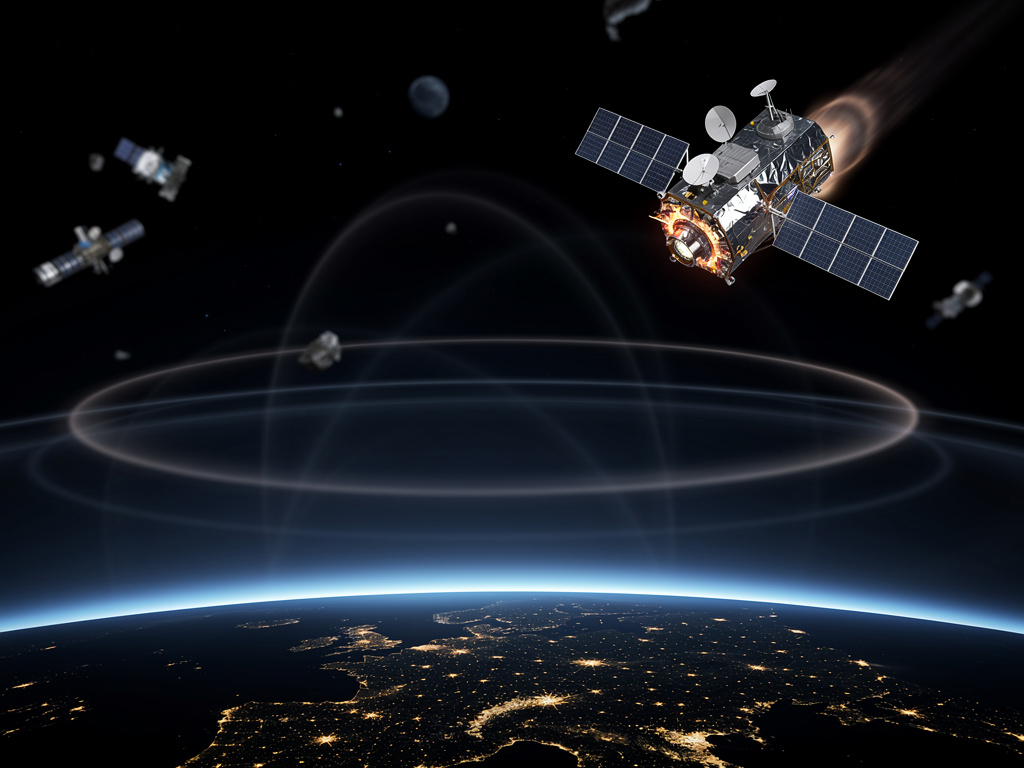
NASA has granted a special exception to its usual safety protocols for the upcoming atmospheric reentry of one of the Van Allen Probes, a decision that highlights the challenges of managing spacecraft at the end of their operational lives. This waiver, approved just days before the event scheduled for this week, allows the probe to descend without meeting all standard risk assessments for potential ground impacts. The move comes after extensive evaluations by engineers and scientists, who determined that the benefits of concluding the mission outweigh the minimal hazards involved.
The Van Allen Probes, originally launched in 2012, consist of two identical spacecraft designed to study the intense radiation belts surrounding Earth. These belts, discovered by physicist James Van Allen in 1958, trap high-energy particles from the sun and cosmic rays, posing significant threats to satellites and astronauts. The probes, equipped with advanced instruments, have provided invaluable data on how these belts form, evolve, and interact with solar activity. Over their seven-year mission, they orbited Earth in highly elliptical paths, dipping close to the planet and soaring out to about 20,000 miles at their farthest points. This configuration allowed them to sample different regions of the belts repeatedly, yielding insights into particle acceleration and loss mechanisms.
By 2019, both probes had exhausted their fuel reserves and were no longer able to maintain precise orbits. NASA decided to deorbit them gradually, letting atmospheric drag pull them down over time. The first probe reentered in 2019, but the second has lingered longer due to orbital dynamics. Now, with reentry imminent, officials faced a dilemma: standard guidelines require that spacecraft reentries pose less than a 1 in 10,000 chance of causing casualties on the ground. However, calculations for this probe slightly exceeded that threshold, prompting the need for a waiver.
According to reports from Ars Technica, the waiver was necessary because the probe’s design includes components that might survive the fiery plunge through the atmosphere. Most satellites burn up completely during reentry, but denser parts like fuel tanks or instrument housings can reach the surface. In this case, engineers estimate that fragments weighing up to 100 pounds could potentially land in uninhabited ocean areas, given the probe’s trajectory over the Pacific. The risk assessment, conducted by NASA’s Orbital Debris Program Office, factored in population densities, flight paths, and atmospheric conditions to arrive at their conclusions.
This isn’t the first time NASA has bent its rules for reentries. Similar waivers have been issued for other missions, such as the Rossi X-ray Timing Explorer in 2018, where the casualty risk was deemed acceptably low despite not meeting the strict criteria. The decision-making process involves a panel of experts who review data from simulations and historical reentries. For the Van Allen Probe, the team concluded that the actual danger to people or property is negligible, especially since the reentry window avoids densely populated regions.
Beyond the immediate safety concerns, this event underscores broader issues in space debris management. With thousands of satellites now in orbit, the accumulation of defunct hardware poses growing risks. The Van Allen Probes themselves contributed to understanding how radiation affects spacecraft longevity, ironically informing strategies to mitigate debris. Data from the mission has shown that solar storms can erode satellite components faster than expected, leading to premature failures and more objects in space.
International agreements, like those from the United Nations Committee on the Peaceful Uses of Outer Space, encourage nations to minimize debris through controlled reentries or graveyard orbits. NASA’s waiver reflects a pragmatic approach when ideal conditions can’t be met. Critics, however, argue that such exceptions could set precedents that erode safety standards over time. Environmental groups have also raised concerns about ocean pollution from falling debris, though studies indicate that most materials disintegrate harmlessly.
The scientific legacy of the Van Allen Probes remains profound. Their observations have refined models of Earth’s magnetosphere, helping predict space weather events that disrupt communications, GPS, and power systems on the ground. For instance, the probes detected unexpected “killer electrons” accelerated to near-light speeds during geomagnetic storms, providing clues to protect future missions. Researchers at institutions like the Johns Hopkins University Applied Physics Laboratory, which built the probes, continue to analyze the data archive, publishing findings in journals such as Geophysical Research Letters.
As the probe prepares for its final descent, tracking stations worldwide will monitor its path. Ground-based radars and optical telescopes, part of networks like the U.S. Space Surveillance Network, will provide real-time data to confirm the reentry trajectory. If deviations occur, contingency plans include public alerts, though none are anticipated given the remote impact zones.
This reentry also serves as a test case for emerging technologies in debris mitigation. Future spacecraft designs incorporate features like sails or thrusters to ensure faster deorbits, reducing long-term clutter. Companies such as SpaceX and OneWeb, deploying large constellations, face pressure to adhere to stricter guidelines. NASA’s experience with the Van Allen Probes informs these efforts, emphasizing the need for end-of-life planning from the outset.
In the context of ongoing space exploration, events like this highlight the balance between scientific advancement and responsible stewardship. The probes’ contributions to understanding radiation belts have direct applications for missions to the Moon and Mars, where similar environments challenge human and robotic explorers. For example, data from the probes has influenced shielding designs for the Artemis program, ensuring astronauts are protected from solar particle events.
Looking ahead, the disposal of aging satellites will become more frequent as the space industry expands. Regulatory bodies are pushing for updates to orbital guidelines, including requirements for all new launches to include deorbit mechanisms. The European Space Agency, for instance, has proposed missions to actively remove debris, such as the ClearSpace-1 project set for 2025.
For the Van Allen Probe’s reentry, public interest has spiked, with amateur astronomers planning to observe the event. Bright streaks across the sky, visible from certain locations, will mark the probe’s disintegration, a spectacular end to a mission that expanded our knowledge of near-Earth space.
Engineers involved in the project reflect on the probes’ durability. Built to withstand extreme radiation, the spacecraft far exceeded their initial two-year design life, operating for over seven years. This resilience stemmed from redundant systems and radiation-hardened electronics, lessons applied to subsequent missions like the Parker Solar Probe.
The waiver decision, while controversial in some circles, aligns with NASA’s risk management philosophy, which prioritizes overall mission objectives. Detailed reports on the reentry will be published post-event, offering transparency and data for future assessments.
As space activities intensify, managing reentries responsibly ensures the sustainability of orbital environments. The Van Allen Probes’ story, from launch to fiery conclusion, exemplifies the cycle of exploration: bold ventures yielding discoveries, followed by careful closure.
In wrapping up the mission, NASA officials emphasize the probe’s role in advancing space weather forecasting. Accurate predictions can prevent billions in economic losses from disrupted infrastructure. The data continues to support global efforts, shared through open-access repositories.
This week’s reentry closes a chapter, but the knowledge gained endures, shaping the future of space science. With the waiver in place, the stage is set for a controlled end, minimizing risks while honoring the probe’s achievements. Observers worldwide await the spectacle, a reminder of humanity’s reach into the cosmos and the responsibilities that come with it.


 WebProNews is an iEntry Publication