
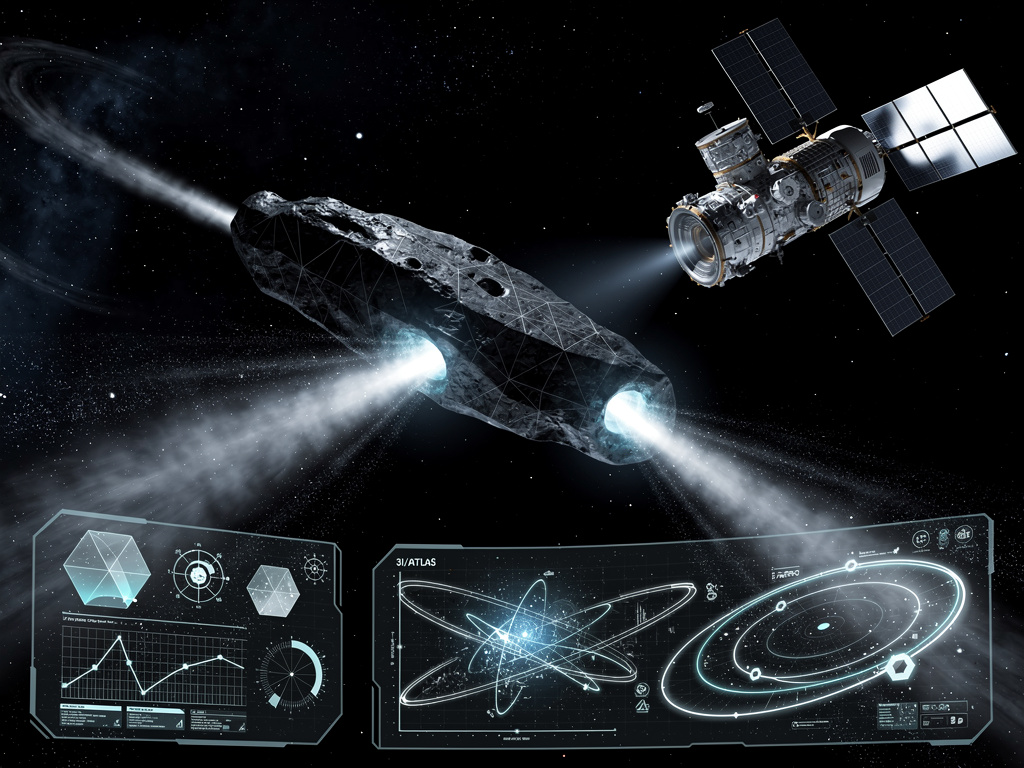
The Enigmatic Symmetry: Decoding the Triple Jets of Interstellar Wanderer 3I/ATLAS
In the vast expanse of space, where comets and asteroids typically follow predictable paths dictated by gravity and solar winds, the interstellar object known as 3I/ATLAS has emerged as a celestial enigma. Discovered in July 2025, this visitor from beyond our solar system has captivated astronomers with its unusual behavior and composition. Recent Hubble Space Telescope images have revealed a striking feature: three symmetrical jets emanating from its core, challenging conventional explanations of cometary activity. Harvard astronomer Avi Loeb, known for his provocative theories on extraterrestrial artifacts, has spotlighted this “symmetric jet structure” as potentially indicative of something more than natural processes.
The jets, observed in a series of 17 Hubble images taken between November 30 and December 27, 2025, appear to protrude at regular 120-degree intervals, forming a near-perfect geometric pattern. This configuration is not aligned with the sun’s direction, which would be expected if solar heating were solely responsible for outgassing. Instead, the jets seem to align with the object’s rotation axis, suggesting a possible internal mechanism at play. Loeb, in his analysis published on Medium, questions whether this could be a “technological signature” or merely an exotic natural phenomenon.
Comparisons to previous interstellar objects like ‘Oumuamua, the first confirmed visitor in 2017, highlight key differences. While ‘Oumuamua exhibited anomalous acceleration without visible outgassing, 3I/ATLAS displays a coma and tail more akin to solar system comets. Yet, its interstellar origin and high speed—clocking in as the fastest known object of its kind—set it apart. Data from NASA’s missions, as detailed on the agency’s Science page, show collaborative efforts to track its trajectory as it exits our system.
Unveiling the Jets Through Advanced Imaging
Further scrutiny of the Hubble data reveals that these jets are not static; they evolve over time, with slight wobbling observed in the sun-facing tail. This “anti-tail,” pointing toward the sun rather than away, is rare and typically results from perspective effects during a comet’s orbit. However, the embedded jet structures within this tail display a rhythmic shifting, as reported in a December 23, 2025, article from Space.com. Astronomers suggest this could stem from precession in the object’s spin, but the symmetry remains puzzling.
Social media platforms, particularly X (formerly Twitter), have buzzed with speculation. Posts from astronomy enthusiasts and experts alike describe “razor straight jets shooting sideways” and “stable, straight jets that defy comet physics,” reflecting a groundswell of public interest. One notable thread highlights a new image stack showing two jets forming a perfect X, not aligned with solar radiation pressure, fueling debates on whether 3I/ATLAS is a comet or something engineered.
In contrast, mainstream scientific voices urge caution. An international team of researchers, as covered in a January 3, 2026, piece by Yahoo News, refutes alien hypotheses, emphasizing that 3I/ATLAS resembles typical comets despite its origins. They point to its unelongated nucleus and coma as evidence of natural formation, dismissing Loeb’s ideas as far-fetched.
Debating Origins: Natural or Artificial?
Loeb’s persistence in exploring extraterrestrial possibilities stems from the jets’ precise geometry. In his Medium post, he poses rhetorical questions: Could the 120-degree separation indicate a structural design, perhaps from an advanced civilization? While ice sublimation in comets often produces irregular bursts, this pattern suggests uniformity that surface weathering alone might not explain. Recent web searches reveal ongoing discussions, with some posts on X noting a six-degree alignment with the object’s rotation, hinting at an internal propulsion-like system.
Counterarguments abound. A study referenced in a January 2, 2026, article from DNyuz argues that 3I/ATLAS is more comet-like than ‘Oumuamua, with no compelling evidence for artificiality. Researchers highlight its carbon dioxide profile and nickel-rich outgassing, which challenge but don’t overturn conventional models. NASA’s Hubble revelations, detailed in a fresh report from International Business Times UK just hours ago, describe the jets as defying easy explanation yet potentially explainable through exotic gas dynamics.
Efforts to detect alien signals add another layer. An international team used the world’s largest single-dish radio telescope to scan 3I/ATLAS for technosignatures during its closest Earth approach. Results, announced in a January 3, 2026, update from Futurism, found no artificial emissions, bolstering the natural origin camp. However, the absence of signals doesn’t rule out dormant technology, as Loeb might argue.
Historical Context and Comparative Analysis
To appreciate 3I/ATLAS’s significance, consider the brief history of interstellar objects. Only three have been confirmed: ‘Oumuamua in 2017, 2I/Borisov in 2019, and now 3I/ATLAS. Each has sparked similar debates, but 3I/ATLAS’s visible activity provides more data points. Filtered images, as shared in X posts from late 2025, expose coherent wave-like jets aligned with non-sublimation forces, prompting reevaluation of comet physics.
Avi Loeb’s role in this narrative is pivotal. As a Harvard professor and author, he has championed the search for extraterrestrial intelligence through anomalies like these. His January 1, 2026, Medium analysis delves into the Hubble images, calculating jet angles and proposing models for both natural and artificial scenarios. Critics, including NASA scientists, counter that the wealth of observational data aligns with cometary behavior, even if interstellar.
Public sentiment, gleaned from recent X activity, leans toward fascination with the alien angle. Threads discuss “wobbling jets in a rare sun-facing tail” and “exotic composition,” with view counts in the tens of thousands. This mirrors broader interest in space anomalies, amplified by media coverage.
Technological Implications and Future Observations
The symmetric jets raise questions about propulsion in space. If natural, they could inform models of interstellar comet formation, perhaps involving unique ices or internal heat sources. Loeb speculates on technological parallels, like rocket plumes aligned with rotation axes, drawing from earthly engineering principles.
Ongoing research includes spectral analysis of the jets’ composition. Reports from Gizmodo, dated January 2, 2026, detail the radio scan’s null results but emphasize the value in ruling out signals. As 3I/ATLAS recedes, opportunities for study diminish, making Hubble’s dataset invaluable.
Industry insiders in astronomy and space exploration see this as a call for better instrumentation. Proposals for dedicated interstellar object telescopes gain traction, potentially revolutionizing our understanding of these rare visitors.
Broader Scientific Ramifications
The debate extends to exocomet studies. A Mashable India article from January 2, 2026, available at Mashable India, flags the anti-tail’s baffling persistence, suggesting revisions to models of outgassing in vacuum.
Loeb’s questioning of “gas dynamics” versus “technological signatures” encapsulates the tension between skepticism and speculation. While most experts favor natural explanations, the symmetry’s precision invites scrutiny.
As more data trickles in, the scientific community remains divided. X posts continue to highlight new images showing jets distinct from the anti-tail, with users debating their implications in real-time.
Pushing Boundaries in Space Research
Ultimately, 3I/ATLAS exemplifies the thrill of discovery in astronomy. Its jets, whether born of alien ingenuity or cosmic coincidence, challenge preconceptions and spur innovation.
Future missions, like those probing similar objects, could yield definitive answers. For now, the symmetric structure stands as a testament to the universe’s mysteries.
Reflecting on this, industry experts anticipate that anomalies like these will drive funding toward advanced observatories, ensuring we’re better prepared for the next interstellar guest.


 WebProNews is an iEntry Publication