
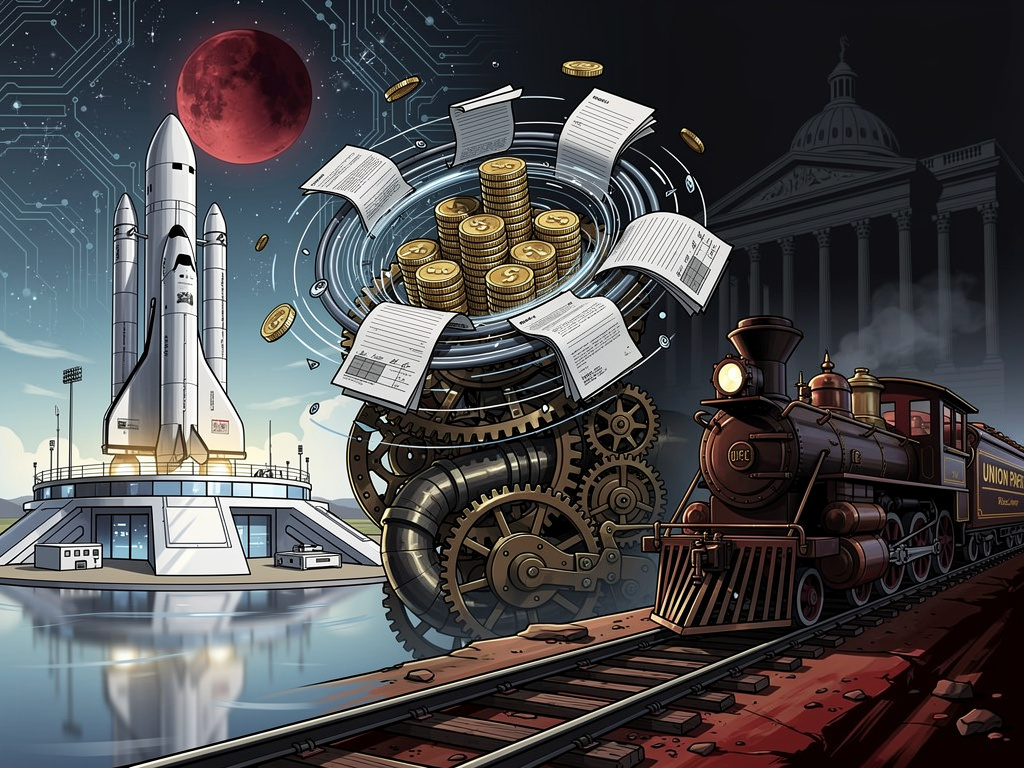
Elon Musk sees parallels where others see red flags. In a pre-IPO investor presentation this spring, the SpaceX founder declared his rocket company stood in the shoes of a 19th-century railroad giant. “We’re kind of like the Union Pacific,” he said. The analogy aimed to frame massive capital raises and ambitious infrastructure as visionary bets that would reshape economies. History tells a messier story.
Union Pacific didn’t just build tracks across the continent. It fed on government bonds, vast land grants and military protection. Congress chartered the company in 1862 to stitch East and West together. Executives soon devised a scheme that funneled public money into private pockets. They created Crédit Mobilier of America, a construction subsidiary they controlled. Costs ballooned. The railroad’s actual build ran near $50 million. Crédit Mobilier billed $94 million. Insiders pocketed the difference. Adjusted for today, that $44 million profit equals roughly $1.2 billion.
The Scandal That Defined an Era
Bribes kept the arrangement alive. Union Pacific leaders sold discounted stock to members of Congress, including the vice president and speaker of the House. The New York Sun broke the story in 1872 during Ulysses S. Grant’s reelection campaign. Congressional hearings followed. Reputations crumbled. Yet the railroad got finished. Tracks reached Utah. California boomed. The company survived scandals that would sink most modern firms.
Musk invoked this history to justify SpaceX’s sky-high ambitions. He pointed to skeptics who once doubted the transcontinental railroad. Few lived in California then, he noted. The rail link changed that. SpaceX, in his telling, would do the same for Mars and beyond. Transport first. Entrepreneurs and markets would follow. The pitch landed amid preparations for what became one of the largest IPOs ever. SpaceX debuted on Nasdaq in June 2026. It raised billions. Valuations climbed past $2.5 trillion at points. And the company eyes tens of billions more in bond markets to fund artificial intelligence infrastructure, orbital data centers and repeated Starship launches.
But the comparison lands awkwardly. Stanford University professor emeritus Richard White, a leading historian of the American West, called Union Pacific “a mess of self-dealing and corruption.” He told the Los Angeles Times that Musk’s analogy “plays on the immense ignorance of the history of this country, of financial markets and most Americans.” White’s point cuts sharp. The railroad succeeded despite fraud, not because of visionary execution free from government entanglement.
SpaceX itself thrives on public contracts. NASA awards. Federal launch licenses. Regulatory approvals that competitors envy. The company has received billions in taxpayer-backed funding over the years. Critics see echoes. SpaceX operates with monopoly-like advantages in certain heavy-lift markets. Its Starlink network reaches remote areas but has drawn scrutiny for enabling fraud abroad. In 2025, U.S. Sen. Maggie Hassan pressed Musk to block Starlink terminals used by scam compounds in Southeast Asia. Reuters reported the senator’s letter citing billions lost to transnational criminals. SpaceX later disabled over 2,500 kits in Myanmar, according to company statements. Action came after activist pressure.
And. The fundraising push continues. Bloomberg News detailed plans for at least $20 billion in bonds shortly after the IPO. Capital expenditure forecasts run staggering. Analysts model more than $700 billion annually by 2031 to support AI ambitions tied to SpaceX hardware. Short sentences don’t capture the scale. Longer ones reveal the bet: spend now at levels that dwarf current revenues, assume demand materializes for compute in space and interplanetary logistics, and trust that execution will outpace the skeptics just as rails eventually did.
Short-term questions pile up. Debt markets must price SpaceX without a long investment-grade history. Jim Chanos, the short seller, highlighted the irony of the Union Pacific reference in the same Los Angeles Times coverage. The Credit Mobilier episode stands as the biggest fraud of the 19th century. Musk’s team didn’t address that part of the analogy. They focused on outcomes. California became an economic powerhouse. Mars could too.
Yet outcomes carry costs. Union Pacific’s construction displaced Native American tribes. Laborers, many Chinese immigrants, faced brutal conditions. The Crédit Mobilier profits enriched a small circle while taxpayers bore inflated bills. SpaceX faces its own controversies. Labor complaints. NLRB cases later dismissed. Allegations of foreign investor ties that raise national security flags, as ProPublica reported last fall. Musk’s dual role atop Tesla, SpaceX, xAI and more invites scrutiny over conflicts and capital allocation.
So the Musk comparison invites examination rather than celebration. SpaceX pushes boundaries in reusable rockets. Starship prototypes fly more frequently. Launch cadence sets records. These feats matter. They don’t erase dependence on government support or the risks of overpromising on timelines and returns. Investors pour in anyway. The IPO succeeded. Bond deals loom. AI integration with Tesla and xAI adds another layer of complexity and capital demand.
History rarely repeats exactly. But patterns linger. Gilded Age monopolies mixed innovation with excess. They delivered infrastructure that powered growth. They also produced scandals that reshaped regulation. Musk positions SpaceX as the rail of the 21st century. The rails reached the Pacific. Whether SpaceX reaches Mars at promised costs and whether public money yields commensurate benefits remains unproven. The analogy Musk chose carries more weight than he perhaps intended. It reminds that spectacular infrastructure often travels with spectacular risks. And hidden transfers.
Recent coverage reinforces the tension. As SpaceX integrates deeper into AI hardware plans, questions about sustainable returns grow louder. Oppenheimer analysts and Goldman Sachs teams model the capex. Few forecast near-term profits at the scale required. The company burns cash to build capacity first. Just as Union Pacific did. But that railroad had explicit federal charters and land subsidies. SpaceX competes in commercial markets too. It must deliver satellites, tourism flights and defense contracts while chasing the red planet.
But skeptics aren’t silent. They note the Credit Mobilier playbook: insiders profiting from construction markups under government umbrellas. No one accuses SpaceX of identical fraud. The parallel sits in the optics of massive public-private entanglement and the narrative of inevitable success. Musk’s investor decks gloss over failures. Rockets explode. Schedules slip. Costs rise. The vision persists.
In the end, the Union Pacific did connect the coasts. Fortunes were made and lost. America grew. SpaceX may yet open the space economy. Its founder clearly believes the comparison flatters his venture. Observers armed with the full history may draw different lessons. Ambition alone never built a railroad. Or a fleet of orbital factories. Government help, private greed, public tolerance for risk and eventual delivery all played roles. Musk’s SpaceX sits at a similar crossroads. The tracks ahead look promising. The ground beneath them has shifted before.


 WebProNews is an iEntry Publication