
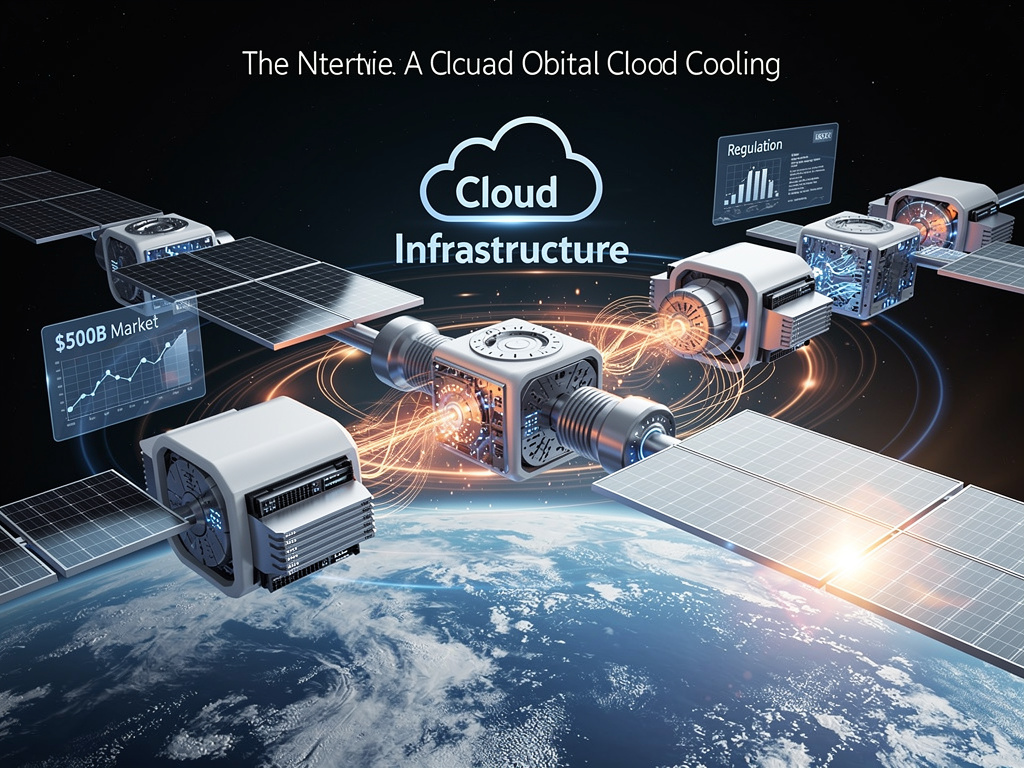
Elon Musk’s latest venture into orbital infrastructure represents a fundamental reimagining of how humanity processes and stores information. According to TechCrunch, the SpaceX founder is accelerating plans to deploy data centers in low Earth orbit, a move that could reshape the $500 billion cloud computing industry while addressing terrestrial limitations in power consumption, cooling costs, and physical space constraints. The initiative, which builds upon SpaceX’s Starlink satellite network expertise, marks a significant departure from conventional data center construction that has dominated the industry for decades.
The technical and economic rationale behind orbital data centers stems from several compelling factors that traditional ground-based facilities cannot easily overcome. Terrestrial data centers consume approximately 1-2% of global electricity, with cooling systems accounting for nearly 40% of that energy expenditure. In the vacuum of space, passive radiation cooling eliminates this burden entirely, while abundant solar energy provides consistent, renewable power without transmission losses or grid dependencies. Industry analysts estimate that orbital facilities could reduce operational energy costs by 60-70% compared to their Earth-bound counterparts, though initial deployment costs remain substantially higher.
Musk’s timing coincides with escalating challenges facing the data center industry. Artificial intelligence workloads have driven unprecedented demand for computing capacity, straining electrical grids in major tech hubs from Northern Virginia to Dublin. According to recent industry reports, some regions face decade-long waiting lists for new data center power allocations, while others have imposed outright moratoriums on construction. This bottleneck threatens to constrain AI development and cloud service expansion precisely when demand is accelerating most rapidly, creating an opening for alternative approaches that circumvent terrestrial infrastructure limitations.
Engineering Challenges and SpaceX’s Unique Advantages
The technical hurdles of operating data centers in orbit are formidable, requiring innovations across multiple engineering disciplines. Radiation hardening of processors and memory systems presents the most immediate challenge, as cosmic rays and solar particle events can cause data corruption and hardware failures. However, recent advances in radiation-tolerant computing architectures, combined with strategic shielding approaches, have made commercial space computing increasingly viable. SpaceX’s vertical integration—controlling both launch vehicles and satellite manufacturing—provides cost advantages that no competitor can currently match, with Starship’s projected launch costs potentially dropping below $10 per kilogram to orbit.
Latency concerns, long considered a fatal flaw for orbital computing, may prove less problematic than initially assumed for specific workloads. While real-time applications requiring sub-millisecond response times remain unsuitable for space-based processing, batch processing, machine learning training, rendering, and archival storage tolerate higher latencies without performance degradation. These workloads represent a substantial portion of current data center utilization, potentially comprising a $150-200 billion addressable market segment. SpaceX’s existing Starlink infrastructure provides the communications backbone necessary to shuttle data between ground stations and orbital facilities, leveraging investments already made in laser inter-satellite links and ground terminal technology.
Market Disruption and Competitive Response
Traditional cloud computing giants face an uncomfortable strategic dilemma as orbital data centers transition from theoretical concept to practical reality. Amazon Web Services, Microsoft Azure, and Google Cloud have collectively invested hundreds of billions in terrestrial infrastructure that could face premature obsolescence if space-based alternatives prove economically superior. Yet these same companies cannot ignore a potential paradigm shift that could undermine their competitive positions. Industry observers note that AWS, through its relationship with Blue Origin, possesses potential capabilities to pursue similar orbital strategies, while Microsoft has explored space-based computing through various research initiatives, though neither has announced concrete deployment plans.
The regulatory environment surrounding orbital data centers remains largely undefined, creating both opportunities and risks for early movers. Current space law, primarily governed by the Outer Space Treaty of 1967, establishes broad principles but lacks specific frameworks for commercial computing infrastructure. Questions regarding data sovereignty, jurisdiction for legal disputes, taxation, and environmental regulations for deorbiting obsolete equipment require resolution before large-scale deployment. Musk’s companies have historically demonstrated willingness to operate in regulatory gray areas while working toward favorable policy outcomes, an approach that may accelerate development timelines but could invite government scrutiny and potential restrictions.
Economic Models and Investment Implications
The financial architecture of orbital data centers diverges significantly from terrestrial models, requiring new frameworks for evaluating returns on investment. Capital expenditures shift from real estate, construction, and grid connections toward launch costs, satellite manufacturing, and redundancy systems. Operating expenses decrease dramatically in energy and cooling while increasing in areas like orbital maintenance, replacement cycles, and insurance premiums. Early financial modeling suggests break-even timelines of 7-10 years for initial deployments, comparable to conventional facilities but with substantially different risk profiles weighted toward upfront technical execution rather than ongoing operational management.
SpaceX’s private ownership structure provides strategic flexibility that publicly traded competitors lack, enabling longer investment horizons and tolerance for near-term losses in pursuit of market-defining positions. The company’s valuation, recently exceeding $200 billion in private markets, reflects investor confidence in Musk’s ability to execute ambitious technical programs, though orbital data centers represent a departure from core transportation and communications businesses. Success could unlock entirely new revenue streams while creating synergies with existing Starlink operations, potentially justifying further premium valuations. Conversely, technical setbacks or cost overruns could strain even SpaceX’s substantial financial resources, particularly if Starship development or Starlink expansion encounter simultaneous challenges.
Environmental Considerations and Sustainability Claims
Proponents position orbital data centers as environmentally superior to terrestrial alternatives, citing elimination of cooling-related water consumption and utilization of clean solar energy. Traditional data centers consume billions of gallons of water annually for cooling purposes, straining resources in drought-prone regions. Space-based facilities eliminate this burden entirely while avoiding the carbon emissions associated with grid electricity, even in regions with renewable energy portfolios. However, critics note that rocket launches themselves generate significant emissions and environmental impacts, though distributed across the operational lifetime of orbital infrastructure, these may prove negligible compared to decades of terrestrial facility operations.
The growing problem of space debris introduces environmental concerns unique to orbital infrastructure. Each data center satellite eventually requires deorbiting, either through controlled reentry or natural orbital decay, adding to an increasingly crowded low Earth orbit environment. SpaceX’s track record with Starlink satellites, which include deorbit capabilities and have demonstrated controlled reentry procedures, provides some reassurance, though scaling to thousands of larger, more complex data center satellites amplifies both risks and consequences of failures. International coordination on space traffic management and debris mitigation remains inadequate for the scale of deployment Musk envisions, potentially requiring new governance frameworks before widespread adoption.
Strategic Implications for Enterprise Computing
Enterprise customers evaluating orbital data center services face novel considerations absent from traditional cloud provider selection processes. Data sovereignty concerns intensify when information physically resides beyond any nation’s territorial boundaries, potentially complicating compliance with regulations like GDPR, HIPAA, or financial services requirements. Yet this extraterritorial status might appeal to organizations seeking to minimize exposure to government data access demands or geopolitical risks associated with specific jurisdictions. The calculus differs dramatically across industries and use cases, likely resulting in bifurcated adoption patterns with early uptake concentrated in specific verticals and applications.
The potential for orbital computing to enable entirely new applications and business models may ultimately prove more significant than simple cost arbitrage against terrestrial facilities. Global, persistent coverage without dependence on local infrastructure could revolutionize services in remote regions, maritime operations, and disaster response scenarios. Reduced latency for inter-satellite processing within orbital networks might enable new distributed computing architectures impossible with ground-based systems. These second-order effects, difficult to quantify in advance, could drive adoption beyond what pure economic comparisons would suggest, particularly as costs decline through economies of scale and technological maturation.
Timeline and Deployment Realities
Despite growing momentum, orbital data centers remain years away from meaningful commercial operations. SpaceX must first complete Starship development and demonstrate reliable, high-cadence launch capabilities before orbital infrastructure deployment becomes economically feasible. Current timelines suggest initial prototype missions within 2-3 years, followed by limited commercial services perhaps by decade’s end, with substantial scale requiring the early 2030s. This extended timeline provides traditional cloud providers opportunity to respond, whether through competing orbital initiatives, efficiency improvements to terrestrial facilities, or strategic partnerships that hedge against multiple technology trajectories.
Musk’s historical pattern of ambitious timelines followed by delayed but eventually successful execution suggests skepticism regarding near-term milestones while maintaining confidence in ultimate technical achievement. Starship’s development has progressed more slowly than initial projections, though recent test flights demonstrate accelerating maturity. The orbital data center initiative benefits from relatively forgiving technical requirements compared to human spaceflight—radiation tolerance matters more than life support, and gradual deployment enables iterative refinement. These factors suggest higher probability of success than some previous Musk ventures, though commercial viability remains unproven until actual operations demonstrate projected cost advantages and reliability.
The convergence of multiple technology trends—declining launch costs, increasing terrestrial data center constraints, growing computing demand from AI, and improving space-rated hardware—creates conditions favorable for orbital computing’s emergence as a legitimate industry segment. Whether SpaceX captures dominant market share or merely catalyzes broader industry transformation remains uncertain, but the fundamental economics increasingly favor supplementing terrestrial infrastructure with orbital alternatives for appropriate workloads. Traditional assumptions about where computing happens are being challenged, with implications extending far beyond the data center industry to reshape humanity’s relationship with space itself as infrastructure rather than frontier.


 WebProNews is an iEntry Publication