
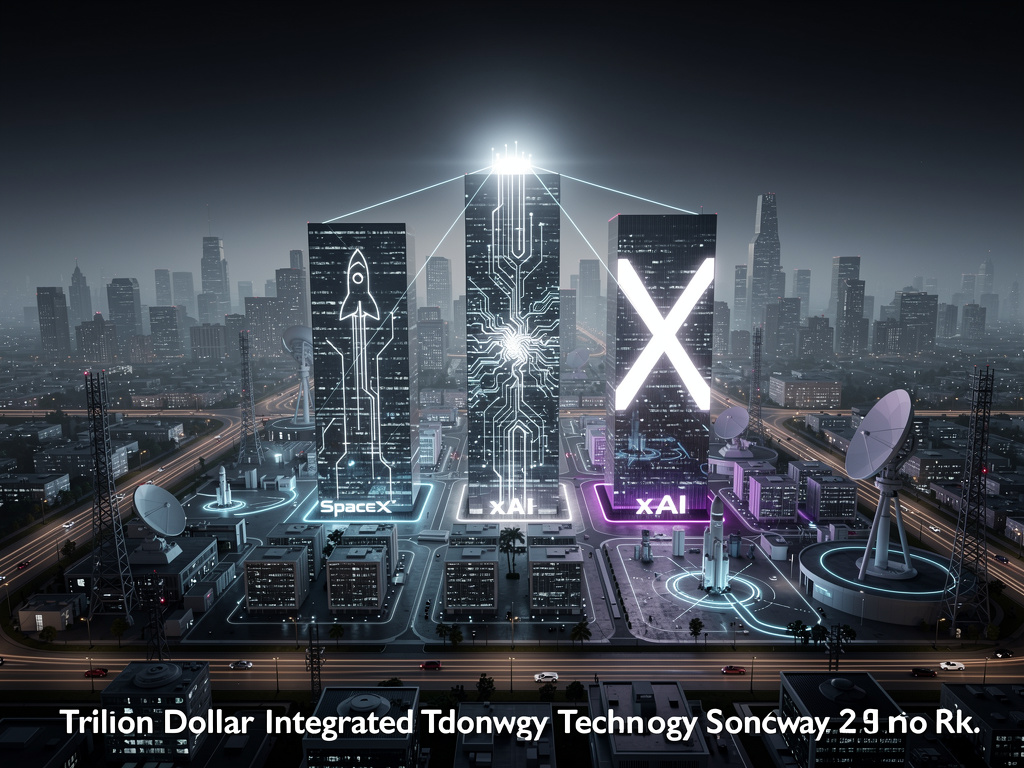
Elon Musk’s sprawling corporate empire may be on the verge of its most ambitious restructuring yet. In a series of cryptic social media posts and regulatory filings that have sent shockwaves through Silicon Valley and Wall Street alike, the billionaire entrepreneur appears to be laying groundwork for an unprecedented consolidation that would unite SpaceX, his artificial intelligence venture xAI, and the social media platform X into a single corporate behemoth. The implications of such a merger would reshape not only Musk’s business empire but potentially redefine the competitive dynamics of multiple industries simultaneously.
According to The Information, Musk responded affirmatively to speculation about merger plans in a post on X, though he provided few details about the structure or timeline of such a transaction. The confirmation, characteristically brief and enigmatic, has left investors, employees, and industry observers scrambling to understand the strategic rationale and practical mechanics of combining three companies with vastly different business models, regulatory requirements, and shareholder structures. For a corporate leader known for unconventional moves, this potential consolidation represents perhaps his boldest gambit yet.
The timing of these merger discussions coincides with significant developments across all three companies. SpaceX recently achieved record launch cadence and continues to dominate the commercial space industry with its Starlink satellite internet service approaching profitability. Meanwhile, xAI has emerged as a formidable competitor in the artificial intelligence race, with its Grok chatbot gaining traction among X’s user base. The social media platform itself, despite ongoing controversies and advertiser exodus, remains a critical communications infrastructure that Musk views as essential to his broader vision of creating what he calls “the everything app.”
The Strategic Calculus Behind Corporate Consolidation
Industry analysts suggest multiple strategic motivations could be driving Musk toward consolidation. First, combining these entities would create powerful synergies in data collection, artificial intelligence development, and global communications infrastructure. SpaceX’s Starlink constellation could provide the backbone for X’s global expansion while simultaneously feeding vast amounts of data into xAI’s training models. The social media platform, in turn, offers a ready-made distribution channel and user base for AI products, creating a vertically integrated technology stack that few competitors could match.
Financial considerations also loom large in any merger discussion. SpaceX’s private valuation reportedly exceeds $150 billion, making it one of the world’s most valuable private companies. However, the capital requirements for Musk’s ambitions—including Mars colonization, AI supremacy, and transforming X into a super-app—are staggering. A consolidated entity might find it easier to access capital markets, whether through debt financing, strategic investments, or an eventual public offering. The cross-pollination of revenue streams could also provide financial stability, with SpaceX’s profitable launch business potentially subsidizing xAI’s research-intensive operations and X’s ongoing restructuring.
Regulatory Hurdles and Antitrust Scrutiny
Any merger of this magnitude would face intense regulatory scrutiny across multiple jurisdictions. SpaceX operates under strict oversight from NASA, the Federal Aviation Administration, and the Federal Communications Commission, with national security implications that make foreign ownership restrictions particularly stringent. Adding AI capabilities and social media operations to this mix would likely trigger reviews from the Federal Trade Commission and potentially the Department of Justice, particularly given ongoing concerns about market concentration in both the technology and space sectors.
European regulators, already aggressive in policing American tech giants, would almost certainly subject such a merger to rigorous examination under both competition law and the Digital Markets Act. The combination of satellite internet infrastructure, AI capabilities, and social media reach could be viewed as creating dangerous concentrations of power over digital communications and information flows. China’s regulatory stance would add another layer of complexity, particularly given SpaceX’s sensitive national security work and the geopolitical tensions surrounding AI development and data sovereignty.
The Technical Integration Challenge
Beyond regulatory approval, the practical challenges of integrating three technologically sophisticated but operationally distinct companies would be formidable. SpaceX’s engineering culture, honed through years of iterative rocket development and manufacturing discipline, differs markedly from the fast-moving, experimental approach of xAI’s research teams. X’s content moderation challenges, advertising business complexities, and public-facing nature present entirely different operational demands than the B2B and government contracting focus of SpaceX or the research orientation of xAI.
Corporate culture integration represents another significant hurdle. SpaceX employees have traditionally enjoyed relative stability and clear mission focus, while X has undergone dramatic upheaval since Musk’s acquisition, with massive layoffs and rapid policy changes. xAI, as the newest venture, is still establishing its identity and competing for talent with deep-pocketed rivals like OpenAI, Google, and Anthropic. Merging these distinct cultures while maintaining the innovative edge that has characterized each company would require extraordinary leadership and change management capabilities.
Financial Engineering and Shareholder Complications
The financial structure of a potential merger presents labyrinthine complexity. SpaceX has multiple share classes and a diverse shareholder base including venture capital firms, strategic investors, and employees. X remains privately held following Musk’s $44 billion acquisition, with a consortium of co-investors including venture capital firms and foreign sovereign wealth funds. xAI has raised substantial funding but remains in earlier stages of corporate development. Determining exchange ratios, valuation methodologies, and governance structures that satisfy all stakeholders would require financial engineering on an unprecedented scale.
Existing investors in each entity face divergent incentives and risk profiles. SpaceX shareholders have invested in a capital-intensive aerospace company with long development timelines but potentially revolutionary technology. xAI investors bet on artificial intelligence’s transformative potential but face intense competition and uncertain regulatory futures. X’s investors, many of whom participated reluctantly or as favors to Musk, have watched their investments decline in value amid advertising boycotts and user base volatility. Reconciling these different expectations and investment theses within a single corporate structure would test even the most skilled negotiators.
Market Reactions and Competitive Implications
The potential merger has already begun reshaping competitive dynamics across multiple industries. Rival aerospace companies face the prospect of competing against an entity with integrated AI capabilities for autonomous operations and satellite data processing. AI competitors must contemplate a rival with access to SpaceX’s engineering talent, X’s real-time data streams, and Musk’s unparalleled ability to marshal resources and public attention. Social media platforms confront the possibility of X gaining technological advantages through AI integration and global connectivity via Starlink.
Investors and analysts remain divided on whether consolidation would create or destroy value. Bulls argue that Musk’s track record of defying conventional wisdom and achieving seemingly impossible goals justifies optimism about synergies and strategic vision. Bears contend that the complexity of managing such diverse operations, combined with Musk’s already-stretched attention across multiple ventures, creates execution risks that outweigh potential benefits. The debate reflects broader questions about conglomerate structures in the modern economy and whether focused specialization or diversified integration better serves innovation and shareholder returns.
The Vision of an Integrated Technology Ecosystem
Understanding Musk’s consolidation plans requires examining his long-articulated vision of creating interconnected technology platforms that reinforce each other. In this conception, Starlink provides global connectivity infrastructure, enabling X to reach users anywhere while generating massive data streams. xAI processes this data to create increasingly sophisticated artificial intelligence, which enhances user experiences on X and optimizes SpaceX operations. The social platform becomes a testing ground and distribution channel for AI capabilities, while space-based infrastructure provides strategic advantages in computing, communications, and data storage.
This integrated ecosystem approach mirrors strategies employed by Chinese technology giants like Tencent and Alibaba, which have built sprawling conglomerates spanning multiple sectors. However, the Western regulatory environment and corporate governance expectations differ markedly from China’s model, raising questions about whether such consolidation can succeed in the United States. Musk’s ability to navigate these differences while maintaining the innovative culture that has characterized his ventures will likely determine whether this ambitious consolidation creates lasting value or becomes a cautionary tale of overreach.
Long-Term Implications for Technology and Society
The potential merger raises profound questions about power concentration in critical technology infrastructure. A single entity controlling satellite internet access, major social media communications, and cutting-edge artificial intelligence would wield unprecedented influence over information flows, technological development, and digital infrastructure. Democratic societies have historically been wary of such concentrations, whether in media, telecommunications, or computing platforms, viewing them as threats to pluralism and competition.
Yet Musk’s defenders argue that only such scale and integration can compete effectively with Chinese technology champions and achieve civilization-scale ambitions like Mars colonization and artificial general intelligence development. They contend that traditional corporate structures and regulatory frameworks, designed for 20th-century industries, inadequately address 21st-century technological challenges requiring massive capital deployment, long time horizons, and tolerance for failure. This tension between concentration concerns and competitive necessity will likely define regulatory debates surrounding any merger proposal, with outcomes shaping technology industry structure for decades to come. Whether Musk’s consolidation vision represents the future of technology conglomerates or an overextension of even his considerable capabilities remains the trillion-dollar question facing investors, regulators, and society at large.


 WebProNews is an iEntry Publication