
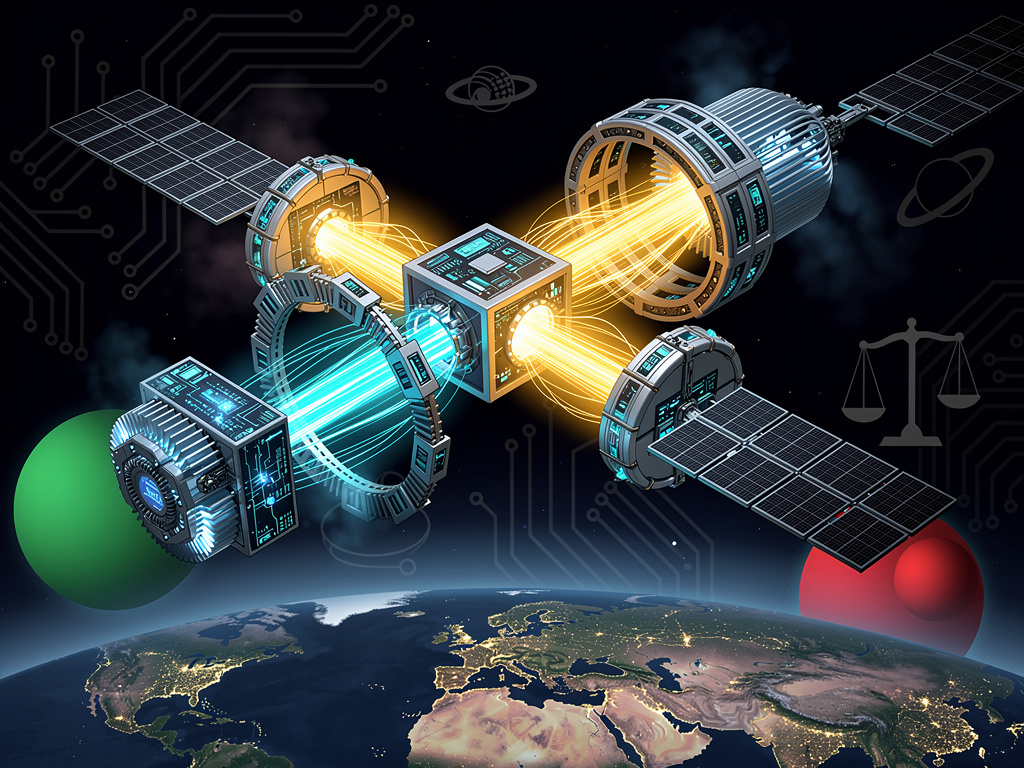
Elon Musk’s latest venture pushes the boundaries of technological ambition beyond terrestrial limits, as his artificial intelligence company xAI explores plans to construct a massive data center in orbit around Earth. The proposal, which would represent humanity’s first space-based AI supercomputing facility, signals a dramatic escalation in the competition among tech titans to secure computational advantages in the rapidly evolving artificial intelligence sector.
According to CNN Business, xAI has been conducting feasibility studies for an orbital data center that would leverage the unique advantages of space—unlimited solar power, natural cooling through radiation, and freedom from terrestrial energy grid constraints. The project, still in preliminary planning stages, would require unprecedented coordination between Musk’s SpaceX rocket company and xAI, potentially creating synergies that could fundamentally alter the economics of both space transportation and artificial intelligence development.
The timing of this revelation comes as the AI industry confronts mounting challenges related to energy consumption and computational capacity. Data centers currently account for approximately 2% of global electricity usage, a figure projected to surge as AI models grow exponentially more complex. Musk’s orbital solution proposes to sidestep earthbound energy limitations entirely, tapping into the constant, unfiltered solar radiation available beyond Earth’s atmosphere. Industry analysts estimate that space-based solar collection could theoretically provide 24/7 power at efficiencies impossible to achieve on the ground, where atmospheric interference, weather patterns, and the day-night cycle impose inherent constraints.
The Physics and Economics of Extraterrestrial Computing
The technical challenges of operating a data center in space are formidable but not insurmountable. Unlike terrestrial facilities that rely on air conditioning and water cooling systems consuming vast amounts of energy, an orbital data center could dissipate heat through thermal radiators directly into the vacuum of space. This passive cooling mechanism, already proven on the International Space Station and countless satellites, eliminates one of the largest operational expenses for ground-based facilities. However, the initial capital investment would dwarf conventional construction costs, with launch expenses alone potentially reaching billions of dollars.
SpaceX’s Starship rocket, currently in advanced testing phases, emerges as the critical enabling technology for this vision. With a payload capacity exceeding 100 metric tons to low Earth orbit, Starship could theoretically transport modular data center components in a series of launches. Musk has repeatedly stated his goal of reducing launch costs to under $10 million per flight through full reusability—a price point that could make orbital infrastructure economically viable for the first time in history. The convergence of reduced launch costs and increasing terrestrial energy prices creates a narrowing window where space-based computing might achieve cost parity with ground facilities.
Strategic Implications for the AI Arms Race
The orbital data center concept arrives amid intensifying competition in artificial intelligence development, where access to computational resources increasingly determines competitive advantage. xAI’s Grok chatbot competes against OpenAI’s ChatGPT, Anthropic’s Claude, and Google’s Gemini in a market where training cutting-edge models requires clusters of tens of thousands of specialized chips running continuously for months. An orbital facility could potentially operate outside the constraints of national power grids and energy regulations, providing xAI with flexibility unavailable to competitors.
Geopolitical considerations add another dimension to the orbital computing proposition. Data sovereignty concerns have led numerous countries to impose restrictions on where sensitive information can be processed and stored. A data center in international space, while legally complex, could theoretically operate under different jurisdictional frameworks than terrestrial facilities. This raises profound questions about data governance, national security, and the extension of terrestrial legal systems into orbit—issues that international space law, largely crafted during the Cold War, inadequately addresses.
Environmental Calculus and Sustainability Questions
Proponents of space-based computing emphasize potential environmental benefits. By relocating energy-intensive operations beyond Earth’s biosphere, the technology could reduce strain on terrestrial power grids and eliminate the carbon emissions associated with electricity generation for data centers. Solar panels in orbit capture energy that would otherwise never reach Earth’s surface, representing a net addition to humanity’s available power rather than a reallocation of existing resources.
Critics, however, question the environmental accounting of such proposals. Rocket launches themselves generate significant emissions and environmental impacts, though SpaceX’s methane-fueled Starship promises lower per-kilogram carbon intensity than previous launch vehicles. The production of hardware, the energy required for manufacturing, and the challenge of space debris all factor into the true environmental footprint. Moreover, the proliferation of large structures in low Earth orbit raises concerns among astronomers about light pollution and interference with ground-based observations—issues already contentious due to SpaceX’s Starlink satellite constellation.
Technical Architecture and Operational Realities
Engineering an orbital data center requires solving problems that terrestrial facilities never encounter. Cosmic radiation, which Earth’s atmosphere normally filters, can corrupt data and degrade electronic components over time. Space-qualified computing hardware must incorporate radiation hardening, error correction, and redundancy far exceeding commercial standards. The vacuum environment eliminates convective cooling but also prevents the use of conventional thermal management techniques, necessitating large radiator arrays to dissipate heat generated by thousands of processors.
Communication latency presents another significant challenge. While orbiting data centers could achieve impressive bandwidth through laser-based optical links, the physical distance introduces unavoidable delays. A facility in low Earth orbit, approximately 400 kilometers above the surface, would experience round-trip communication times of several milliseconds—acceptable for training large AI models but potentially problematic for real-time inference applications. This latency consideration might dictate that orbital facilities focus on computationally intensive training runs rather than serving end-user requests.
Regulatory Hurdles and International Frameworks
The legal framework governing commercial space activities remains underdeveloped relative to the pace of technological advancement. The Outer Space Treaty of 1967 establishes that space is the province of all mankind and prohibits national appropriation of celestial bodies, but its provisions inadequately address modern commercial activities. Who regulates a data center in orbit? Which nation’s laws apply to data processed there? How are disputes resolved when facilities operate beyond any single country’s jurisdiction?
The United States Federal Communications Commission licenses satellite communications, while the Federal Aviation Administration regulates launches, but no agency holds clear authority over orbital data processing facilities. International coordination through bodies like the United Nations Committee on the Peaceful Uses of Outer Space moves slowly, struggling to keep pace with private sector innovation. Musk’s proposal may force accelerated development of space governance frameworks, potentially setting precedents that shape commercial space activity for decades.
Market Dynamics and Competitive Response
If xAI proceeds with orbital data center development, competitors will face strategic decisions about whether to follow suit or double down on terrestrial infrastructure. Amazon Web Services, Microsoft Azure, and Google Cloud have invested tens of billions in conventional data centers worldwide, creating sunk costs that complicate pivots to space-based alternatives. However, these same companies possess resources and technical capabilities to pursue orbital projects if the economics prove favorable.
The semiconductor industry watches these developments closely, as space-based computing could drive demand for specialized processors optimized for the orbital environment. Traditional data center chips prioritize raw performance, but space applications require balancing computational power against radiation tolerance, power efficiency, and thermal characteristics. This could spawn a new market segment for space-qualified AI accelerators, potentially worth billions annually if orbital computing achieves commercial viability.
The Broader Vision of Space Industrialization
Musk has consistently articulated a vision of humanity becoming a multiplanetary species, with Mars colonization as the ultimate goal. An orbital AI data center fits within this broader narrative, serving as a stepping stone toward more ambitious space infrastructure. Developing expertise in operating complex industrial facilities in orbit builds capabilities applicable to lunar bases, asteroid mining, and eventually Martian settlements. The economic model for space industrialization requires identifying applications where space offers sufficient advantages to justify the costs—and AI computing may represent one of the first such opportunities.
The project also exemplifies the increasing convergence of Musk’s various enterprises. SpaceX provides launch services, Starlink offers communications infrastructure, Tesla’s battery technology could inform energy storage solutions, and xAI supplies the computational workload. This vertical integration potentially creates efficiencies unavailable to competitors pursuing any single element in isolation. Whether this synergy proves sufficient to overcome the enormous technical and financial challenges remains an open question that will likely take years to answer.
Investment and Financial Considerations
The capital requirements for an orbital data center would likely exceed $10 billion, potentially reaching $50 billion or more depending on scale and capabilities. xAI, valued at approximately $50 billion in its most recent funding round, would need additional investment to pursue such an ambitious project while continuing terrestrial AI development. Musk’s track record of securing funding for seemingly impossible projects—from reusable rockets to electric vehicle mass production—suggests he could attract the necessary capital if preliminary studies demonstrate feasibility.
The return on investment timeline for space infrastructure extends far beyond typical venture capital horizons. Terrestrial data centers typically achieve payback within five to seven years, but an orbital facility might require decades to recoup initial costs, even assuming successful deployment and operation. This temporal mismatch between capital requirements and returns demands patient investors willing to fund infrastructure with potentially transformative long-term implications but uncertain near-term profitability. Sovereign wealth funds, which operate on generational timescales, might prove more suitable capital sources than traditional venture investors.
Technical Milestones and Development Timeline
If xAI commits to the orbital data center concept, the development timeline would likely span a decade or more. Initial phases would focus on prototype systems, possibly beginning with small-scale demonstrations aboard existing satellites or the International Space Station. These proof-of-concept missions would validate thermal management systems, radiation hardening approaches, and operational procedures before committing to full-scale deployment. Parallel development tracks would address launch vehicle readiness, ground station infrastructure, and the specialized computing hardware required for the space environment.
The modular nature of the proposed facility suggests an incremental deployment strategy, with initial capacity measured in hundreds of processors expanding to thousands or tens of thousands as the system proves itself. This phased approach would allow course corrections based on operational experience and spread capital expenditures over multiple years. However, it also extends the period before the facility achieves sufficient scale to impact xAI’s competitive position in AI development, creating tension between the desire for rapid capability and the need for methodical, risk-managed expansion.
Musk’s orbital AI data center proposal represents either visionary infrastructure development or technological overreach, depending on one’s perspective. The concept addresses real constraints facing the AI industry while introducing novel challenges that may prove insurmountable. Whether this project advances beyond feasibility studies to actual hardware in orbit will depend on technical validation, economic analysis, regulatory developments, and Musk’s ability to marshal resources across his business empire. Regardless of outcome, the proposal has already succeeded in expanding the boundaries of what the technology industry considers possible, potentially inspiring alternative approaches to the fundamental challenge of providing sufficient computational resources for artificial intelligence’s continued advancement.


 WebProNews is an iEntry Publication