
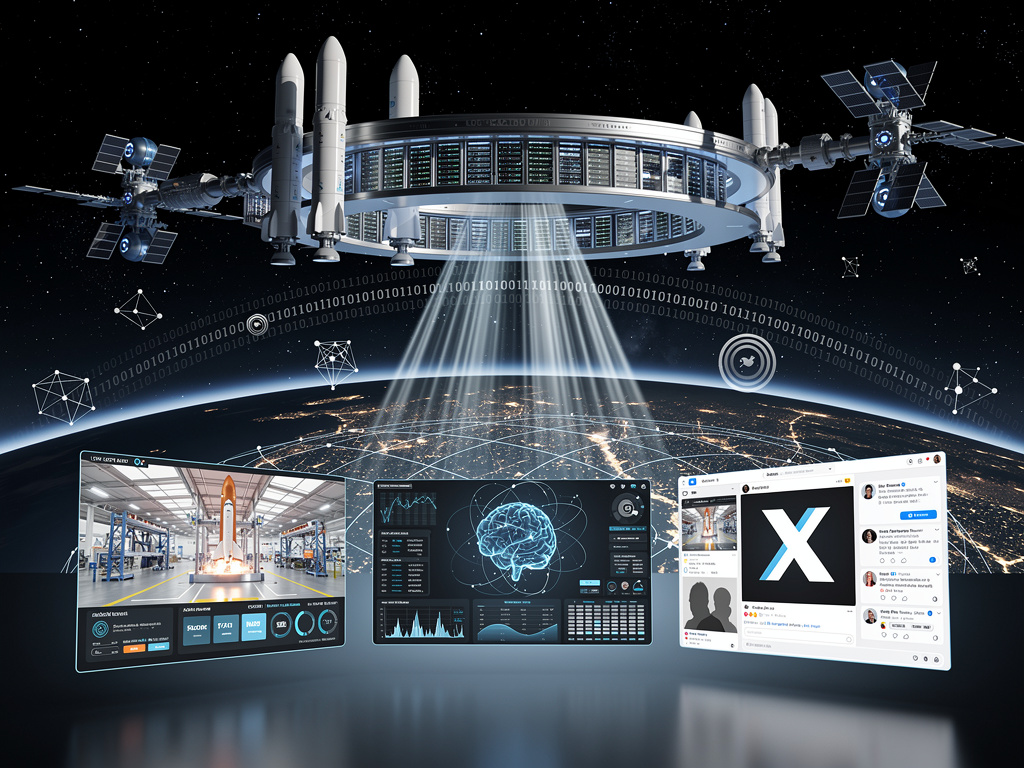
In a transaction that redefines the boundaries between terrestrial artificial intelligence and extraterrestrial infrastructure, Elon Musk has orchestrated the merger of SpaceX with his AI startup xAI, creating what he describes as “the most ambitious, vertically-integrated innovation engine on (and off) Earth.” The combined entity, valued at an eye-watering $1.25 trillion ahead of a planned initial public offering, represents the largest consolidation within Musk’s sprawling business empire and signals a fundamental shift in how computational power might be generated and deployed in the coming decades.
According to CNBC, public records filed with the state of Nevada indicate the deal was completed on February 2, with Space Exploration Technologies Corp. listed as the “managing member” of X.AI Holdings. The transaction brings together two companies that have been experiencing stratospheric valuations in private markets: SpaceX conducted a secondary share sale last year at an $800 billion valuation, while xAI was valued at approximately $230 billion in a $20 billion funding round that closed earlier this year.
The merger announcement, delivered through a blog post from Musk on Monday, outlined an ambitious vision that extends beyond conventional corporate consolidation. By combining rocket manufacturing capabilities, satellite internet infrastructure, artificial intelligence development, and social media operations under one corporate umbrella, Musk is positioning the merged entity to pioneer what he believes will become the dominant paradigm for AI computation: space-based data centers orbiting Earth.
The Strategic Architecture of Vertical Integration
The strategic rationale behind this merger extends far beyond simple economies of scale. SpaceX, founded by Musk in 2002, has evolved into the preeminent provider of orbital launch services through contracts with NASA and the Department of Defense. The company’s Starlink satellite internet service currently operates more than 9,000 satellites in orbit, serving approximately 9 million customers worldwide. This existing infrastructure provides the foundation for Musk’s vision of orbital computational facilities.
According to Reuters, SpaceX generated an estimated $8 billion in profit on $15 billion to $16 billion of revenue in 2024, demonstrating the financial strength of the rocket manufacturer. This profitability stands in stark contrast to xAI’s current financial position, as the younger company continues to burn through capital while racing to build the infrastructure necessary to compete with established players like OpenAI and Google.
The investor roster for xAI’s most recent funding round reads like a who’s who of technology and sovereign wealth investment, including Nvidia, Cisco Investments, Valor Equity Partners, Stepstone Group, Fidelity, Qatar Investment Authority, Abu Dhabi’s MGX, and Baron Capital Group. These sophisticated investors are betting not merely on the current state of AI development but on Musk’s ability to execute a vision that fundamentally reimagines where and how computational power is generated.
The Economics of Orbital Computing
Musk’s central thesis for the merger rests on a provocative economic argument: within two to three years, generating AI compute power in space will become more cost-efficient than terrestrial alternatives. “This cost-efficiency alone will enable innovative companies to forge ahead in training their AI models and processing data at unprecedented speeds and scales, accelerating breakthroughs in our understanding of physics and invention of technologies to benefit humanity,” Musk wrote in his announcement.
This assertion, while ambitious, is grounded in several potential advantages of space-based computing. Orbital data centers would benefit from the vacuum of space for cooling, eliminating the massive energy expenditures required to maintain optimal temperatures for high-performance computing equipment on Earth. Additionally, solar power collection in space operates with far greater efficiency than ground-based installations, as orbital solar panels face no atmospheric interference and can maintain near-constant exposure to sunlight.
SpaceX has already begun laying the groundwork for this vision by requesting authorization from the Federal Communications Commission to launch up to 1 million satellites as part of its “orbital data centers” initiative. This represents a staggering expansion beyond the current Starlink constellation and would require manufacturing and launch capabilities that only the merged entity could realistically achieve in the proposed timeframe.
Regulatory Complexities and National Security Implications
The merger arrives at a moment of heightened scrutiny regarding foreign investment in critical American technology infrastructure. As CNBC reported, executives at SpaceX and xAI did not respond to requests for comment on whether the merger may require regulatory review by the Committee on Foreign Investment in the United States (CFIUS), despite xAI’s recent funding round including substantial investments from Qatar Investment Authority and Abu Dhabi’s MGX.
The national security dimensions of this merger extend beyond foreign investment concerns. SpaceX already ranks among the most significant defense contractors in the United States, holding tens of billions of dollars worth of federal government contracts. The integration of xAI’s artificial intelligence capabilities into this defense infrastructure creates new questions about data security, algorithmic transparency, and the appropriate boundaries between commercial AI development and military applications.
In January, the Department of Defense initiated use of Grok, xAI’s flagship AI product, within the Pentagon. According to available reports, the DoD is allowing information flowing through its military intelligence databases to be analyzed using Grok alongside Google’s Gemini and other AI-based systems. This integration of commercial AI tools into the most sensitive corners of American military intelligence represents a significant departure from traditional procurement practices and raises questions about data sovereignty and algorithmic accountability that the merger will only intensify.
Tesla’s Strategic Investment and Cross-Pollination
Adding another layer of complexity to Musk’s corporate web, Tesla—the electric vehicle manufacturer that remains the primary source of Musk’s liquid wealth—announced last week that it was investing approximately $2 billion into xAI. This investment creates intricate cross-holdings among Musk’s various enterprises and raises questions about potential conflicts of interest and resource allocation that public market investors will need to evaluate carefully ahead of the planned IPO.
The Tesla investment also suggests potential technological synergies that extend beyond the immediate SpaceX-xAI merger. Tesla’s autonomous driving development relies heavily on AI training and inference, areas where xAI’s computational infrastructure could provide significant advantages. Similarly, SpaceX’s satellite internet service could benefit from AI-optimized routing and resource allocation, while Tesla’s global fleet of vehicles could serve as distributed data collection nodes for training AI models.
Early last year, Musk expanded xAI by merging it with his social network X, formerly known as Twitter. This earlier consolidation brought the social media platform’s vast troves of user-generated text data under the same corporate umbrella as xAI’s model training operations, providing a proprietary dataset for AI development. The addition of SpaceX’s satellite communications data and operational telemetry to this information ecosystem creates an unprecedented concentration of diverse, high-value data streams under unified control.
The OpenAI Shadow and Competitive Dynamics
Musk launched xAI in 2023 as a direct response to OpenAI, the company he co-founded in 2015 as a nonprofit AI research laboratory before departing in 2018. The relationship between Musk and OpenAI CEO Sam Altman has deteriorated into a heated legal battle, with Musk arguing that OpenAI has strayed from its original nonprofit mission by partnering closely with Microsoft and pursuing commercial objectives.
This personal and professional rivalry provides crucial context for understanding the urgency behind the SpaceX-xAI merger. OpenAI, backed by Microsoft’s vast resources and computational infrastructure, has maintained a significant lead in the race to develop the most capable and widely adopted large language models. Google, with its own substantial computing resources and AI expertise, represents another formidable competitor. For xAI to close this gap, it requires not just capital but also differentiated infrastructure that could provide competitive advantages unavailable to rivals.
The space-based computing thesis offers precisely such differentiation. Neither OpenAI nor Google currently possesses orbital launch capabilities or satellite constellation infrastructure. By leveraging SpaceX’s unique assets, xAI gains access to computational possibilities that competitors cannot easily replicate, potentially leapfrogging current technological limitations through architectural innovation rather than incremental improvement.
Community Concerns and Environmental Considerations
The merger brings together not only technological assets but also accumulated community controversies. As CNBC noted, xAI has faced significant backlash in and around Memphis, Tennessee, where it has been building out infrastructure, starting with its Colossus facility. The NAACP and environmental groups in Memphis have attempted to halt xAI’s use of gas-burning turbines to power the supercomputer facility, while residents have complained about emissions contributing to existing air pollution problems.
In nearby Southaven, Mississippi, where xAI is constructing additional data infrastructure, the community has protested noise levels from the company’s equipment. These local conflicts highlight the terrestrial environmental costs of AI development—costs that Musk’s space-based computing vision ostensibly aims to eliminate by moving computational infrastructure beyond Earth’s atmosphere. However, critics might reasonably question whether the environmental impact of launching hundreds of thousands or millions of satellites outweighs the benefits of reduced ground-based energy consumption.
Beyond environmental concerns, xAI faces regulatory probes in multiple international jurisdictions following incidents where its Grok AI tools enabled users to generate and share sexualized images of children and non-consensual intimate images of adults, predominantly women. These content moderation failures demonstrate the challenges of deploying powerful AI systems at scale and raise questions about whether the merged entity will possess adequate governance structures to prevent similar incidents as it expands its capabilities and user base.
The IPO Calculus and Market Implications
The planned initial public offering at a $1.25 trillion valuation, as reported by Bloomberg, would rank among the largest market debuts in history. This valuation implies that public market investors will need to embrace Musk’s long-term vision of space-based computing infrastructure, as current financial performance alone cannot justify such a price tag. SpaceX’s profitability provides a foundation, but the valuation premium clearly derives from expected synergies and the potential of orbital data centers.
For prospective shareholders, the investment thesis combines several distinct elements: the established and profitable orbital launch business, the growing Starlink satellite internet service, the speculative but potentially transformative space-based computing vision, and the high-risk, high-reward AI development operations. This combination offers diversification within a single equity security but also creates complexity in valuation and risk assessment.
The involvement of sophisticated institutional investors in xAI’s recent funding rounds suggests that serious capital allocators find merit in Musk’s vision, despite its ambitious timeline and technical challenges. Nvidia’s participation is particularly noteworthy, as the chip manufacturer possesses deep expertise in AI computing requirements and would presumably conduct thorough due diligence before committing capital to a venture dependent on novel computing architectures.
Technical Feasibility and Engineering Challenges
While Musk’s vision of cost-effective orbital computing carries theoretical appeal, the engineering challenges involved in realizing this vision are formidable. Space-based data centers must contend with radiation hardening requirements, the difficulty of repairs and upgrades in orbit, thermal management in vacuum environments, and the fundamental challenge of data transmission latency between Earth and orbital facilities.
Current AI training workloads require extremely high bandwidth, low-latency connections between computing nodes—requirements that become significantly more challenging when those nodes orbit Earth at thousands of kilometers per hour. While inference workloads might prove more amenable to space-based deployment, the most computationally intensive aspects of AI development may remain bound to terrestrial facilities for the foreseeable future, potentially limiting the near-term impact of orbital computing infrastructure.
However, SpaceX’s track record of achieving engineering objectives that skeptics deemed impossible—reusable orbital rockets, private crewed spaceflight, and a profitable satellite internet constellation—suggests that dismissing Musk’s space computing vision would be premature. The company has demonstrated an institutional capability for iterative development and rapid problem-solving that could prove applicable to the novel challenges of orbital data centers.
Geopolitical Dimensions and Space Governance
The merger arrives amid intensifying geopolitical competition in both artificial intelligence and space infrastructure. China has announced ambitious plans for its own satellite constellations and has made AI development a national priority. The concentration of American capabilities in AI and orbital infrastructure within a single corporate entity controlled by Musk creates both opportunities and vulnerabilities from a national security perspective.
On one hand, the merged company could serve as a powerful instrument of American technological leadership, combining capabilities that no foreign competitor can currently match. On the other hand, the concentration of such critical infrastructure under the control of a single individual raises questions about resilience, redundancy, and the appropriate relationship between private enterprise and national strategic interests.
International space governance frameworks, primarily embodied in the Outer Space Treaty of 1967, were drafted in an era when only nation-states possessed space capabilities. The emergence of private entities deploying infrastructure at the scale contemplated by the SpaceX-xAI merger challenges these frameworks and raises questions about jurisdiction, liability, and the appropriate allocation of orbital resources that international bodies have yet to adequately address.
The Broader Technology Industry Response
Competitors in both the AI and space sectors are closely monitoring the merger’s implications for their own strategic positioning. Amazon’s Project Kuiper satellite internet initiative and Blue Origin space venture represent the most direct competitive response from another technology billionaire, though Jeff Bezos has not articulated a vision for space-based AI computing comparable to Musk’s.
Traditional aerospace contractors, already displaced by SpaceX in the launch services market, face the prospect of further marginalization as the merged entity leverages vertical integration to reduce costs and accelerate development timelines. Similarly, cloud computing providers like Amazon Web Services, Microsoft Azure, and Google Cloud must contemplate whether space-based computing represents a genuine competitive threat or a speculative distraction from terrestrial infrastructure development.
The merger may also catalyze increased investment in space infrastructure by other technology companies seeking to avoid strategic disadvantage. If Musk’s thesis about the cost-efficiency of orbital computing proves correct, companies that fail to develop space-based capabilities could find themselves at a permanent competitive disadvantage in AI development and deployment.
Implications for AI Development Trajectories
Beyond the immediate corporate and financial implications, the SpaceX-xAI merger could influence the broader trajectory of artificial intelligence development. The availability of novel computing architectures and potentially lower-cost computational resources could enable research directions that current economic constraints render impractical. Larger model sizes, more extensive training datasets, and more computationally intensive inference approaches might become feasible if orbital computing delivers on its cost-efficiency promise.
The merger also raises questions about AI governance and safety research. As computational capabilities expand and concentrate within a single corporate entity, the mechanisms for ensuring that AI development proceeds safely and in alignment with human values become increasingly critical. Musk has previously expressed concerns about AI safety and has advocated for regulatory oversight of AI development, creating an interesting tension with his simultaneous push to rapidly expand AI capabilities through the merged entity.
The integration of X’s social media platform into the merged entity creates unique opportunities for real-time AI training and deployment at scale. The platform’s global user base generates continuous streams of text, image, and video data that can inform model development, while also providing a distribution channel for AI-powered features and services. This closed-loop system of data collection, model training, and deployment could accelerate AI development cycles in ways that competitors relying on more fragmented data sources cannot easily replicate.
Financial Engineering and Capital Structure
The mechanics of the merger and the planned IPO involve sophisticated financial engineering that will significantly impact the merged entity’s capital structure and governance. The decision to pursue a public offering rather than maintaining private ownership suggests that the capital requirements for building out space-based computing infrastructure exceed what private markets can efficiently provide, even given the substantial valuations achieved in recent funding rounds.
Public market investors will demand transparency and governance structures that may constrain Musk’s historical preference for rapid decision-making and unconventional strategic pivots. The tension between the requirements of public company governance and Musk’s entrepreneurial approach will likely emerge as a central theme in the post-IPO period, potentially influencing everything from capital allocation decisions to communications strategy.
The cross-holdings between Tesla, SpaceX, and xAI create complex valuation interdependencies that sophisticated investors will need to untangle. Tesla’s $2 billion investment in xAI, now part of the merged SpaceX entity, creates circular ownership structures that could complicate financial reporting and raise questions about related-party transactions. These structural complexities may require innovative approaches to corporate governance and financial disclosure to maintain investor confidence.
Workforce Integration and Organizational Culture
Beyond financial and technological considerations, the merger faces significant organizational challenges in integrating workforces with distinct cultures and operational approaches. SpaceX has developed over two decades a culture focused on aerospace engineering, manufacturing excellence, and the incremental achievement of ambitious technical objectives. xAI, by contrast, emerged from the fast-moving AI research community, where rapid experimentation and algorithmic innovation take precedence over hardware reliability and safety-critical systems engineering.
The successful integration of these organizational cultures will prove critical to realizing the merger’s strategic objectives. Space-based computing requires both the hardware reliability and systems engineering discipline of aerospace development and the algorithmic innovation and rapid iteration characteristic of AI research. Creating an organizational structure that preserves the strengths of both cultures while fostering productive collaboration represents a management challenge as significant as the technical obstacles to orbital data centers.
Talent retention and recruitment will also play crucial roles in the merged entity’s success. The AI research community remains highly competitive, with leading researchers commanding premium compensation and enjoying significant latitude in choosing employers. SpaceX’s location in Southern California and xAI’s facilities in Memphis and Mississippi may prove less attractive to AI talent than traditional technology hubs, potentially requiring the merged entity to develop distributed work arrangements or establish new research facilities in locations with deeper AI talent pools.
The Path Forward for Innovation
As the merged entity moves toward its public market debut, the fundamental question facing investors, regulators, and the broader technology community centers on whether Musk’s vision of vertically integrated innovation spanning AI, space infrastructure, and communications represents a genuine breakthrough in organizational architecture or an unwieldy conglomerate that will struggle to execute across too many domains simultaneously.
Historical precedents offer mixed guidance. Vertical integration has produced significant advantages in industries where control of the full value chain enables cost reduction and quality improvement—precisely the arguments Musk advances for the merger. However, conglomerates combining disparate businesses have often underperformed more focused competitors, as management attention becomes divided and capital allocation grows politicized rather than optimized.
The unprecedented nature of the SpaceX-xAI combination—bringing together rocket manufacturing, satellite operations, AI development, and social media under unified control—means that historical analogies provide limited predictive value. The merger represents a genuine experiment in corporate organization and technological development whose outcomes will unfold over years and potentially decades. For shareholders willing to embrace this uncertainty and the attendant risks, the potential rewards include participation in infrastructure that could fundamentally reshape how humanity generates and deploys computational power. For those seeking more predictable returns and clearer paths to profitability, the merged entity’s $1.25 trillion valuation and speculative strategic vision may prove difficult to justify.
What remains clear is that Musk has once again demonstrated a willingness to pursue objectives that conventional wisdom deems impractical or impossible. Whether orbital data centers become the dominant paradigm for AI computing within the timeline he projects, or whether terrestrial infrastructure continues to prove more economically viable, the merger itself represents a significant bet on a future where the boundaries between Earth-based and space-based economic activity grow increasingly permeable. The coming years will reveal whether this vision represents prescient anticipation of inevitable technological evolution or ambitious overreach that underestimates the enduring advantages of keeping computational infrastructure firmly grounded on Earth.


 WebProNews is an iEntry Publication