
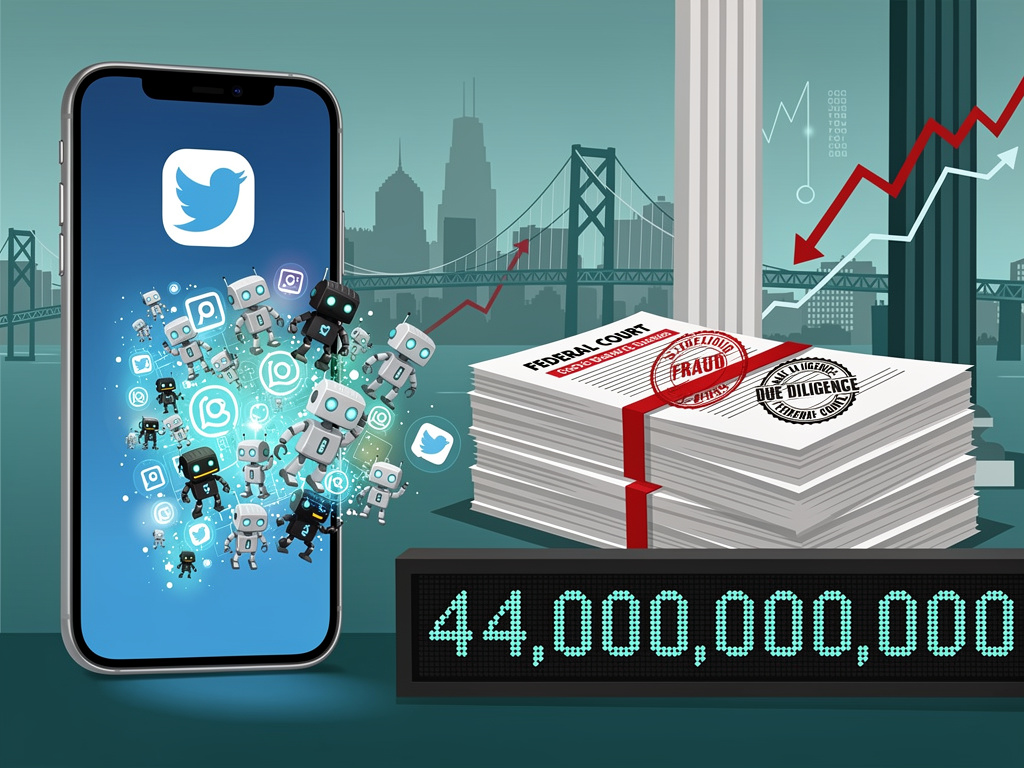
Elon Musk returned to a San Francisco federal courtroom this week, revisiting the contentious $44 billion acquisition of Twitter in a legal spectacle that seeks to rewrite the narrative of one of the most chaotic takeovers in corporate history. Testifying under oath, the billionaire owner of X Corp. doubled down on allegations that the social media platform’s former leadership engaged in systemic fraud regarding the prevalence of automated bot accounts. The testimony serves as the latest flashpoint in a sprawling legal war that has continued long after the deal closed in October 2022.
The proceedings, centered on shareholder claims and countersuits, offered a rare window into the internal deliberations that preceded the buyout. Musk, dressed in a dark suit and appearing visibly frustrated at times, told the jury that the company’s regulatory filings prior to the acquisition contained material misrepresentations. According to a report by MSN, Musk explicitly stated that the company "lied" about the number of monetizable daily active users (mDAU), a key metric for advertisers and investors. He argued that the actual number of human users was significantly lower than the figures presented to the Securities and Exchange Commission, artificially inflating the company’s valuation.
The Arithmetic of Authenticity
At the heart of the dispute lies the methodology used to calculate spam accounts. For years, Twitter’s legacy management claimed that spam and fake accounts represented less than 5% of its user base. Musk’s legal team has long contended that this figure was a statistical impossibility, derived from a sampling method designed to obfuscate the truth rather than reveal it. During his testimony, Musk referenced independent data analysis commissioned during the due diligence phase—a phase he famously waived in his initial rush to secure the deal—which suggested the bot prevalence could be multiples higher than disclosed.
The implications of these claims extend beyond historical grievances. If Musk can prove that Twitter’s former executives, including former CEO Parag Agrawal, knowingly falsified documents, it could influence pending severance lawsuits and shareholder class actions. However, legal observers note the difficulty of proving fraud when the buyer explicitly bypassed standard pre-merger verification processes. As noted in coverage by The Wall Street Journal, the courts have historically held sophisticated buyers to the terms of their contracts, particularly when they voluntarily forgo protective clauses to accelerate a transaction.
Valuation Shifts and Investor Fallout
The courtroom drama unfolds against a backdrop of severely diminished valuations for the platform now known as X. Fidelity, one of the outside investors that backed Musk’s takeover, has repeatedly marked down the value of its holding. Recent filings suggest the asset manager views its stake as worth nearly 70% less than the purchase price. This financial deterioration adds weight to Musk’s courtroom arguments: he is attempting to demonstrate that the asset he purchased was fundamentally broken upon arrival, rather than broken by his subsequent restructuring.
Musk’s testimony also touched on the operational reality he discovered upon taking control. He described a company where engineering resources were misallocated and where the infrastructure for detecting automated scripts was essentially nonexistent. This narrative supports his defense in related securities litigation, where plaintiffs argue that Musk’s erratic behavior and disparaging tweets during the closing period depressed the stock price, harming investors who sold before the deal was finalized. By framing the acquisition as a rescue mission based on faulty intelligence, Musk attempts to shift liability back to the sellers.
The Legal threshold for Material Adverse Effects
To prevail in his broader legal strategy, Musk must navigate the high bar set by Delaware and federal courts regarding "Material Adverse Effects" (MAE). Historically, courts are reluctant to let buyers walk away from or renegotiate deals based on information that could have been discovered earlier. The crux of Musk’s argument in San Francisco is that the information was not merely hidden, but actively fabricated. This distinction is vital. If the user metrics were simply a matter of differing estimation methodologies, Musk loses. If they were the result of intentional data manipulation, the legal ground shifts.
During cross-examination, opposing counsel pressed Musk on his public statements from early 2022, where he vowed to "defeat the spam bots or die trying." The plaintiffs argue this proves Musk was fully aware of the bot issue before signing the merger agreement. They contend that his later attempts to terminate the deal were driven by a downturn in the general equities market and the declining value of Tesla stock, which he used to finance the purchase, rather than any new revelation about user counts. A recent analysis by Reuters highlights that text messages revealed during discovery show Musk discussing the financial strain of the deal with his bankers, lending credence to the theory that his fraud accusations were a pretext for renegotiation.
Severance Battles and Executive Compensation
Parallel to the shareholder suits, Musk is fighting a multi-million dollar battle against the very executives he accuses of lying. Agrawal, former CFO Ned Segal, and former policy chief Vijaya Gadde are suing for unpaid severance, amounting to over $128 million. Musk’s testimony in the federal securities case serves as a foundational pillar for his defense in these employment disputes. He argues that they were terminated "for cause" due to the alleged fraud, thereby nullifying their golden parachute clauses.
This aggressive legal maneuvering is characteristic of Musk’s approach to corporate governance. Rather than settling, he often chooses to litigate, using the discovery process to unearth internal communications that might embarrass opponents or provide leverage in other areas. However, this strategy carries risks. The current trial has exposed chaotic decision-making processes within Musk’s inner circle, potentially alienating remaining advertisers who crave stability. According to Bloomberg, ad revenue for X has plummeted by nearly 50% since the acquisition, a decline exacerbated by the very public and litigious nature of the transition.
The Burden of Proof in Federal Court
The specific case in San Francisco requires the jury to determine if Musk’s statements regarding the deal violated federal securities laws. The plaintiffs, a class of Twitter shareholders, allege that Musk manipulated the stock price downward to create leverage for a lower buyout price. Musk’s defense—that he was genuinely concerned about fraud—requires the jury to believe his intent was investigative rather than manipulative. Legal experts suggest that while Musk’s testimony was impassioned, the documentary evidence of the binding merger agreement remains a formidable obstacle.
Furthermore, the judge has limited the scope of evidence regarding the actual number of bots, ruling that the trial is about Musk’s disclosures and intent, not a relitigation of the merger trial that never happened in Delaware. Nevertheless, Musk managed to weave the "bot narrative" into his answers repeatedly, a tactic likely designed to sway the jury’s perception of the fairness of the entire transaction. The MSN report highlights Musk’s insistence that he was the victim of a "bait and switch," a phrase that resonates with the broader public even if it struggles to find purchase in strict contract law.
Implications for Future M&A Activity
The outcome of this litigation will likely reverberate through the mergers and acquisitions sector. If Musk succeeds in convincing a jury that his erratic behavior was a justified response to corporate stonewalling, it could embolden future activist investors to use hostile public communications as a negotiation tactic. Conversely, a verdict against him would reinforce the sanctity of signed merger agreements and the principle of "buyer beware." Corporate boards are already tightening due diligence requirements and updating disclosure language to protect against similar post-closing assaults on valuation metrics.
The trial also raises questions about the definition of "active users" in the social media industry. There is no standardized audit for mDAU, allowing platforms significant latitude in how they define engagement. Musk’s challenge, while self-serving, exposes the opacity of the digital advertising economy. Advertisers have long suspected that platform metrics are inflated, and the public airing of Twitter’s internal data disputes confirms those suspicions. Regardless of the verdict, the industry may see a push for third-party auditing of user bases as a standard requirement for future tech acquisitions.
The Long Shadow of the Deal
As the trial proceeds, the contrast between the courtroom arguments and the reality of X Corp. becomes stark. While Musk argues about the state of Twitter in 2022, the company in 2025 is a fundamentally different entity, stripped of most of its pre-acquisition staff and pivoting toward video and payments. The litigation serves as a costly rearview mirror, fixated on a version of the internet that no longer exists. Yet for Musk, the fight appears to be as much about vindication as it is about money. He has staked his reputation on the claim that he was misled, and he is utilizing the federal court system to seek a judicial stamp of approval on that version of history.
The proceedings are expected to continue with testimony from financial advisors and former board members. Each witness will be asked to reconstruct the frenetic weeks of April and May 2022, dissecting emails and text messages to determine whether the richest man in the world was a victim of corporate fraud or simply a buyer who got cold feet. The verdict will ultimately decide whether the $44 billion price tag was a valid contract or, as Musk insists, the proceeds of a lie.


 WebProNews is an iEntry Publication