
Elon Musk didn’t hold back. “Unfortunately, electric rockets are impossible,” he posted on X shortly after reports surfaced that MSCI had assigned SpaceX its lowest possible ESG score. The rating, a CCC, placed the rocket company on par with the Kremlin in the days after Russia’s 2022 invasion of Ukraine. Shares in the newly public SpaceX slipped as much as 5.7 percent in response. But the pullback proved short-lived. Enthusiasm for the company’s launch cadence and Starlink growth soon pushed valuations back above the IPO price.
The episode echoes a familiar script. Four years earlier Musk lashed out when S&P Global removed Tesla from its ESG index. “ESG is a scam,” he declared then. “It has been weaponized by phony social justice warriors.” Now the same critique lands on his space venture. And this time the stakes sit higher. SpaceX debuted as one of the most anticipated listings in years, with a valuation north of $200 billion at points. Institutional buyers piled in despite red flags.
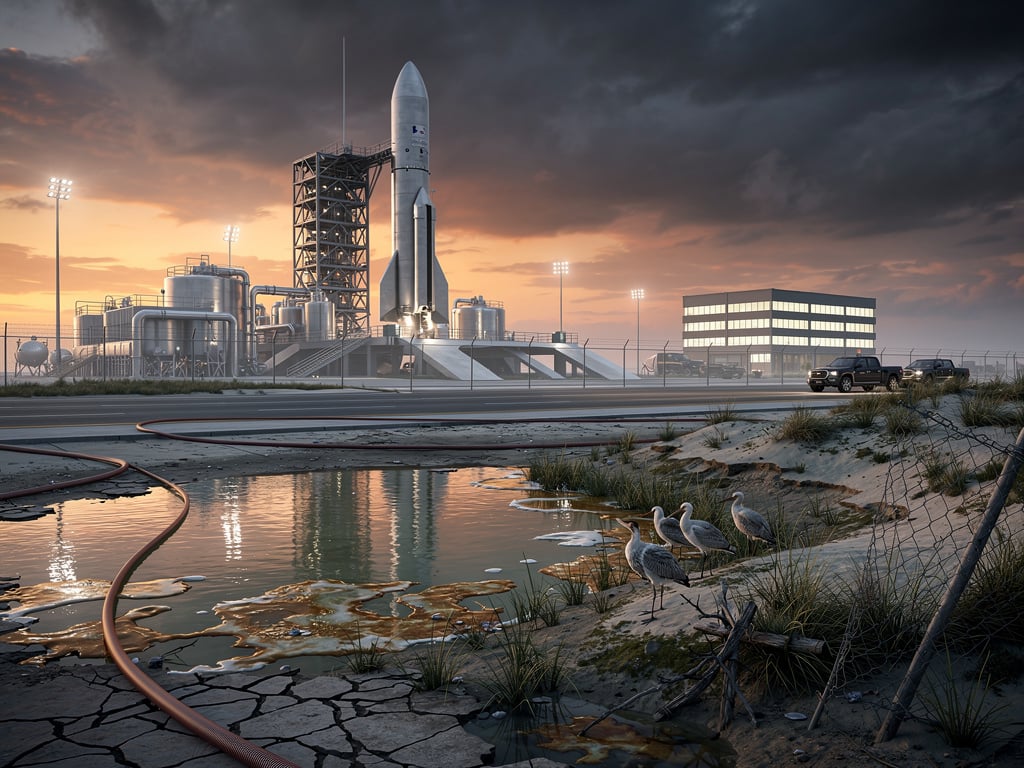
Yet the MSCI assessment pulled no punches. It flagged weak performance across environmental, social and governance categories. Environmental marks suffered from rocket fuel emissions that reach the stratosphere, repeated wastewater discharges at the Starbase facility in Boca Chica, Texas, and debris that scars protected wetlands. The company earned just 1 out of 10 on a controversy metric, dragged down by Musk’s public statements and the firm’s regulatory clashes. Governance scored 3.2 out of 10. Musk controls roughly 85 percent of voting power through a dual-class share structure that leaves public investors with little sway.
Frédéric Ducoulombier, a professor at Edhec business school, called the setup close to a governance horror story for public-market investors. His assessment, reported by Futurism, captured the tension many fund managers feel. They want exposure to the upside of reusable rockets and global internet service. They worry about accountability when one executive can steer decisions with minimal pushback.
Those governance worries surfaced weeks before the June 12 debut. Morningstar’s Lindsey Stewart told ESG Dive that institutional investors flagged the dual-class scheme and board composition. Roughly half the shares carry super-voting rights reserved for Musk and a handful of allies. Texas domicile, shared with Tesla, adds another layer. The state makes it harder for shareholders to file resolutions or pursue certain lawsuits. A mandatory arbitration clause in the charter further limits courtroom recourse. “Investors have concerns over whether that means they might be disadvantaged in some way,” Stewart said.
But the environmental file runs thicker. Starbase sits in a sensitive coastal wetland. It hosts migratory birds and serves as nesting ground for sea turtles. Rocket launches and static-fire tests rattle homes miles away. They scatter concrete dust and drop metallic debris across refuge lands. In 2024 the Environmental Protection Agency and Texas Commission on Environmental Quality cited SpaceX for multiple unauthorized discharges of industrial wastewater. One episode involved 36,000 gallons of liquid oxygen mixed with other contaminants that reached adjacent wetlands. The EPA levied a $148,378 penalty. The firm paid without admitting liability.
Activists keep pressing. Bekah Hinojosa, co-founder of the South Texas Environmental Justice Network, described Starbase as a sacrifice zone for Black and brown communities. She pointed to cracked walls in local houses, restricted beach access and fears that larger operations after the IPO will worsen pollution. Protests greeted investor meetings in April. Lawsuits from environmental groups have challenged Federal Aviation Administration approvals, arguing the agency relied on inadequate reviews. A 2023 Starship explosion sent a cloud of pulverized concrete over nearby towns and ignited ground fires. SpaceX later installed a water deluge system, but critics question its own permitting.
Musk frames the trade-offs differently. He argues that reaching Mars will ultimately safeguard Earth’s species by creating a backup for humanity. The long-term vision, he has said, protects life rather than endangers it. Starship burns methane, which produces water vapor and carbon dioxide instead of more toxic soot from older fuels. Satellites help monitor climate change from orbit. Yet those arguments have not swayed ratings agencies or regulators on the ground. MSCI’s score reflects the immediate footprint. Stratospheric emissions from frequent launches remain poorly understood. Noise and vibration stress wildlife. Unpermitted discharges violate clean-water rules even if penalties stay modest relative to company scale.
The rating arrives at an awkward moment. SpaceX filed detailed financials in May showing rising revenue but persistent losses. The IPO process itself drew scrutiny over transparency and the intertwined valuations with Musk’s xAI venture. Some index providers fast-tracked inclusion despite governance gaps, leaving passive funds with little choice but to own the stock. That reality frustrates governance purists. They see misaligned incentives when economic ownership diverges so sharply from control.
And yet demand proved overwhelming. Retail and institutional buyers chased the narrative of American space dominance. Starship tests continue at a brisk pace. Starlink adds subscribers in remote markets. The company books NASA contracts worth billions. These operational wins overshadow paper ESG grades for many allocators. Short-term stock moves after the MSCI news stayed contained. Longer-term questions linger about how regulators and communities will respond to an even more ambitious launch cadence.
Public-market investors now own a slice of an enterprise that blends genuine technological leaps with documented environmental costs and concentrated power. Musk’s dismissal of the rating changes little on the ground. Regulators still inspect wastewater outfalls. Wildlife biologists track nesting success near the pad. Shareholder advocates push for sunset clauses on super-voting shares. The CCC score simply puts numbers to tensions that have simmered for years.
SpaceX has improved some practices. It upgraded its launch pad to recapture water and limit dust. It works with federal agencies on mitigation plans for turtles and birds. Yet the pattern of citations and lawsuits suggests those steps trail the pace of expansion. As launch frequency climbs toward dozens per year from Boca Chica alone, pressure will only grow. The same holds for governance. Musk shows no sign of diluting control. Boards stacked with allies from his other companies offer limited independent oversight.
The Musk effect cuts both ways. It draws capital and talent that accelerate progress. It also invites skepticism from those who view ESG frameworks as legitimate risk signals rather than ideological tools. Previous battles over Tesla’s factory conditions, autopilot safety and workplace culture set the template. SpaceX now follows the same arc, but with added complexity from orbital debris, atmospheric chemistry and coastal ecology.
So the market has spoken for now. Valuations hold firm. Launch schedules remain aggressive. But the CCC rating, the lawsuits and the activist protests won’t vanish. They form a backdrop that future earnings calls and regulatory filings will have to address. Musk may scoff at the scoring system. Plenty of his shareholders focus instead on payload mass to orbit and subscriber growth. The gap between those priorities and the concerns captured in the MSCI assessment defines the challenge ahead. Success in space has always required managing risk on the ground. For the newly public SpaceX that balancing act just became more visible to millions of investors.


 WebProNews is an iEntry Publication