
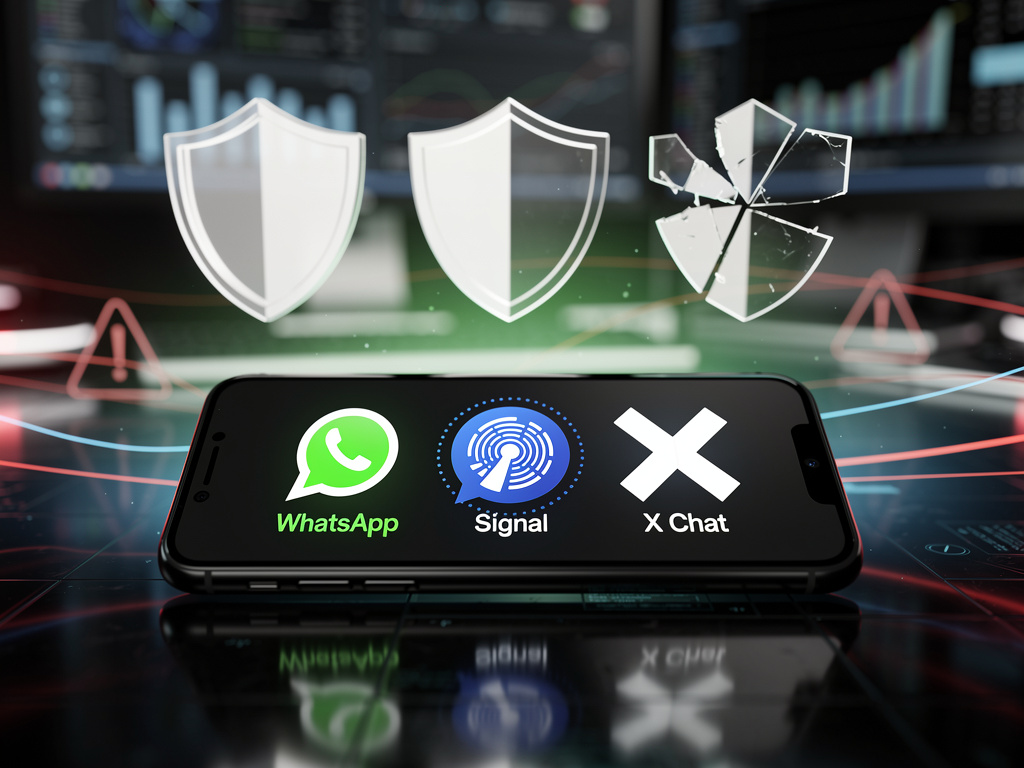
In a move that sent tremors through the encrypted messaging world, Elon Musk, the billionaire proprietor of the social media platform X, launched a broadside against the security of his chief rivals, WhatsApp and Signal. The attack, delivered to his more than 180 million followers, was a calculated gambit to sow doubt about the industry’s most trusted privacy tools and funnel users toward his own platform’s nascent messaging feature, X Chat.
The controversy ignited when Mr. Musk amplified a post on X detailing a purported security flaw in WhatsApp, Meta Platform Inc.’s messaging behemoth. He added his own stark warning: “WhatsApp is not secure.” He then went a step further, taking aim at the industry’s most revered privacy application. “Even Signal is questionable,” he wrote, before delivering the final pitch: “Use X Chat.” The assertion was quickly picked up by global news outlets, including Turkey’s Anadolu Ajansı, amplifying a debate that pits Mr. Musk’s market ambitions against the established reputations of the world’s most popular communication apps.
The incident Mr. Musk referenced involved a security researcher’s discovery that Meta could, under certain conditions, see a link preview’s server-side metadata, a flaw that cybersecurity experts say was significant but has since been addressed. Will Cathcart, the head of WhatsApp, immediately pushed back on X, calling the characterization of the vulnerability “false” and stating, “The security and privacy of our users is our number one priority, which is why we will continue to use end-to-end encryption to protect their personal messages.” The public back-and-forth highlights a growing tension in the tech world, where security has become both a critical feature and a potent marketing weapon.
A Battle of Protocols and Public Perception
While the criticism of WhatsApp tapped into long-standing skepticism surrounding its parent company, Meta, the swipe at Signal was viewed by many in the cybersecurity community as a step too far. Signal, a non-profit organization, is widely considered the gold standard for secure communication. Its open-source encryption protocol, the Signal Protocol, is so robust that it is licensed and used by competitors, including WhatsApp and Google Messages, to power their own end-to-end encryption (E2EE).
Meredith Whittaker, the president of Signal, responded directly to Mr. Musk on X, defending her platform’s integrity. She pointed out that Signal is a non-profit that operates without the data-driven business models of its rivals. “Signal is not ‘questionable,’” Ms. Whittaker wrote. “It’s an independent non-profit that built and maintains the Signal Protocol—the E2EE protocol that WhatsApp and others use. We are 100% open source, and our work is regularly audited by independent experts.” Her defense underscores a key distinction: while WhatsApp uses Signal’s encryption technology, it remains a closed-source product embedded within Meta’s vast data-collection apparatus, a point of concern that privacy advocates frequently raise regarding metadata and cloud backups.
The debate over implementation is critical for industry insiders. Experts note that even with the Signal Protocol, a platform’s overall security depends on how it is integrated. Issues like unencrypted cloud backups on WhatsApp have historically been a weak link, potentially exposing message history if a user’s cloud account is compromised. Signal, by contrast, prioritizes keeping all data, including backups, on a user’s device by default, a more stringent approach that appeals to its security-conscious user base. Mr. Musk’s blanket dismissal of both platforms, however, glossed over these crucial nuances, lumping the industry leader and the non-profit standard-bearer into the same category of untrustworthiness.
X Enters the Encryption Arena
Mr. Musk’s proposed alternative, X Chat, is his platform’s effort to compete in the secure messaging space. X, formerly Twitter, began rolling out a first version of end-to-end encryption for its direct messages last year, a feature long requested by users. However, its implementation comes with significant limitations when compared to the mature systems of Signal and WhatsApp. According to a report by The Verge, X’s encryption is not enabled by default; users must opt-in for each conversation. Initially, it was also restricted to verified users, creating a pay-to-play dynamic for secure communication.
Furthermore, the system has notable architectural weaknesses. X’s encryption does not protect against man-in-the-middle (MITM) attacks, a scenario where a third party—potentially X itself—could intercept communications without users knowing. The platform’s own documentation acknowledges this, stating it “does not provide protection against man-in-the-middle attacks.” As reported by TechCrunch, while the feature is now available to all users, it still does not support group messages and offers no protection for metadata, such as who is talking to whom and when. This stands in stark contrast to Signal, which has developed advanced techniques to obscure such metadata from its own servers.
This technical disparity raises questions about Mr. Musk’s strategy. By attacking the security of his rivals while promoting a demonstrably less-secure product, he appears to be leveraging his massive platform to shape a narrative that benefits his business interests, regardless of the underlying technical facts. For a platform that has faced its own security challenges, including major data breaches and concerns over content moderation, earning user trust for sensitive communications will be an uphill battle fought on more than just its owner’s proclamations.
The ‘Everything App’ Gambit and Market Dynamics
This public feud is not merely a debate over cryptographic protocols; it is a strategic maneuver in Mr. Musk’s quest to transform X into an “everything app.” This vision, modeled after China’s WeChat, envisions a single platform for communication, social media, payments, and other services. A private, sticky messaging feature is the cornerstone of such an application, as it keeps users deeply engaged within the ecosystem. To achieve this, Mr. Musk must peel users away from the deeply entrenched networks of WhatsApp, which boasts over two billion users, and iMessage, which dominates the U.S. market.
By publicly questioning the security of these dominant players, Mr. Musk is employing a classic FUD (Fear, Uncertainty, and Doubt) tactic. The goal is to create just enough hesitation in a user’s mind to make them consider an alternative. If a fraction of his followers switch to X Chat for some of their conversations, it establishes a foothold from which the service can grow. The challenge, however, is the powerful network effect that messaging apps possess—a user’s choice of app is dictated primarily by where their friends, family, and colleagues already are.
The ultimate test for X Chat will not be its owner’s marketing prowess but its ability to deliver a product that is not only secure but also reliable and user-friendly enough to overcome the immense inertia of the market. The episode serves as a powerful reminder that in the high-stakes world of technology, the battle for user trust is fought in the court of public opinion just as much as it is in the lines of code. For now, the verdict from the security community remains clear: while no system is perfect, established, open-source, and independently audited platforms like Signal remain the benchmark for private communication, a standard that X Chat has yet to meet.


 WebProNews is an iEntry Publication