
Record labels and artist groups have drawn a line. A broad alliance of music organizations wants Spotify, Apple Music and other major platforms to mark songs that rely on artificial intelligence. The push comes as AI-generated tracks flood catalogs and listeners struggle to tell human work from machine output.
But this isn’t about banning the technology. Coalition leaders stress they recognize AI as a creative aid. They just want fans to know what’s what. Transparency now sits at the center of the industry’s response to generative tools.
The initiative, announced Friday, introduces two simple icons. One features white capital letters “AI” on a black background. It signals tracks where generative AI handled the entirety or primary elements. Think lead vocals, key instrumental performances or output created almost entirely from text prompts. The second shows a lowercase “ai” in black on a white background. This marks works made substantially by humans that still used AI for some expressive parts. Humans performed the lead vocal and primary instruments in these cases.
The Recording Industry Association of America and the International Federation of the Phonographic Industry led the effort. They gathered support from the Grammys, SAG-AFTRA, the Human Artistry Campaign, the American Association of Independent Music, the Worldwide Independent Network and IMPALA, which represents European independents. Mitch Glazier, RIAA chairman and CEO, joined Vikki Oakley, IFPI CEO, in a joint statement. “Fans want to know whether and how generative AI has been used in the music to which they listen,” they said. “Given how important human artistry and authenticity is to music lovers all over the world, these labels will provide an immediately understandable and easily scalable approach to transparency. We acknowledge the many ways AI is being used creatively, so we expect to offer fans additional information as adoption of generative AI labeling grows and technology evolves.”
The labels remain voluntary for now. Artists, labels and distributors would declare AI use when uploading. Platforms would then display the icons. The system does not yet address AI in lyrics, composition, music videos or cover art. Still, the coalition plans to collaborate with digital services, distributors, aggregators and standards bodies for wider rollout.
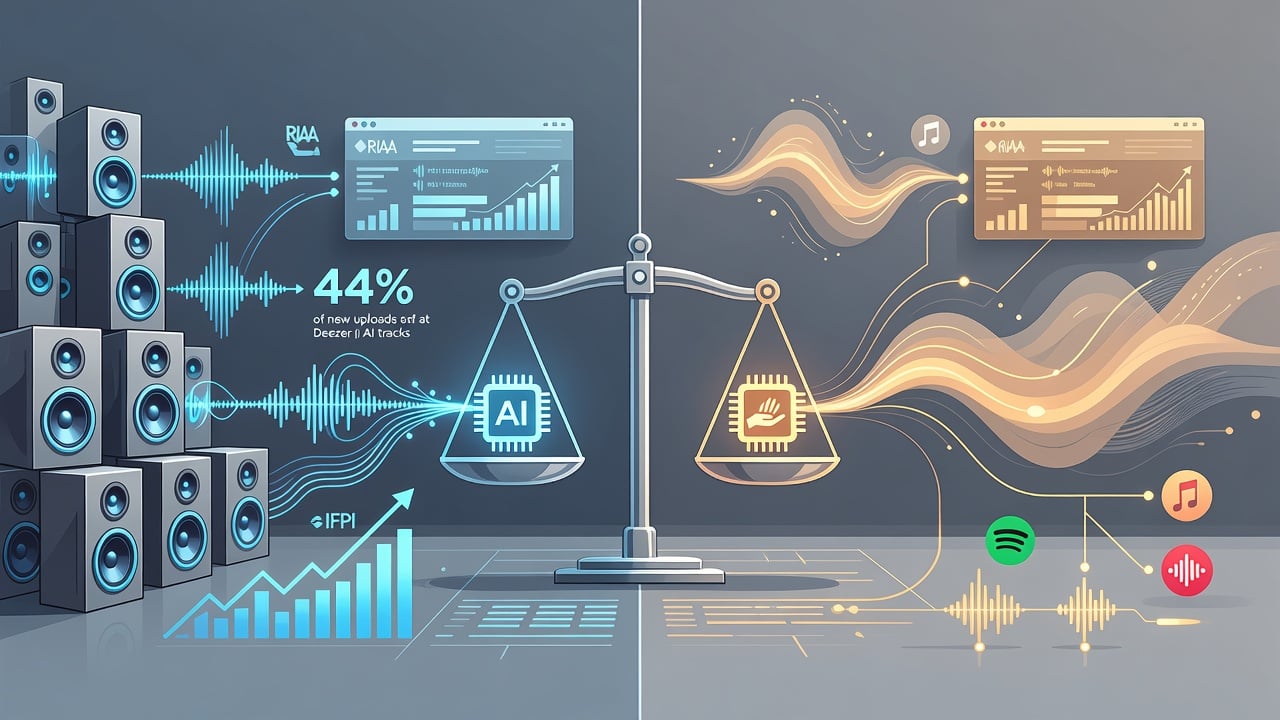
Numbers tell a story of rapid change. Deezer reported that AI-generated tracks made up 44% of all new music on its platform. Apple Music noted more than one-third of its tracks were “100% AI.” Those figures come from Deadline. The surge explains the urgency. Platforms already take steps to curb spam and fraud. Spotify purged 75 million AI-generated songs last year. Deezer tags such tracks and keeps them out of algorithmic recommendations.
Yet detection proves tricky. AI music evolves fast. Metadata can shift. Early viral hits showed the risk. A 2024 track using AI voice clones of Drake and The Weeknd racked up millions of streams before takedowns. Many listeners never realized the source. That incident, detailed in Gizmodo, fueled calls for clearer signals.
Platforms have moved on their own. Spotify now lets artists note AI involvement in song credits. It supports a DDEX standard that can flag AI-generated vocals, instrumentation, mixing or mastering. Apple Music rolled out Transparency Tags earlier this year. Labels and distributors can apply them to tracks, compositions, artwork and videos. The company has signaled these will become mandatory for new content. The Wall Street Journal first reported the coalition’s coordinated push, noting how it builds on those individual efforts.
And the reactions vary. Deezer welcomed the framework. “It was encouraging to see steps being taken towards a unified approach to generative AI in music,” the company said in a statement to Deadline. “As the first music streaming platform to detect, tag and exclude AI-generated music from algorithmic recommendations, Deezer is ready to support the development of an industry-wide framework.” The service also flagged concerns around training data and fair pay for rights holders.
Streaming executives sound open but cautious. The Digital Media Association, which represents services including Spotify and Apple Music, said it follows the proposal closely. Graham Davis, the group’s president, noted that “creation-related information can be of maximum value only when it is completely transmitted from the creator to the audience.” Platforms need upstream cooperation to make standards work.
Some artists embrace AI. They compare it to synthesizers or digital audio workstations. Others worry. They see their voices and styles cloned without consent or compensation. Floods of low-effort tracks dilute playlists and squeeze human creators out of recommendations. The coalition aims to balance those views. Transparency, they argue, lets listeners choose while protecting the human element that defines music’s appeal.
Legislators watch too. U.S. senators revived the AI Labeling Act of 2026 in June. It would require visible disclosures on generated audio, video and images. The Federal Trade Commission would enforce it. Similar rules take effect in the European Union next month under the AI Act. Industry self-regulation could head off heavier mandates. Or it could set the stage for them.
Implementation details still need work. Who verifies declarations? How do platforms display the tags prominently without cluttering interfaces? What happens when creators mislabel tracks? Those questions linger. Detection tools improve, yet they remain imperfect. Some experts push provenance systems that record creation history from the start rather than guess after the fact.
For now the focus stays practical. Simple icons. Consistent across services. Voluntary but encouraged. The music business has handled explicit content warnings for decades. This feels like an extension of that model. Fans don’t always reject AI music. They just want the facts before they hit play.
The coalition’s move marks a shift from reactive purges to structured disclosure. Spotify’s co-CEO Gustav Söderström said last year that the platform shouldn’t police creative tools. AI, in his view, sits alongside guitars and synths. The new labels don’t contradict that stance. They simply inform.
Whether listeners care enough to notice remains to be seen. Early data from Deezer suggests many AI tracks get low engagement once excluded from recommendations. Human curation still drives discovery. Yet the volume keeps rising. Tens of thousands of AI tracks arrive daily across services. Without clear signals, the line between authentic and artificial blurs. And once blurred, it becomes hard to restore.
So the industry acts. Not with panic. With labels. Black and white. Capital and lowercase. A small step that could reshape how audiences experience the next wave of music.


 WebProNews is an iEntry Publication