
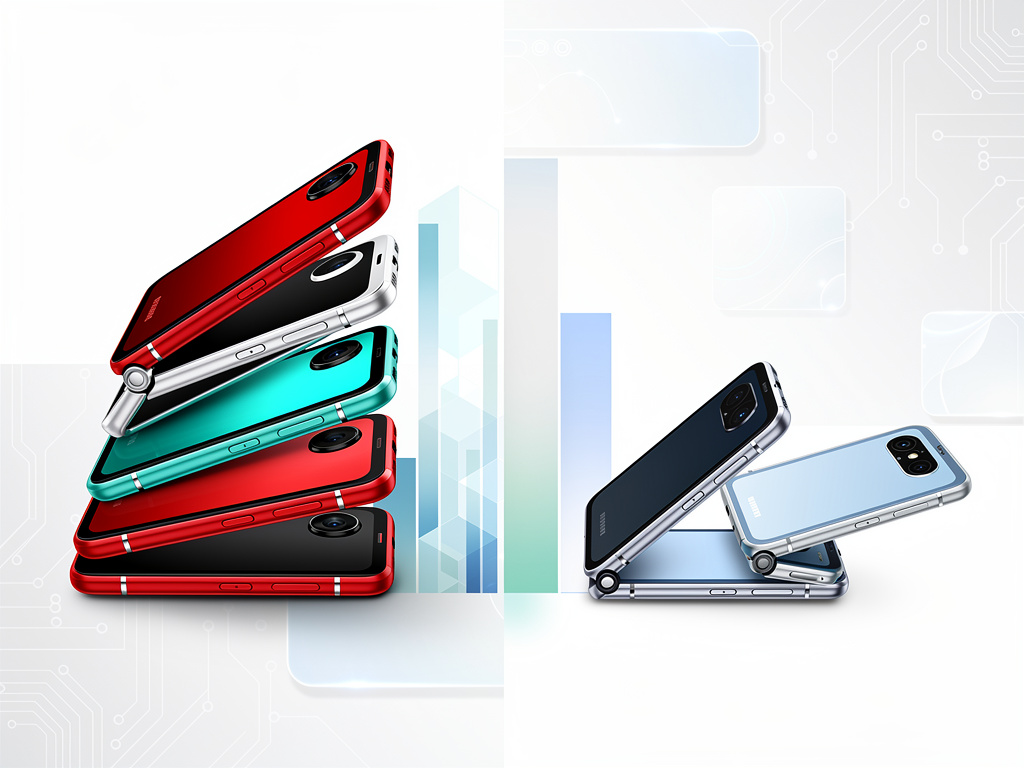
For the better part of a decade, Samsung owned the foldable phone conversation. It spent billions on flexible display technology, launched the Galaxy Fold in 2019 to enormous fanfare (and enormous early failures), and positioned itself as the undisputed leader of a category it essentially created for the mass market. That dominance is now eroding — fast — and the company doing the damage isn’t some deep-pocketed Chinese rival or a resurgent Apple. It’s Motorola.
The Lenovo-owned brand, once left for dead in the smartphone wars, has executed one of the more impressive product turnarounds in recent consumer electronics history. Its Razr line of clamshell foldables has gone from afterthought to category leader in the span of roughly two years, achieving something that seemed improbable: making Samsung look slow.
The Numbers Tell a Brutal Story for Samsung
Samsung’s foldable shipments dropped 27% year-over-year in Q4 2024, according to data from IDC cited by Android Police. In that same quarter, Motorola’s foldable shipments surged 168%. Those aren’t incremental shifts. That’s a market in the middle of a power transfer.
The full-year picture is equally striking. Samsung shipped 7.3 million foldable units in 2024, down from 9.5 million the year before. Motorola shipped 4.2 million, up from 2.3 million. Samsung still holds the overall volume crown, but the trajectory lines are converging with startling speed. At this rate, a crossover point isn’t a matter of if. It’s when.
And it gets worse for Samsung when you zoom into the flip phone subcategory — the clamshell form factor that Motorola has made its primary battlefield. In Q4 2024, Motorola actually outsold Samsung in flip-style foldables globally. Not in a single region. Globally. For a brand that many industry observers had written off as a nostalgia play, that’s a remarkable achievement.
The broader foldable market itself grew 26% in 2024 to reach 28.8 million units, per IDC. Samsung’s share of that market fell from 54% to roughly 38%. Motorola climbed from around 10% to nearly 15%. Huawei, riding strong domestic demand in China, also gained ground. But in markets outside China — particularly North America, Latin America, and parts of Europe — Motorola has become the primary challenger.
So what happened?
The answer is deceptively simple: Motorola built better products at lower prices while Samsung stood still.
The 2024 Razr and Razr Plus represented a genuine leap forward. The standard Razr, priced at $699, offered a large external display, competent cameras, and the kind of refined hinge mechanism that earlier Razr models lacked. The Razr Plus, at $999, went further — matching or exceeding the Galaxy Z Flip 6 in display quality, battery life, and software polish, while offering a substantially larger cover screen. As Android Police noted, Motorola managed to deliver more screen real estate on the outside of the phone, better water resistance ratings, and competitive camera performance, all while undercutting Samsung’s pricing.
Samsung’s Galaxy Z Flip 6, by contrast, felt iterative. Slightly better processor. Slightly improved cameras. The same basic design language that debuted with the Z Flip 3 in 2021. Consumers noticed. Reviewers noticed. And the sales figures reflected it.
Price has been Motorola’s most potent weapon. The $699 entry point for a credible foldable phone demolished the psychological barrier that had kept many buyers on the sidelines. Samsung’s cheapest flip foldable still starts at $1,099.99 at full retail. That $400 gap is enormous in a global smartphone market where average selling prices hover around $300-$350. Motorola didn’t just compete on price — it reframed what a foldable should cost.
The 2025 lineup looks poised to extend Motorola’s momentum. The company announced the Razr Ultra and a refreshed standard Razr earlier this year, both featuring improved cameras, faster processors, and continued refinements to the hinge and display crease. Early hands-on coverage from outlets including Tom’s Guide has been broadly positive, highlighting Motorola’s commitment to iterating quickly — a cadence that now outpaces Samsung’s annual refresh cycle for the Z Flip series.
Samsung’s Strategic Paralysis
Samsung’s problem isn’t engineering capability. The company still manufactures some of the world’s best flexible OLED panels. Its semiconductor division supplies chips to half the industry. It has the R&D budget, the supply chain muscle, and the brand equity to compete with anyone.
The problem is institutional. Samsung’s mobile division, long the profit engine of the broader conglomerate, has grown cautious. The Galaxy Z Flip and Z Fold lines have settled into a predictable annual cadence of modest upgrades — the kind of tick-tock cycle that works when you’re the iPhone and face no serious competition, but falters when a hungry rival is shipping genuinely better hardware at lower prices.
There’s also a strategic tension within Samsung between protecting its premium pricing and growing the foldable category. Every dollar Samsung drops from the Z Flip’s price is a dollar of margin lost on millions of units. Motorola, starting from a much smaller base, doesn’t face that calculus. It can afford to be aggressive because it’s playing for share, not protecting profit.
Samsung reportedly delayed or scaled back plans for a cheaper “Galaxy Z Flip FE” (Fan Edition) model that would have competed directly with the standard Razr at the sub-$700 price point. The reasons were reportedly margin-related. That decision, if accurate, may prove to be one of the more consequential strategic errors in Samsung’s recent mobile history.
Meanwhile, Samsung’s book-style foldable — the Galaxy Z Fold — faces its own challenges from Chinese competitors like Huawei, Honor, and OnePlus, all of whom have shipped thinner, lighter, and often cheaper alternatives. The Z Fold 6, released in mid-2024, was widely criticized for minimal design changes and a price that remained north of $1,800. Reports from SamMobile and Korean media suggest Samsung is planning more significant changes for the Z Fold 7, potentially including a thinner profile and an integrated S Pen slot, but those devices won’t arrive until the second half of 2025.
By then, Motorola will have had another full product cycle to consolidate its gains in the flip segment.
There’s a deeper issue too. Samsung’s software experience on foldables, once a differentiator, has stagnated. One UI’s foldable-specific features haven’t evolved meaningfully since the Z Flip 4 era. Motorola, running a near-stock version of Android with lightweight customizations and increasingly tight integration with Google’s AI features, has closed the software gap entirely. For many users, the cleaner Motorola software experience is actually preferable.
Samsung’s carrier relationships in the United States remain a significant advantage — the Z Flip and Z Fold get prominent placement and aggressive promotional pricing at Verizon, AT&T, and T-Mobile. But Motorola has made inroads here as well, securing better carrier shelf space and promotional support for the Razr line than it’s had in years. The brand’s resurrection has been aided by genuine consumer interest, which carriers are eager to capitalize on.
What Comes Next
The foldable market is still small relative to the broader smartphone industry. Twenty-nine million units against total smartphone shipments of roughly 1.2 billion means foldables represent about 2.4% of the market. But growth rates matter, and the category is expanding while the overall smartphone market barely grows at all. Foldables are where the energy is. And right now, Motorola has more of it than anyone outside China.
The competitive picture could shift again. Samsung has the resources to respond aggressively if it chooses to — a competitively priced Z Flip FE, a meaningfully redesigned Z Fold 7, or a renewed push on software differentiation could all change the calculus. Apple’s long-rumored foldable iPhone, should it materialize in 2026 or 2027, would reshape the entire category overnight. And Chinese brands like Huawei and Honor continue to push the boundaries of what’s physically possible with foldable hardware, even if their global reach remains limited by geopolitical constraints.
But none of that changes what’s happening right now. Motorola identified an opening — a dominant player resting on its laurels, a price tier left completely unaddressed, and a consumer base hungry for something new — and exploited it with precision. The Razr’s resurgence isn’t a fluke or a single-quarter anomaly. It’s the result of sustained product execution over multiple generations, each one materially better than the last.
Samsung built the foldable category. Motorola is taking it.
For an industry that loves to talk about disruption in the abstract, here’s a concrete case study unfolding in real time. The company that pioneered the flip phone in 2004, lost its way for a decade, and was acquired by a Chinese PC maker is now outselling the world’s largest smartphone manufacturer in the very product category that was supposed to define Samsung’s future. No one predicted this two years ago. And yet the data is unambiguous.
The question facing Samsung’s mobile chief TM Roh and his team isn’t whether they can build a better foldable. Of course they can. The question is whether they will — and whether they’ll do it fast enough. Because Motorola isn’t waiting.


 WebProNews is an iEntry Publication