
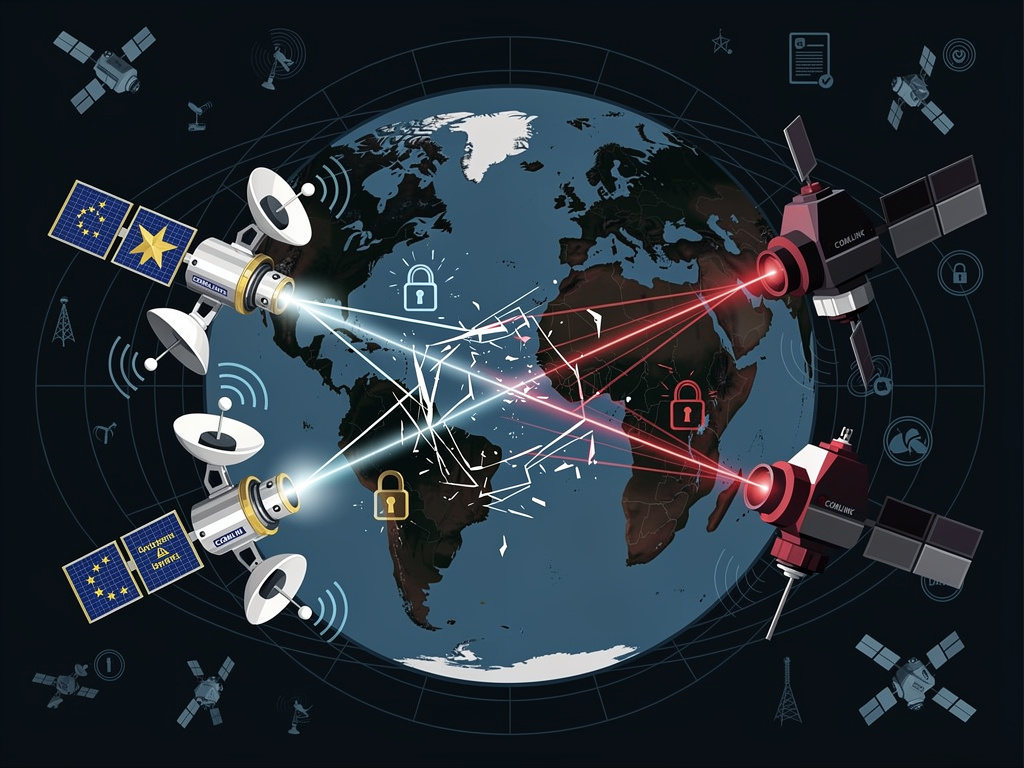
European security officials have confirmed what intelligence agencies have long suspected: Russian spy satellites have successfully intercepted communications from European Union satellites, marking a significant escalation in orbital espionage capabilities. The breach, which has sent shockwaves through NATO defense circles and commercial satellite operators, represents a new frontier in electronic warfare that threatens both military and civilian communications infrastructure.
According to Ars Technica, the interception campaign has been ongoing for an undetermined period, with Russian signals intelligence satellites positioning themselves in proximity to European communications assets. The sophisticated operation demonstrates Moscow’s advancing capabilities in space-based surveillance and its willingness to exploit vulnerabilities in the increasingly crowded orbital environment. European defense officials, speaking on condition of anonymity due to the sensitive nature of ongoing investigations, indicated that the interceptions have compromised both encrypted and unencrypted transmissions.
The revelation comes at a particularly sensitive time for European space security, as the continent races to deploy next-generation satellite constellations for both military and commercial purposes. The European Union has invested billions of euros in developing independent space capabilities, including the Galileo navigation system and various communications satellites designed to reduce dependence on American infrastructure. The Russian interception campaign threatens to undermine these strategic investments and raises fundamental questions about the security architecture of modern satellite communications.
Technical Sophistication Behind the Breach
Intelligence analysts have identified the Russian satellites involved as part of a new generation of signals intelligence platforms capable of operating in close proximity to target satellites without triggering collision avoidance protocols. These spacecraft, which Russian authorities have publicly described as communications or inspection satellites, possess highly sensitive receiving equipment capable of capturing radio frequency emissions from nearby satellites. The technical achievement required to successfully intercept and decode satellite-to-satellite communications represents a significant leap in Russian space capabilities.
The interception technique relies on positioning Russian satellites within the electromagnetic footprint of European communications satellites, allowing them to capture signals that would normally be directed toward ground stations or other orbital assets. Unlike traditional ground-based interception, which must contend with atmospheric interference and the limited window when satellites pass overhead, orbital interception provides continuous access to communications traffic. Defense contractors familiar with satellite security protocols note that many older European satellites were designed with minimal protection against this type of threat, as orbital interception was considered technically prohibitive when they were deployed.
Strategic Implications for European Defense
The compromise of EU satellite communications carries profound implications for European defense planning and NATO operations. Military communications, intelligence sharing between allied nations, and coordination of defense systems increasingly rely on satellite links that may now be vulnerable to Russian surveillance. European defense ministers have convened emergency sessions to assess the scope of the breach and determine what classified information may have been exposed. The incident has accelerated calls for a comprehensive review of European space security protocols and increased investment in quantum encryption technologies.
Beyond immediate military concerns, the interception campaign threatens commercial satellite operators who provide communications services to European governments and businesses. The commercial satellite industry, which has experienced explosive growth in recent years with the deployment of mega-constellations by companies like SpaceX and OneWeb, now faces difficult questions about the security of their networks. Insurance companies that underwrite satellite operations are reassessing risk models, while corporate clients are demanding guarantees that their communications remain secure from state-sponsored espionage.
Historical Context and Escalating Space Competition
The Russian interception campaign represents the latest chapter in a decades-long competition for dominance in space-based intelligence gathering. During the Cold War, both the United States and Soviet Union developed sophisticated signals intelligence satellites, but these systems primarily focused on intercepting ground-based communications and radar emissions. The current generation of Russian satellites marks a qualitative shift toward targeting other spacecraft directly, effectively weaponizing the space environment for intelligence collection.
This escalation parallels Russia’s broader military modernization efforts and its increasingly assertive posture in contested domains. From cyberattacks on critical infrastructure to the deployment of anti-satellite weapons, Moscow has demonstrated a willingness to challenge Western technological superiority across multiple fronts. Space has emerged as a particularly attractive domain for Russian operations because international law remains ambiguous about what constitutes hostile action in orbit, and attribution of malicious activity can be difficult to establish definitively.
European Response and Countermeasures
European Space Agency officials have announced an accelerated timeline for deploying next-generation communications satellites with enhanced security features. These new platforms will incorporate advanced encryption, frequency-hopping capabilities, and narrow-beam transmissions designed to minimize the electromagnetic signature vulnerable to interception. The European Union has also allocated emergency funding for the development of space situational awareness systems that can better track potential threats and identify suspicious satellite maneuvers.
NATO has activated provisions for collective consultation on space security, recognizing that an attack on one member’s space assets could trigger broader alliance responses. The alliance is developing new protocols for sharing information about orbital threats and coordinating defensive measures. Some member states have advocated for treating the interception of military satellite communications as a hostile act that could justify retaliatory measures, though consensus on this position remains elusive given the legal complexities and potential for escalation.
Commercial Sector Vulnerabilities
The incident has exposed significant vulnerabilities in the commercial satellite sector, where cost pressures often lead operators to prioritize affordability over security. Many commercial communications satellites rely on relatively simple encryption schemes that were never designed to resist determined attacks by sophisticated state actors. Industry experts warn that Russian intelligence services may have gained access to proprietary business communications, intellectual property, and sensitive commercial negotiations conducted over supposedly secure satellite links.
Satellite manufacturers are now scrambling to retrofit existing spacecraft with enhanced security measures while incorporating military-grade protections into new designs. However, the economics of the satellite industry make wholesale security upgrades challenging. Launch costs, though declining thanks to reusable rockets, still run into millions of dollars per satellite, and operators face difficult decisions about whether to replace vulnerable assets prematurely or accept the risk of continued exposure to Russian surveillance.
International Law and Orbital Governance
The Russian interception campaign has highlighted critical gaps in international space law and the absence of clear norms governing hostile activities in orbit. The Outer Space Treaty of 1967, which forms the foundation of space law, prohibits the placement of weapons of mass destruction in orbit but says little about signals intelligence or other forms of espionage. Legal scholars debate whether intercepting satellite communications constitutes a use of force under international law or falls into a gray zone of permissible intelligence gathering.
The United Nations Committee on the Peaceful Uses of Outer Space has struggled to develop consensus on rules governing satellite operations, with Russia and China consistently opposing measures they view as limiting their freedom of action in space. Western nations have proposed transparency and confidence-building measures, including advance notification of satellite maneuvers and sharing of orbital data, but these initiatives have made little progress. The current incident may provide impetus for renewed diplomatic efforts, though the deteriorating state of US-Russia and EU-Russia relations complicates prospects for meaningful agreement.
Future of Secure Space Communications
As the space domain becomes increasingly contested, governments and commercial operators are investing heavily in technologies designed to secure satellite communications against interception. Quantum key distribution, which uses the principles of quantum mechanics to create theoretically unbreakable encryption, represents one promising avenue. Several countries, including China and the United States, have successfully demonstrated quantum communication via satellite, though the technology remains expensive and technically challenging to deploy at scale.
Artificial intelligence and machine learning are also being applied to detect anomalous satellite behavior that might indicate surveillance or other hostile activities. Advanced algorithms can analyze orbital mechanics, radio frequency emissions, and other telemetry data to identify spacecraft conducting suspicious maneuvers. These systems promise to provide earlier warning of potential threats, though they also raise concerns about false alarms and the risk of misinterpreting legitimate operations as hostile acts. The integration of these technologies into a comprehensive space security architecture will require unprecedented cooperation between government agencies, commercial operators, and international partners—a challenging proposition in an era of increasing geopolitical fragmentation.


 WebProNews is an iEntry Publication