
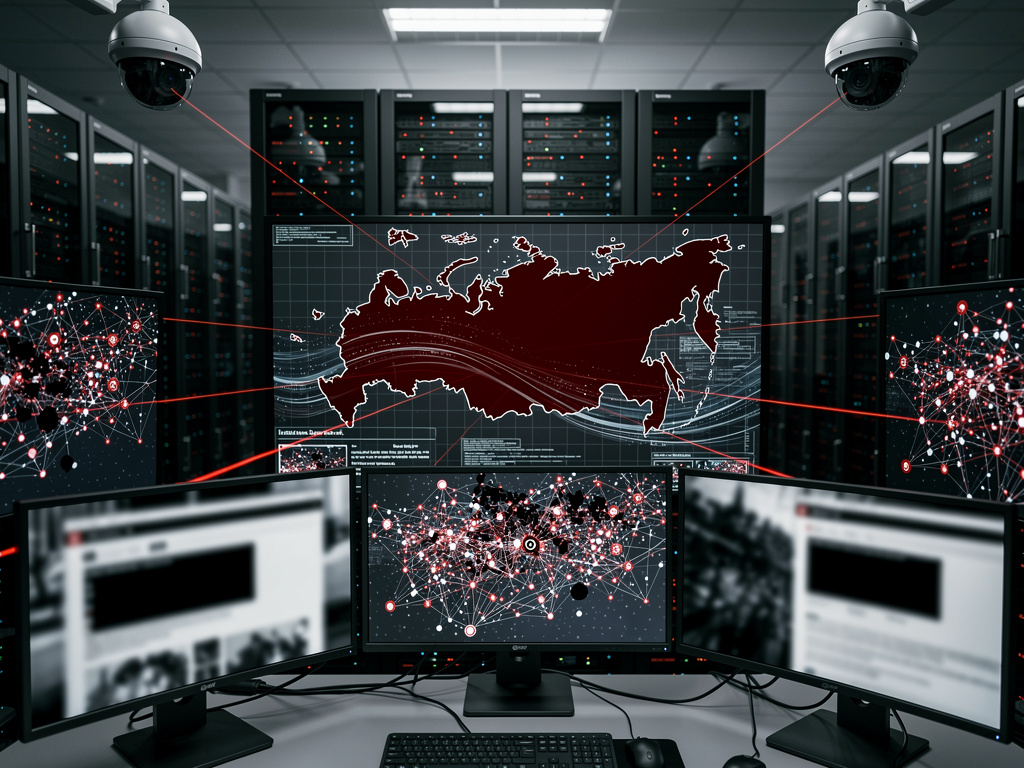
Russia is building an AI-powered content moderation machine. Not the kind Silicon Valley talks about — optimized for brand safety and advertiser comfort — but one designed to enforce state ideology across every corner of the Russian internet, from social media posts to online news commentary. The ambition is sweeping. The implications, for both Russian citizens and the global debate over AI governance, are profound.
According to MSN News, Russia’s internet regulator Roskomnadzor is advancing plans to deploy artificial intelligence systems capable of scanning and flagging content that violates Russian law. That includes material the Kremlin deems extremist, content related to drug use, LGBTQ+ advocacy — which Russia has classified as “extremist” — and anything that contradicts the state’s official narrative on the war in Ukraine. The effort represents a significant escalation of Moscow’s already formidable censorship apparatus, moving from reactive takedown orders and VPN-blocking campaigns to a proactive, algorithmically driven surveillance system that can operate around the clock without human fatigue or hesitation.
The timing isn’t accidental. Russia has spent years tightening its grip on information flows, particularly since its full-scale invasion of Ukraine in February 2022. Platforms like Facebook and Instagram were banned. Twitter, now X, was throttled and eventually blocked. Independent news outlets were shuttered or driven into exile. But even with these blunt instruments, the Russian internet — known as Runet — remains vast and difficult to police manually. Tens of millions of posts, comments, and messages circulate daily across domestic platforms like VKontakte, Telegram channels, and Odnoklassniki. Human moderators can’t keep up. AI, Russian officials believe, can.
Roskomnadzor has been quietly building this capability for some time. The agency’s technical arm, the Main Radio Frequency Center (GRFC), has been testing systems designed to automatically detect prohibited content using natural language processing and image recognition. These tools are meant to identify not just explicit violations — such as calls for violence or distribution of illegal materials — but also subtler forms of dissent. Irony, euphemism, coded language. The very things that Russian internet users have long relied on to speak around the censors.
That’s where the technical challenge gets interesting. And where the risks multiply.
AI content moderation systems, even those built by the world’s most well-resourced technology companies, struggle with context. Meta’s systems routinely flag legitimate news content. YouTube’s algorithms have been criticized for both over-removal and under-removal. The challenge of understanding sarcasm, regional slang, or political subtext in Russian — a language rich in double meaning and literary allusion — is enormous. Russia’s AI systems, likely trained on smaller and less diverse datasets than those available to Western tech giants, will almost certainly produce high rates of false positives. But in an authoritarian context, false positives aren’t a bug. They’re a feature. Overcensorship chills speech more effectively than targeted removal ever could.
The Kremlin’s AI push fits within a broader national technology strategy. President Vladimir Putin has repeatedly emphasized AI as a strategic priority, both for economic competitiveness and national security. Russia’s National AI Strategy, updated in 2024, calls for the development of domestic AI capabilities across government, defense, and civilian sectors. Content moderation is just one application. But it’s the one that most directly intersects with political control.
Russia is not alone in using AI for content regulation. China’s Cyberspace Administration has deployed sophisticated AI tools for years, scanning WeChat, Weibo, and Douyin for content that violates the Chinese Communist Party’s expansive censorship rules. Beijing’s systems are widely considered the most advanced state-run content moderation tools in existence, capable of detecting and removing sensitive posts within minutes — sometimes seconds — of publication. Moscow appears to be studying China’s model closely, though Russian officials have not publicly acknowledged this.
The European Union, too, has moved toward AI-assisted content moderation, though with a fundamentally different philosophy. The EU’s Digital Services Act requires large platforms to use automated tools to detect illegal content, but it also mandates transparency, appeals processes, and independent audits. The contrast with Russia’s approach could not be starker. There is no transparency requirement in Russia’s framework. No independent oversight. No meaningful appeals process for users whose content is removed or whose accounts are suspended.
For ordinary Russians, the practical effect is a further narrowing of the already constricted space for online expression. Telegram, which has functioned as a kind of semi-free zone for Russian discourse — hosting everything from war correspondents to opposition voices to mundane community groups — is a particular target. The platform, founded by Russian-born entrepreneur Pavel Durov, has historically resisted government demands for user data and content removal. But Durov’s arrest in France in August 2024 on charges related to Telegram’s content moderation failures appears to have shifted the platform’s posture. Telegram has since increased cooperation with law enforcement requests from multiple countries. Whether that cooperation extends to Russia’s AI-driven content demands remains unclear.
And then there’s the question of enforcement infrastructure. Roskomnadzor already operates TSPU (Technical Means for Countering Threats), deep packet inspection equipment installed at internet service providers across Russia. This hardware, deployed beginning in 2019 under Russia’s so-called “sovereign internet” law, gives the agency the ability to throttle, redirect, or block specific types of internet traffic. Layering AI content detection on top of this existing infrastructure would give Russia a remarkably comprehensive system: AI identifies the content, TSPU controls the pipes. The combination is more powerful than either tool alone.
Western governments and digital rights organizations have raised alarms. The Electronic Frontier Foundation and Access Now have both warned about the global precedent set by state-deployed AI censorship systems, arguing that the technology — once developed — can be exported to other authoritarian regimes. Russia has already shared surveillance technology with countries in Central Asia and Africa. AI content moderation tools could follow the same path.
So could the legal frameworks that justify them. Russia’s laws on “extremism,” “fake news,” and “discrediting the armed forces” are vaguely worded by design. They give authorities enormous discretion in determining what constitutes a violation. When that discretion is handed to an algorithm, the vagueness doesn’t disappear. It gets encoded. And it scales.
There’s a commercial dimension, too. Russia’s domestic tech sector, led by companies like Yandex and Sber (the state-controlled banking giant that has aggressively expanded into AI), stands to benefit from government contracts related to content moderation AI. Yandex, which operates Russia’s dominant search engine and a range of other digital services, has significant AI research capabilities. Sber has built its own family of large language models and has positioned itself as a national AI champion. Both companies operate under intense government pressure and have little ability to refuse state demands.
The talent pipeline is another factor. Russia has historically produced world-class computer scientists and mathematicians. Many left after the invasion of Ukraine — a brain drain that Russian officials have publicly lamented. But enough expertise remains, particularly within state-affiliated research institutions and defense contractors, to build functional content moderation systems. They may not match the sophistication of Google’s or OpenAI’s models. They don’t need to. For censorship purposes, “good enough” is good enough.
What makes Russia’s AI censorship push particularly notable is its openness about the intent. Democracies that deploy AI content moderation tools typically frame the effort around child safety, counterterrorism, or combating misinformation — goals that, whatever one thinks of the implementation, carry at least some broadly shared legitimacy. Russia’s framework makes no such pretense. The prohibited content categories are explicitly political. The goal is explicitly control.
This candor, paradoxically, may be instructive for Western policymakers grappling with their own AI governance debates. The same underlying technology — large language models, computer vision, automated classification systems — powers content moderation tools everywhere. The difference lies in the governance structure wrapped around it. Russia’s example illustrates what happens when that governance structure is designed to serve the state rather than the public.
Not everyone in Russia’s tech community is comfortable with the direction. Anonymous accounts on Habr, Russia’s equivalent of Hacker News, have posted critical commentary about the technical and ethical implications of AI-driven censorship. Some developers have reportedly refused to work on government content moderation projects, though such refusals carry real professional and legal risk in the current environment. Dissent exists. It’s just quiet.
The timeline for full deployment remains somewhat unclear. Russian government technology projects have a mixed track record — the sovereign internet law, for example, took years longer to implement than originally planned, and its effectiveness remains uneven. VPN usage in Russia surged after the invasion of Ukraine, and many tech-savvy Russians continue to access blocked platforms. AI content moderation won’t eliminate these workarounds. But it will make the baseline experience of the Russian internet — the experience of the average user who doesn’t use a VPN — significantly more controlled.
And that, ultimately, is the point. Authoritarian censorship has never required perfection. It requires enough friction, enough fear, enough uncertainty to keep most people within the lines. AI doesn’t change that fundamental calculus. It just makes it cheaper and faster to enforce.
Moscow’s bet is that artificial intelligence can do what armies of human censors could not: monitor the full breadth of Russian online speech in real time, flagging deviations from the approved narrative before they can spread. Whether the technology delivers on that promise is an open question. That the Kremlin is willing to try tells you everything about where Russia’s internet is headed.


 WebProNews is an iEntry Publication