
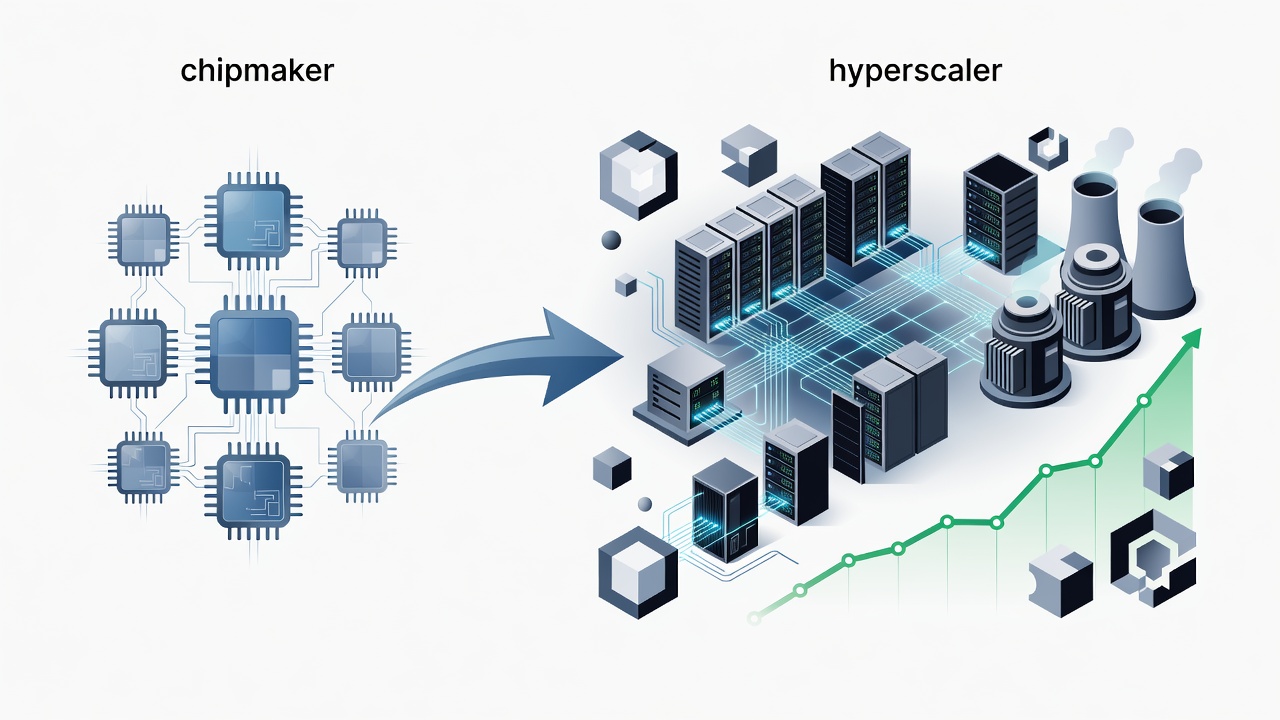
Investors who rode the artificial intelligence wave through semiconductor names now face a fork in the road. Morgan Stanley says the path leads toward the very companies writing the biggest checks for data centers, power plants and networking gear. The hyperscalers. Not the chipmakers.
That call, issued Monday, lands at a moment when the Philadelphia Semiconductor Index has given back nearly all its June gains. Chip stocks soared 11% last month on AI optimism. They dropped 11% in the past two weeks. The reversal feels telling. And timely.
Hyperscalers such as Alphabet, Amazon and Meta underperformed during the recent selling. Their shares lagged while pure-play semiconductor names ran hot. Morgan Stanley interprets the divergence as the start of something larger. A rotation. One that rewards the owners of the infrastructure rather than the suppliers of the silicon.
The numbers back the view. Hyperscalers plan to pour between $635 billion and $690 billion into capital spending in 2026, according to company guidance compiled by analysts. Amazon alone eyes $200 billion. Alphabet targets $175 billion to $185 billion. Meta aims for $115 billion to $135 billion. Microsoft tracks toward $120 billion or higher. Oracle adds another $50 billion. (John Rothe, May 29, 2026)
Only about 25% of that torrent heads to chips. The other 75% funds the physical buildout. Data centers. Power systems. Cooling equipment. Networking hardware. Land. The body that carries the brain. Investors who fixated on GPUs missed the bigger bill. Infrastructure plays have noticed. Vertiv Holdings returned 94% year-to-date through late May. NVIDIA managed just under 15% in the same stretch. Cooling specialists as a group beat NVIDIA by four to one. (John Rothe, May 29, 2026)
Earlier this year Morgan Stanley had already flagged the scale. The bank forecast hyperscalers would drive roughly 40% of total Russell 1000 cash capital expenditures from 2026 through 2028. That slice exceeds $2 trillion. Broader AI-related investment could top half of all Russell 1000 capex. Cash capex-to-sales ratios for the hyperscalers would climb past levels last seen in the dot-com era, hitting 34% to 39% over those three years. Add in leases and the figures reach 38% to 45%. (Yahoo Finance, Feb. 26, 2026)
Semiconductor suppliers still win in that world. The bank saw 2026 sales revisions for chip companies climbing about 60%. Yet the tone has evolved. In its latest note the firm highlights near-term capex discipline among the hyperscalers. Spending will continue. The pace may moderate. Returns on those massive outlays remain unproven. Investors want evidence that revenue will follow the enormous expense.
JPMorgan captured the tension in a report published days ago. AI capex has jumped from 33% of hyperscaler cash flow from operations in 2023 to an estimated 93% in 2026. Balance sheets feel the strain. Cash piles have dwindled. Pairwise correlations among the big hyperscalers have hit record lows. Performance gaps widened dramatically. Alphabet led. Meta lagged by 125 percentage points over the past year through early June. (JPMorgan, July 3, 2026)
The market senses the shift. Semiconductor stocks slid Monday as investors questioned whether the breakneck pace of AI infrastructure spending can last beyond 2026. Big Tech companies reaffirmed plans for massive 2026 budgets. Analysts still model $650 billion to $725 billion in combined hyperscaler capital expenditures next year. Doubts linger about monetization. (Bloomberg Television, July 5, 2026)
Power has emerged as the new choke point. Data centers consume staggering amounts of electricity. Utilities scramble to keep up. Some hyperscalers sign deals directly with power producers or explore nuclear options. Cooling technology, once an afterthought, now commands premium valuations. Networking gear that moves data at AI speeds represents another thick slice of the 75% non-chip spend.
But the pivot carries risks. If AI revenue disappoints relative to the hundreds of billions deployed, those capex budgets could shrink fast. Hyperscalers have transformed from cash-rich software giants into capital-hungry industrial utilities. Their software-like valuations may not survive if free cash flow stays trapped in concrete and copper. (Investing.com, May 6, 2026)
Morgan Stanley pairs its hyperscaler call with broader rotation recommendations. Consumer discretionary. Transportation. Biotechnology. The bank sees falling oil prices and expectations for Federal Reserve rate cuts as tailwinds for these groups. The AI trade, once narrowly focused on chips, broadens. Gains spread. Concentration risk eases.
Recent X chatter echoes the theme. One macro analyst summed it up Monday: “AI rotation favors hyperscalers over chipmakers. Drivers: chip pullback, capex discipline, softer Fed path.” Others noted the supercycle in data center construction now stretches into power, cooling and networking. Demand looks durable even as software multiples compress.
Memory chip prices have already soared on AI demand. Morgan Stanley warned earlier of “chipflation” spreading from data centers into the wider economy. That pressure may force hyperscalers to seek efficiencies elsewhere. Custom silicon. Better software. Improved utilization rates. The winners will be those who convert capex into actual earnings growth.
History offers mixed lessons. The dot-com boom left behind fiber networks and cheap bandwidth that powered the next decade of internet growth. Today’s AI buildout could yield similar overcapacity. Or it could prove just enough to unlock autonomous agents, enterprise copilots and entirely new applications. The jury remains out. The money keeps flowing.
For now the signal seems clear. Pure-play chip stocks have enjoyed their moment of singular focus. Attention turns to the companies that control the data centers, the power contracts and the end-to-end infrastructure. Hyperscalers spent years preparing for this. Their suppliers rode the first wave. The second wave may lift a wider set of names. Investors who adjust early stand to benefit most.
The scale still astonishes. Upward revisions to 2026-27 capex plans reached $630 billion in recent months. Total AI-related spending through 2030 could hit $5.5 trillion, according to updated JPMorgan forecasts. Debt financing might cover $4.1 trillion of that total. The capital cycle has no recent precedent.
So the rotation makes sense on paper. Chip valuations reflect years of forward earnings. Hyperscaler shares trade at discounts to their growth potential if AI delivers. Discipline on spending could improve returns on invested capital. Evidence of monetization would re-rate the group.
Yet markets rarely move in straight lines. Chip weakness may prove temporary. New model releases or breakthrough inference performance could reignite semiconductor enthusiasm. Hyperscalers could stumble on execution or face regulatory pushback on energy use and land development.
Still, the Morgan Stanley note captures a sentiment building for months. The AI trade has matured. Its center of gravity moves from the silicon wafer to the steel and concrete that houses it. From the chipmakers to the hyperscalers. The next leg of the boom may look different from the first. (Investing.com, July 6, 2026)


 WebProNews is an iEntry Publication