
For years, Elon Musk painted Mars as humanity’s destiny — the red planet where civilization would plant its second flag and become multiplanetary. He spoke of it with the fervor of a prophet, sketching timelines that put boots on Martian soil by the late 2020s and a self-sustaining city by mid-century. SpaceX’s entire corporate identity was built around the premise: the company’s name, after all, is shorthand for Space Exploration Technologies, and its founding mythology centers on Musk’s obsession with making life interplanetary.
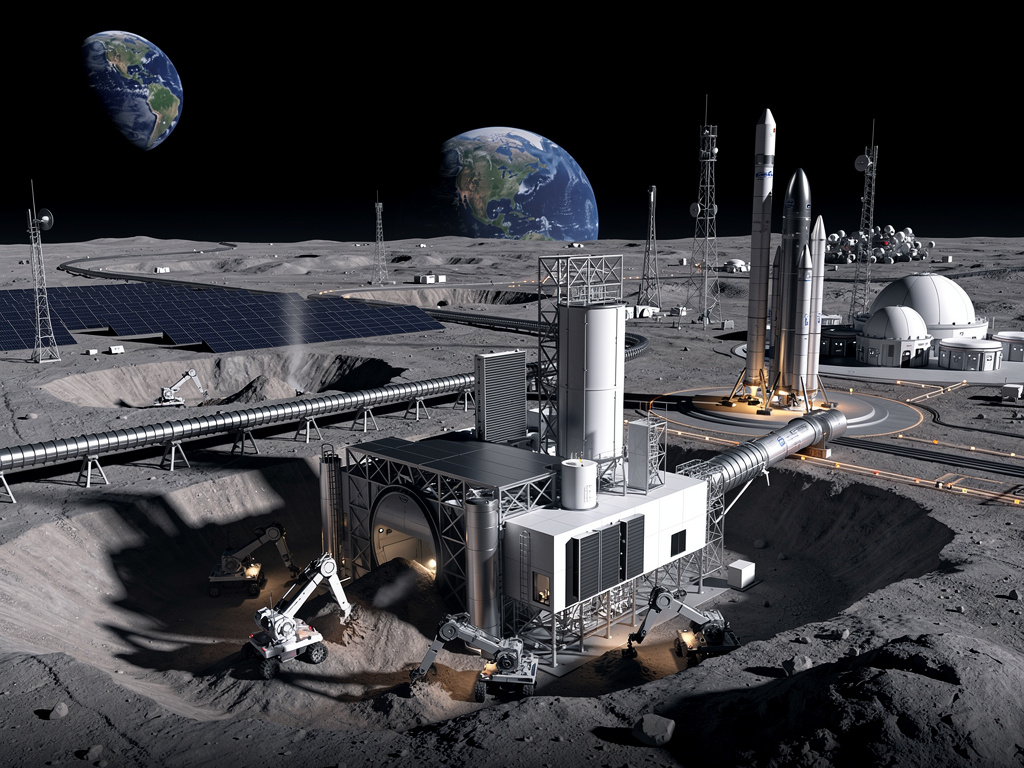
But in a dramatic strategic reversal that has sent shockwaves through the aerospace industry, the defense establishment, and global capital markets, Musk has told SpaceX employees to shift their near-term focus from Mars to the Moon — and not merely to land there, but to build a factory on the lunar surface. The directive, delivered in an internal company meeting and subsequently confirmed in public statements, represents the most significant recalibration of SpaceX’s mission since the company’s founding in 2002.
From Red Planet Dreams to Lunar Concrete: The Announcement That Stunned the Industry
The news first broke through a combination of internal leaks and Musk’s own social media activity. According to reporting by Futurism, Musk told employees that SpaceX would pursue an aggressive lunar development program, including the construction of manufacturing infrastructure on the Moon. The concept goes far beyond the flags-and-footprints approach of the Apollo era or even NASA’s Artemis program. Musk envisions a permanent industrial presence — a factory capable of processing lunar regolith, extracting resources, and eventually producing components that could support both lunar habitation and deeper space exploration.
The New York Times reported that Musk framed the pivot in characteristically grandiose terms during the internal meeting, telling engineers and mission planners that the Moon represents “the proving ground” for the technologies that will ultimately enable Mars colonization. Rather than abandoning the Mars dream, Musk argued, SpaceX would use the Moon as a testbed for in-situ resource utilization (ISRU), autonomous construction, and closed-loop life support systems — all technologies that would need to function flawlessly before a Mars city could be viable. The Times described the mood among employees as a mixture of excitement and whiplash, with some long-tenured engineers who had dedicated years to Mars-specific hardware suddenly reassessing their project roadmaps.
The Strategic Logic: Why the Moon, and Why Now?
To understand the pivot, one must examine the convergence of pressures — geopolitical, technological, and financial — that appear to have shifted Musk’s calculus. As Interesting Engineering detailed, SpaceX now finds itself in a direct race with China’s rapidly advancing lunar program. The China National Space Administration (CNSA) has executed a series of increasingly ambitious robotic missions to the Moon, including the Chang’e 5 sample return and the Chang’e 6 far-side sample retrieval, and has publicly announced plans for a crewed lunar landing before 2030 and a permanent International Lunar Research Station (ILRS) in partnership with Russia and other nations. The geopolitical implications are profound: whoever establishes a durable presence on the Moon first will have de facto control over prime landing sites, water ice deposits at the poles, and the regulatory precedent for resource extraction under the still-ambiguous Outer Space Treaty framework.
Musk, who has increasingly positioned himself as a figure at the intersection of government and private enterprise, appears to have recognized that the political and funding environment favors lunar development over Mars exploration in the near term. NASA’s Artemis program, despite its delays and cost overruns, remains the agency’s flagship human spaceflight initiative, and SpaceX holds the contract for the Human Landing System (HLS) that will deliver astronauts to the lunar surface using a modified Starship. As Scientific American noted, pivoting toward the Moon allows SpaceX to align its commercial ambitions with government contracts worth tens of billions of dollars — a pragmatic consideration for a company that, despite its revolutionary technology, still depends heavily on institutional customers for revenue.
A Factory on the Moon: Engineering the Impossible
The most eye-catching element of Musk’s announcement is the factory concept itself. According to Singularity Hub, Musk described a phased approach that would begin with robotic cargo deliveries using Starship, followed by the deployment of autonomous construction equipment capable of processing lunar regolith into building materials. The regolith — the fine, abrasive dust that blankets the Moon’s surface — contains silicon, iron, aluminum, titanium, and oxygen, all of which could theoretically be extracted and refined using solar-powered furnaces and electrolysis systems. The oxygen alone is enormously valuable: it could serve as breathable atmosphere for habitats and as oxidizer for rocket propellant, dramatically reducing the cost of return missions and enabling the Moon to function as a refueling depot for deeper space ventures.
The factory concept also envisions the production of solar panels from lunar silicon, structural components from sintered regolith (essentially lunar concrete), and eventually, the manufacture of spare parts and tools using advanced 3D printing techniques adapted for the lunar environment. As Space.com reported, SpaceX engineers have been quietly working on ISRU prototypes for several years, but the technology has never been tested in actual lunar conditions. The gap between laboratory demonstrations and operational reliability on the Moon — where temperatures swing from 127°C in sunlight to -173°C in shadow, where micrometeorite bombardment is constant, and where the regolith itself is electrostatically charged and abrasive enough to degrade seals and mechanisms — remains one of the most formidable engineering challenges in the history of spaceflight.
The Catapult Concept: Launching Payloads Without Rockets
Perhaps the most provocative technical detail to emerge from the announcement involves what Musk has described as a lunar catapult — an electromagnetic launch system that could hurl payloads from the Moon’s surface into orbit or even on trajectories toward Earth without the need for chemical rockets. As Futurism reported, the concept draws on decades of theoretical work on electromagnetic mass drivers, first popularized by physicist Gerard O’Neill in the 1970s as a means of supplying orbital habitats with raw materials from the lunar surface. The Moon’s low gravity — roughly one-sixth of Earth’s — and lack of atmosphere make it an ideal location for such a system: escape velocity is only about 2.38 km/s, compared to 11.2 km/s on Earth, and there is no atmospheric drag to overcome.
Musk reportedly told employees that a functional mass driver could transform the economics of space industry by enabling the export of refined lunar materials — metals, oxygen, even water ice from permanently shadowed craters — to orbital facilities, fuel depots, and eventually Mars-bound spacecraft at a fraction of the cost of launching equivalent mass from Earth. The idea is not new, but SpaceX’s engineering culture, which has repeatedly turned theoretical concepts into operational hardware (reusable orbital-class rockets being the most prominent example), gives the proposal more credibility than it might otherwise command. Still, experts caution that the engineering challenges are immense. A mass driver capable of achieving lunar escape velocity would require enormous amounts of electrical power, precise guidance systems, and materials capable of withstanding the extreme thermal and mechanical stresses of repeated high-speed launches.
Has Musk Given Up on Mars? The Debate Inside and Outside SpaceX
Ars Technica posed the question directly: Has Elon Musk given up on Mars? The answer, according to multiple sources inside SpaceX and analysts who follow the company closely, is nuanced. Musk himself has been careful to frame the lunar pivot not as an abandonment of Mars but as a sequencing decision — a recognition that the technologies required for a self-sustaining Martian city are not yet mature enough to justify the enormous capital expenditure and risk of a direct Mars colonization attempt. The Moon, in this framing, is not a destination but a laboratory: a place to develop and prove the systems that will eventually make Mars habitable.
But not everyone buys this narrative. As Time reported, some long-time Mars advocates within SpaceX and the broader space community view the pivot with suspicion, arguing that the Moon has always been a distraction from the more ambitious goal. Robert Zubrin, the president of the Mars Society and a longtime interlocutor of Musk’s, has publicly expressed concern that lunar development could become a “tar pit” that absorbs resources and attention indefinitely, much as the International Space Station consumed NASA’s human spaceflight budget for decades while Mars remained perpetually “20 years away.” Others counter that the Moon offers something Mars cannot: proximity. At roughly 384,000 kilometers from Earth, the Moon is close enough for real-time communication (with only a 1.3-second delay), emergency resupply, and iterative hardware testing on timescales measured in weeks rather than years.
Blue Origin and the Tortoise-and-Hare Dynamic
The SpaceX pivot also reshapes the competitive dynamics of the commercial space industry. As Business Insider observed, Jeff Bezos’s Blue Origin has been pursuing a Moon-first strategy for years, developing the Blue Moon lander and positioning itself as a key partner in NASA’s Artemis architecture. Where Musk was the hare, sprinting toward Mars with visionary rhetoric and breakneck engineering, Bezos was the tortoise, methodically building lunar capabilities with the patience of a man whose fortune is measured in hundreds of billions of dollars. SpaceX’s sudden pivot toward the Moon could be interpreted as a validation of Bezos’s strategy — or as a competitive threat that could marginalize Blue Origin just as it was beginning to gain traction.
The implications for Blue Origin are significant. SpaceX’s Starship, if it achieves its design goals, will be capable of delivering far more cargo to the lunar surface than Blue Origin’s Blue Moon lander — potentially 100 metric tons or more per mission compared to Blue Moon’s roughly 20 metric tons in its largest configuration. That disparity in payload capacity could prove decisive in a race to establish permanent infrastructure. Blue Origin, for its part, has the advantage of a more focused lunar strategy and a partnership with Lockheed Martin, Northrop Grumman, and Draper through the National Team consortium. But SpaceX’s track record of rapid iteration, cost reduction, and operational tempo is unmatched in the industry, and the company’s ability to self-fund ambitious programs through Starlink revenue gives it a financial flexibility that few competitors can match.
The China Factor: A New Space Race With Existential Overtones
Underlying the entire strategic shift is the specter of Chinese competition. As Interesting Engineering documented, China’s lunar ambitions are not merely scientific — they are strategic. The CNSA’s planned International Lunar Research Station, to be built in collaboration with Russia and potentially other partners, represents a direct challenge to the U.S.-led Artemis coalition. Control of the lunar south pole, where water ice deposits could sustain human habitation and fuel production, is increasingly viewed by defense and intelligence analysts as a matter of national security. The Outer Space Treaty of 1967 prohibits national sovereignty claims over celestial bodies, but it says nothing about the extraction and use of resources, and the 2020 Artemis Accords — signed by the U.S. and dozens of partner nations but notably not by China or Russia — attempt to establish norms for resource utilization that could give early movers a significant advantage.
Musk has publicly acknowledged the competitive dimension. According to NBC News, he told employees that the United States cannot afford to cede the Moon to a geopolitical rival, and that SpaceX has both the capability and the responsibility to ensure American preeminence in cislunar space. This rhetoric marks a notable evolution for Musk, who has historically framed his space ambitions in species-level terms — backing up the “light of consciousness” rather than advancing any single nation’s interests. The shift toward a more nationalistic framing may reflect the influence of Musk’s deepening ties to the U.S. government, or it may simply be a pragmatic recognition that geopolitical competition is the most reliable source of political support and funding for ambitious space programs.
The Economics of Lunar Industry: Who Pays, and Who Profits?
The financial dimensions of the lunar factory concept are staggering. Building permanent manufacturing infrastructure on the Moon will require sustained investment on a scale that dwarfs anything previously attempted in commercial spaceflight. SpaceX’s Starship development program has already consumed billions of dollars, and the company’s valuation — estimated at over $350 billion in recent private funding rounds — reflects investor confidence in its ability to generate returns from Starlink, government launch contracts, and eventually, deep-space ventures. But a lunar factory represents a fundamentally different kind of investment: one with uncertain returns, long time horizons, and technical risks that no amount of venture capital enthusiasm can fully mitigate.
As Yahoo Finance reported, Wall Street analysts are divided on the financial implications of the pivot. Bulls argue that lunar resource extraction could eventually create entirely new markets — propellant depots supplying cislunar transportation, rare earth elements mined from the lunar surface, and construction materials for orbital habitats — worth trillions of dollars over the coming decades. Bears counter that the technology is unproven, the regulatory framework is incomplete, and the history of space commercialization is littered with grandiose promises that failed to materialize. The truth, as usual, likely lies somewhere in between: the Moon will almost certainly become a site of industrial activity within the next two decades, but the timeline, scale, and profitability of that activity remain deeply uncertain.
A City on the Moon: Vision or Vaporware?
Beyond the factory, Musk has sketched an even more ambitious vision: a city on the Moon. As Evrim Ağacı reported, Musk described a long-term plan for a permanent human settlement that could eventually house thousands of people, supported by locally produced food, water, and energy. The city would be built incrementally, starting with small pressurized habitats for rotating crews of engineers and scientists, and expanding over decades into a self-sustaining community with its own governance structures, economic activities, and cultural identity.
The vision is breathtaking in its ambition and, critics would say, in its detachment from engineering reality. Building a single pressurized habitat on the Moon that can reliably protect its occupants from radiation, micrometeorites, temperature extremes, and the insidious effects of lunar dust is a challenge that has never been accomplished. Scaling that to a city is an undertaking of civilizational proportions. Yet Musk’s track record — landing orbital rocket boosters on drone ships, building a global satellite internet constellation, and constructing the largest and most powerful rocket ever flown — suggests that dismissing his ambitions outright is a mistake that his competitors have made repeatedly and regretted.
The Workforce Question: Retooling SpaceX for a Lunar Mission
Inside SpaceX, the pivot has immediate and practical consequences for the company’s workforce. According to The New York Times, teams that were focused on Mars entry, descent, and landing (EDL) systems — one of the most technically demanding aspects of a Mars mission, given the planet’s thin atmosphere and high gravity — are being redirected toward lunar landing and surface operations. Engineers working on Mars habitat designs are now adapting their work for the lunar environment, which presents a different but equally challenging set of constraints. The Raptor engine team, meanwhile, continues its work largely unaffected, since Starship’s propulsion system is central to both lunar and Martian missions.
Recruitment is also shifting. SpaceX has posted new job listings for specialists in lunar geology, ISRU systems, electromagnetic launch technology, and autonomous robotics — skill sets that were previously peripheral to the company’s Mars-centric hiring strategy. The company is also reportedly in discussions with several universities and national laboratories about collaborative research programs focused on lunar resource extraction and processing. As Singularity Hub noted, the pivot has created a surge of interest among aerospace engineering students, many of whom see lunar development as a more tangible and achievable career path than the decades-long timeline of Mars colonization.
NASA’s Reaction: Relief, Concern, and Cautious Optimism
NASA’s response to the SpaceX pivot has been carefully calibrated. The agency, which depends on SpaceX for both crew transportation to the International Space Station and the Artemis lunar landing system, has publicly welcomed the company’s increased focus on the Moon while privately expressing concern about the scope and pace of Musk’s ambitions. As Scientific American reported, NASA officials worry that SpaceX’s factory and city concepts could complicate the agency’s own lunar plans, which are built around a more incremental approach involving the Gateway orbital station, periodic crewed surface missions, and gradual expansion of surface infrastructure over decades.
There is also a governance question. NASA operates under a framework of international agreements, environmental protocols, and safety standards that may not align with SpaceX’s characteristically aggressive development philosophy. The prospect of a private company building autonomous factories and mass drivers on the Moon raises questions about oversight, liability, and the potential for environmental contamination of scientifically valuable sites. The lunar south pole, where water ice deposits are concentrated, is also where many of the most important scientific investigations — including the search for volatiles that could illuminate the history of the inner solar system — are planned. Balancing industrial development with scientific preservation will require a regulatory framework that does not yet exist.
The Broader Implications: Redefining Humanity’s Relationship With Space
Whatever one thinks of Musk’s timeline or his chances of success, the lunar factory announcement represents a qualitative shift in the ambition and scope of commercial space activity. For decades, the space industry has been defined by launch services, satellite communications, and government exploration programs. Musk is proposing something fundamentally different: the extension of industrial civilization beyond Earth. If even a fraction of his vision is realized, the implications for manufacturing, energy, resource extraction, national security, and international law will be profound.
As Time observed, the announcement also raises deep philosophical questions about humanity’s future. Is the Moon a commons to be preserved, a frontier to be settled, or a resource to be exploited? Who decides? And what happens when the interests of private companies, national governments, and the global scientific community collide on a celestial body that belongs, in legal theory, to no one and everyone? These are not abstract questions. They are becoming operational realities, driven by the ambitions of a single individual with the resources, the technology, and the audacity to force the issue.
What Comes Next: Milestones, Risks, and the Road Ahead
SpaceX has outlined a preliminary timeline that calls for the first uncrewed Starship cargo delivery to the lunar surface within the next 18 to 24 months, followed by a series of increasingly complex robotic missions to test ISRU hardware, autonomous construction systems, and surface mobility platforms. Crewed missions would follow, initially as part of NASA’s Artemis program and subsequently as independent SpaceX operations. The factory itself is projected to begin initial operations by the early 2030s, though Musk’s timelines have historically proven optimistic by factors of two to three.
The risks are enormous. Starship has yet to complete a fully successful lunar landing demonstration. The ISRU technologies that the factory depends on have never been tested in lunar conditions. The electromagnetic mass driver exists only as a concept. And the financial demands of the program could strain even SpaceX’s considerable resources, particularly if Starlink revenue growth slows or if government contracts are delayed or canceled. As Ars Technica cautioned, the history of space exploration is a history of ambitions scaled back, timelines extended, and budgets exceeded. The Moon is closer than Mars, but it is no less unforgiving.
Yet the momentum is real. SpaceX has more operational launch capacity than any entity in history. Starship, when fully operational, will be the most powerful and cost-effective launch vehicle ever built. The geopolitical environment is creating urgency and funding that did not exist a decade ago. And Musk, whatever his flaws, has demonstrated a unique ability to attract talent, capital, and public attention to ventures that others dismiss as impossible. The lunar factory may never be built exactly as Musk envisions it. But the fact that it is being seriously discussed — by engineers, investors, government officials, and rival space agencies — is itself a measure of how dramatically the possibilities of human spaceflight have expanded in the SpaceX era.
The Moon, long regarded as a dead world with little to offer beyond scientific curiosity and Cold War nostalgia, is suddenly at the center of the most consequential industrial and geopolitical competition of the 21st century. And Elon Musk, characteristically, has placed himself at the center of it all — daring the world to keep up.


 WebProNews is an iEntry Publication