
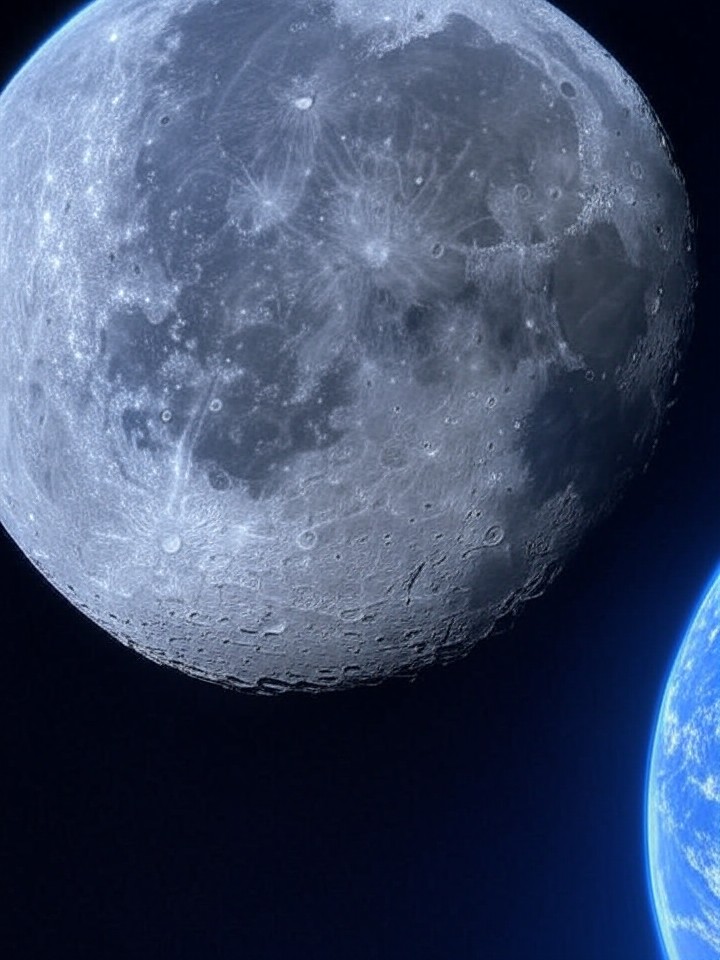
Lunar Feast: How Earth’s Air Became Moon Dust
For billions of years, the moon has been quietly siphoning off bits of Earth’s atmosphere, incorporating terrestrial molecules into its dusty surface. This revelation, stemming from recent astronomical research, challenges long-held assumptions about the isolation of celestial bodies in our solar system. Scientists have puzzled over anomalous elements in lunar soil samples since the Apollo missions, but a new study provides a compelling explanation: Earth’s magnetic field and solar wind collaborate to transport atmospheric particles across the void to the moon.
The discovery builds on analyses of samples collected during NASA’s Apollo program in the late 1960s and early 1970s. These regolith specimens revealed unexpected concentrations of volatile elements like nitrogen, carbon, and noble gases that didn’t match the moon’s native composition. For decades, researchers attributed these to solar wind implantation or meteorite impacts. However, a Live Science report details how a team led by planetary scientists at the University of Chicago reexamined this data, proposing that Earth’s own atmosphere is the source.
By modeling the interaction between solar wind—streams of charged particles from the sun—and Earth’s magnetosphere, the researchers demonstrated how ions from our upper atmosphere escape and hitch a ride to the lunar surface. This process, occurring over eons, means the moon’s soil acts as a historical record of Earth’s atmospheric evolution, potentially offering insights into ancient climate shifts and volcanic activity.
Unraveling the Magnetic Highway
Earth’s magnetic field, generated by its molten core, extends far into space, forming a protective bubble known as the magnetosphere. Contrary to earlier beliefs that this field shields the planet entirely from solar wind, the new findings show it can actually channel particles outward. When solar wind gusts interact with the magnetosphere, they energize atmospheric ions, propelling them along magnetic field lines that occasionally align with the moon’s orbit.
A study published in the journal Nature Astronomy, as covered by CNN, explains that this transfer is most efficient during periods when the moon passes through Earth’s magnetotail—the elongated extension of the magnetic field on the planet’s night side. Here, the field lines stretch out, creating invisible pathways that ferry charged particles like oxygen and nitrogen ions directly to the lunar nearside.
Simulations indicate this has been happening for at least 4 billion years, coinciding with the era when Earth’s magnetic dynamo stabilized. The implications are profound for understanding planetary atmospheres: if Earth can “feed” its moon, similar processes might occur in other systems, such as Jupiter’s interactions with its moons. This could reshape models of atmospheric loss and retention across the solar system.
Apollo Samples Revisited
The breakthrough hinges on isotopic analysis of Apollo samples. Elements like nitrogen-15 and argon-36 found in the regolith match Earth’s atmospheric signatures more closely than solar or cometary sources. A ScienceDaily summary highlights how researchers used advanced mass spectrometry to detect these telltale ratios, overturning a 20-year-old theory that blamed micrometeorites.
This isn’t just academic; it has practical ramifications for future lunar exploration. If the moon’s soil contains Earth-derived volatiles, it could serve as a resource for water or breathable air in sustained human presence. NASA’s Artemis program, aiming for permanent bases by the 2030s, might leverage this “imported” material, reducing the need to transport essentials from Earth.
Moreover, the discovery prompts a reevaluation of lunar geology. The moon’s exosphere—its tenuous atmosphere—is now seen as partially influenced by terrestrial contributions, blending with solar wind and outgassing from the interior. Posts on X from astronomy enthusiasts, including updates from accounts like NASA Solar System, underscore public fascination, with many speculating on how this affects theories of lunar water formation.
Solar Wind’s Role as Cosmic Courier
Solar wind, a constant stream of protons and electrons from the sun’s corona, travels at speeds up to 1 million miles per hour. When it encounters Earth’s magnetosphere, it compresses the dayside and stretches the nightside into a tail extending beyond the moon’s orbit. According to a Rediff article, this dynamic allows atmospheric particles to be ionized and accelerated along the field lines, embedding them into the lunar regolith upon impact.
The process is selective: lighter ions like hydrogen can form water molecules when reacting with lunar oxygen, as noted in earlier detections by NASA’s SOFIA telescope. But the new research expands this to heavier elements, suggesting a broader atmospheric exchange. Geomagnetic storms, triggered by solar flares, amplify the transfer, potentially depositing measurable amounts during intense events.
For industry insiders in aerospace and planetary science, this means refining orbital mechanics models. Satellite operators must account for these particle fluxes, which could affect electronics or propulsion systems in cislunar space—the region between Earth and the moon.
Implications for Lunar Resource Utilization
Envisioning lunar bases, experts are excited about mining this Earth-sourced material. A Space.com piece discusses how volatiles in the regolith could be extracted via heating or chemical processes, yielding gases for life support or fuel. This aligns with in-situ resource utilization (ISRU) strategies, pivotal for cost-effective missions.
However, challenges abound. The concentrations are trace—parts per million—requiring efficient extraction tech. Contamination from Apollo-era handling also complicates pure analysis, prompting calls for new sample-return missions like China’s Chang’e series or NASA’s planned Artemis collections.
Beyond resources, the moon’s soil as an Earth archive offers paleoclimatological value. Layers of regolith, undisturbed for billions of years, might preserve isotopic records of ancient atmospheric compositions, aiding studies of events like the Great Oxidation Event 2.4 billion years ago.
Historical Context and Competing Theories
The puzzle dates back to 1972, when Apollo 16 astronauts returned samples showing odd gas abundances. Initial explanations leaned toward solar implantation, but isotopic mismatches persisted. A 2005 theory suggested meteoritic delivery, but it failed to explain the Earth-like profiles.
Recent computational advances, including high-resolution magnetohydrodynamic simulations, have tipped the scales. As reported in CNN’s international edition, these models show that during full moon phases, when the satellite is in the magnetotail, transfer rates peak.
Skeptics argue that volcanic outgassing on the moon could mimic some signatures, but the new study’s authors counter with precise dating: the anomalies correlate with Earth’s magnetic history, not lunar volcanism, which ceased billions of years ago.
Broader Astrophysical Ramifications
Extending this to exoplanets, astronomers speculate that similar mechanisms could explain atmospheric compositions on moons orbiting gas giants. For instance, Europa’s potential subsurface ocean might receive inputs from Jupiter’s magnetosphere, influencing habitability.
In our system, this discovery reframes Venus-Moon comparisons, though Venus lacks a strong magnetic field. It also ties into ongoing debates about Mars’ atmospheric loss, where solar wind erosion stripped the planet bare without magnetic protection.
For space agencies, integrating this knowledge into mission planning is crucial. The European Space Agency’s upcoming Lunar Orbital Platform could monitor these particle streams in real-time, providing data for predictive models.
Future Research Directions
Upcoming missions promise to test the theory directly. NASA’s VIPER rover, set for a 2024 launch but delayed to 2027, will analyze polar regolith for volatiles, potentially confirming Earth origins. Private ventures like Intuitive Machines’ landers aim to drill deeper, accessing older layers.
Collaborative efforts, such as those between NASA and JAXA, plan spectroscopic observations from orbit to map distribution patterns. If the nearside shows higher concentrations than the farside, it would strongly support the magnetic funneling hypothesis.
Industry experts anticipate this could spur innovations in materials science, like developing regolith-based composites for habitats, leveraging the embedded Earth elements for structural integrity.
Interdisciplinary Insights and Challenges
Geochemists are particularly intrigued by how these particles alter lunar mineralogy. Oxygen ions from Earth might contribute to hematite formation, as hinted in Chandrayaan-1 data referenced in posts on X from space agencies.
Yet, quantifying the total mass transferred remains elusive. Estimates suggest billions of tons over time, but precise measurements require in-situ instruments. Environmental concerns arise too: as humans mine the moon, we risk disturbing this natural archive.
Ethically, preserving sites with high scientific value becomes a priority, akin to Antarctic treaty protections. International agreements may evolve to designate “heritage” zones on the lunar surface.
Evolving Perspectives in Planetary Science
This finding underscores the interconnectedness of Earth-moon systems, blurring lines between planetary bodies. It challenges isolationist views, promoting a holistic approach to solar system dynamics.
For educators and policymakers, it highlights the need for STEM investment in magnetospheric research. Funding for projects like the Decadal Survey could accelerate discoveries, fostering technologies with Earth-bound applications, such as improved space weather forecasting.
As we stand on the cusp of a new space age, understanding this atmospheric bridge reminds us that even in the vacuum of space, connections persist, shaping worlds in unexpected ways. The moon, once thought a barren companion, now reveals itself as a silent witness to Earth’s history, enriched by the very air we breathe.


 WebProNews is an iEntry Publication