
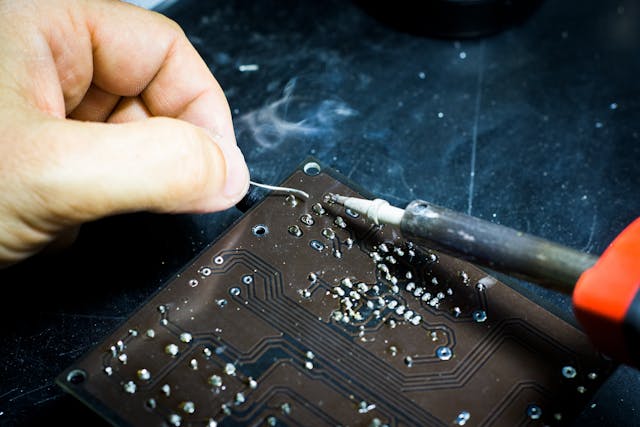
When we think about technology, we usually picture sleek smartphones, powerful laptops, or satellites orbiting the earth. What we rarely consider is the invisible craftsmanship that makes these devices reliable. Sure, automation and robotics dominate production lines, but behind every circuit board and solder joint is a layer of human expertise that machines alone can’t replicate.
In fact, the success of modern electronics depends on a balance: automation for speed and scale, and skilled technicians for precision and trustworthiness.
The Hidden Human Element in Modern Manufacturing
Despite the scale of automation, people remain at the heart of electronics production. Skilled technicians assemble, inspect and test components that measure only millimetres across. Under magnification, they judge the shape of each solder joint, the uniformity of surface finishes and the exact positioning of delicate leads. Their steady hands and trained eyes detect imperfections that machines may overlook. A single lifted pad or uneven solder fillet can lead to intermittent faults that cost thousands to correct later in production.
This human oversight is essential in sectors where safety and reliability cannot be compromised. Aerospace, defence and medical electronics all rely on consistent workmanship. Every connector, sensor and printed circuit must meet exacting standards under thermal stress, vibration and humidity. Professionals in these environments work with the focus of surgeons and the patience of engineers. Technology’s success depends not only on code and circuitry but on the people who bring those designs to life, supported by an experienced electronics training provider.
Precision at the Heart of Modern Electronics
Reliability in modern electronics is built on invisible precision. Each component is placed, soldered and tested to tolerances smaller than a grain of sand. The process demands knowledge of how materials react to heat, how solder alloys flow, and how joints behave over time. Skilled technicians manage variables in real conditions, adjusting iron temperature, airflow or contact pressure to maintain quality. They anticipate how one process affects another, preventing hidden weaknesses that could cause failure months or years later.
To ensure this consistency, manufacturers follow recognised workmanship standards that define what constitutes an acceptable connection. Clear guidelines for solder fillet shape, insulation clearance and rework technique turn experience into measurable quality. These shared principles protect performance across sectors such as automotive, aerospace and consumer electronics. By aligning craftsmanship with defined tolerances, teams ensure that every product leaving the line is both safe and dependable, no matter its scale or complexity.
Quality Assurance and the Cost of Imperfection
In electronics manufacturing, quality assurance is not a single step but a continuous system of control. Every joint, connector and component is scrutinised because even a microscopic defect can have system-wide effects. A small void in solder may increase resistance and generate heat, gradually damaging surrounding parts. A contaminated contact can corrode under voltage, causing intermittent faults that are almost impossible to trace. The cost of such imperfections extends far beyond repair; it affects brand reputation, safety and long-term reliability.
To mitigate these risks, manufacturers combine automated optical inspection, X-ray analysis and boundary-scan testing with manual verification by experienced inspectors. Data collected from each stage informs process improvement, identifying trends before they become failures. Quality is reinforced not by chance but by a culture that values patience, documentation and accountability. Factories that invest in skilled personnel, rigorous training and continual review achieve higher yields and lower defect rates. The commitment to excellence begins at the bench and extends throughout the entire production lifecycle.
Balancing Automation with Artistry
Robotics and artificial intelligence have transformed electronics manufacturing, handling repetitive and high-volume tasks with remarkable precision. Machines can place thousands of components per minute and record every action in a traceable log. Yet there are still decisions and subtleties that no algorithm can replicate. When faced with unique geometries, material anomalies or complex repairs, it is the human technician who interprets the situation, weighs the options and makes the call.
Conclusion
Even in an era dominated by automation, the reliability of electronics still depends on human craftsmanship. Every solder joint and inspection reflects a discipline that machines cannot fully replicate. The silent skill of technicians ensures that innovation is transformed into dependable devices. Automation will handle scale, but human expertise will remain the safeguard of reliability. Businesses that embrace this synergy will lead in both innovation and trustworthiness.


 WebProNews is an iEntry Publication