
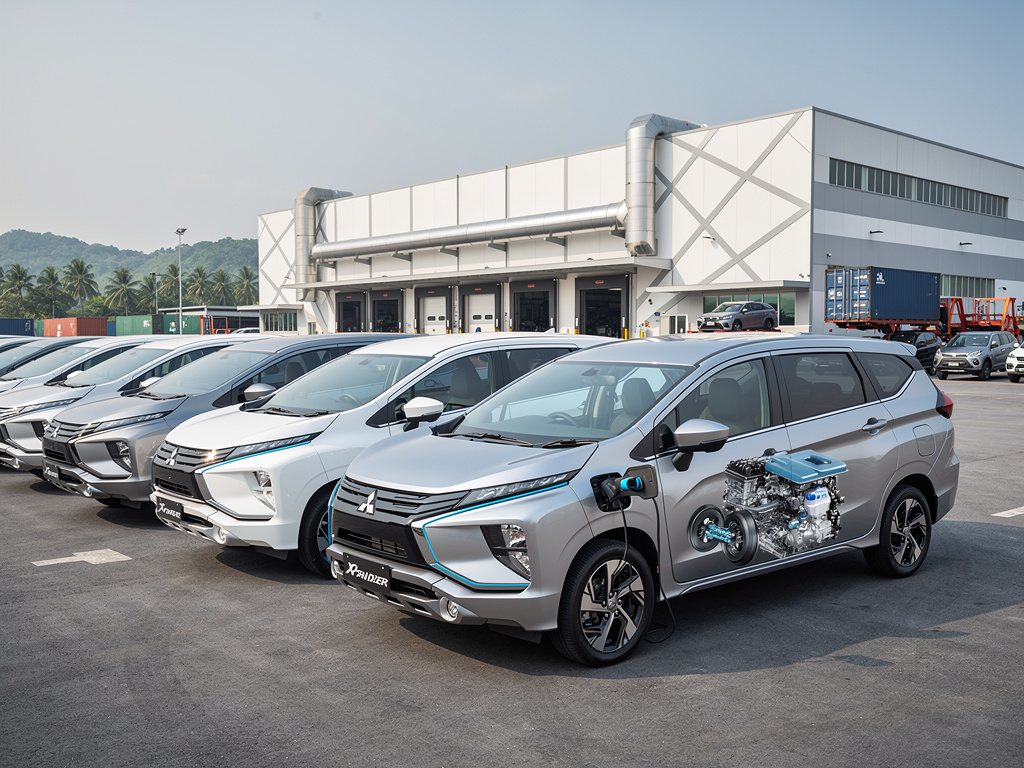
Mitsubishi Motors will begin producing hybrid electric vehicles at its Laem Chabang plant in Thailand by 2027, a move that signals how seriously Japanese automakers are taking the competitive threat from Chinese rivals flooding Southeast Asian markets with affordable electrified models. The decision, announced in late June 2025, isn’t just about one factory or one powertrain. It’s about survival in a region that Japanese carmakers have dominated for decades — and are now at risk of losing.
The plan centers on the company’s next-generation Xpander, one of Mitsubishi’s best-selling models in the ASEAN region. According to Yahoo Finance, Mitsubishi will equip the popular MPV with a hybrid electric powertrain and manufacture it at its existing Thai facility, marking the first time the company has produced HEVs in the country. Production is expected to begin in the first half of 2027.
This isn’t a pivot to full electrification. It’s a calculated half-step.
Mitsubishi’s leadership has concluded that battery-electric vehicles remain too expensive and too dependent on charging infrastructure that doesn’t yet exist across much of Southeast Asia. Hybrid technology — which pairs a conventional internal combustion engine with an electric motor and doesn’t require plug-in charging — offers a more practical bridge for price-sensitive consumers in markets like Thailand, Indonesia, the Philippines, and Vietnam. The company believes this approach will let it defend market share while keeping vehicle costs within reach of its core customer base.
The China Problem in ASEAN
For years, Japanese automakers operated in Southeast Asia with something close to impunity. Toyota, Honda, Mitsubishi, and Suzuki collectively held overwhelming market share across the region, built on decades of investment in local manufacturing, dealer networks, and brand trust. That dominance is eroding.
Chinese automakers — BYD, Chery, Great Wall Motor, and others — have moved aggressively into ASEAN markets over the past three years, offering battery-electric and plug-in hybrid vehicles at price points that undercut Japanese competitors. BYD’s Atto 3 and Dolphin have sold well in Thailand. Great Wall Motor’s Ora brand gained traction. And Chinese brands now account for a rapidly growing share of Thailand’s EV market, which the Thai government has actively promoted through tax incentives and subsidy programs.
The numbers tell the story. In Thailand, Chinese brands captured roughly 80% of battery-electric vehicle sales in 2024, according to industry data tracked by the Federation of Thai Industries. While BEVs still represent a small fraction of total vehicle sales, their growth trajectory has alarmed incumbents.
Mitsubishi has felt the pressure acutely. The company’s global sales have been under strain, and its ASEAN operations — once a reliable profit center — face mounting competition. The Xpander, a seven-seat MPV that dominates in Indonesia, is the kind of high-volume, family-oriented vehicle that Chinese competitors are now targeting with electrified alternatives.
So Mitsubishi is fighting back with hybrids rather than trying to match Chinese BEV pricing head-on. The logic is straightforward: most ASEAN consumers aren’t ready for full electric, but they want better fuel economy and lower emissions. A hybrid Xpander checks both boxes without requiring new charging infrastructure or dramatic changes in ownership behavior.
Thailand’s role in this strategy is critical. The country serves as Mitsubishi’s primary export hub for right-hand-drive markets across the region. Vehicles built in Laem Chabang ship to dozens of countries. By localizing HEV production there, Mitsubishi can take advantage of Thailand’s existing automotive supply chain, benefit from the Thai government’s incentives for electrified vehicle production, and keep logistics costs manageable.
Thailand’s Evolving Industrial Policy
Thailand has been the automotive manufacturing capital of Southeast Asia for decades — the “Detroit of Asia,” as it’s often called. The Thai government wants to keep it that way, but it’s pushing hard for the industry to shift toward electrification.
Bangkok has rolled out a series of incentive packages aimed at attracting EV investment. These include excise tax reductions for electric and hybrid vehicles, subsidies for consumers purchasing EVs, and investment incentives administered by the Board of Investment for companies building electrified vehicle production capacity in the country. The government’s EV 3.5 policy package, announced in late 2024 and refined into 2025, extends consumer subsidies while tightening local production requirements — a direct response to Chinese brands that initially imported vehicles to claim subsidies without manufacturing locally.
For Mitsubishi, the timing aligns. Building HEV capacity in Thailand positions the company to benefit from these incentive structures while demonstrating commitment to the Thai government’s industrial modernization goals. It also gives Mitsubishi a hedge: if Thai policy eventually shifts to favor hybrids more explicitly over BEVs (a possibility, given the infrastructure challenges of full electrification), the company will already have production in place.
But Mitsubishi isn’t the only Japanese automaker making this play. Toyota has been expanding hybrid production in Thailand for years, building on its global dominance in hybrid technology through the Prius and subsequent models. Honda has announced plans to introduce more electrified models in the region. Suzuki is exploring hybrid options for its compact vehicles. The common thread: Japanese manufacturers are converging on hybrids as their primary competitive response to Chinese EV incursion in ASEAN.
Whether this strategy proves sufficient is an open question. Chinese automakers aren’t standing still. BYD announced plans to build a factory in Thailand with annual capacity of 150,000 vehicles. Chery has committed to local production. These investments will allow Chinese brands to qualify for Thai incentives, reduce costs through local sourcing, and compete even more aggressively on price.
And price matters enormously in ASEAN. Per-capita income across the region’s major markets ranges from roughly $4,000 to $15,000. Vehicles that cost $15,000 to $25,000 dominate sales volumes. Any powertrain technology that adds significant cost to a vehicle faces a hard ceiling on adoption. Hybrids typically add $1,500 to $3,000 to a vehicle’s sticker price compared to a conventional equivalent — a meaningful but manageable premium. Full BEVs, even with subsidies, often carry larger premiums that push them beyond the budgets of mainstream buyers.
Mitsubishi’s bet is that this math favors hybrids for at least the next five to seven years across most of ASEAN.
The company’s broader corporate situation adds urgency. Mitsubishi Motors has been the junior partner in the Renault-Nissan-Mitsubishi alliance, and the alliance itself has been restructuring following years of turmoil. Nissan’s well-publicized financial difficulties and its ongoing merger discussions with Honda have created uncertainty about Mitsubishi’s long-term position within any combined entity. Strong performance in ASEAN — the region where Mitsubishi has its greatest independent strength — could give the company more strategic leverage in alliance negotiations and more options if it eventually needs to chart a more independent course.
The Xpander is central to that performance. The model has been a consistent top seller in Indonesia, where it competes against Toyota’s Avanza and Daihatsu’s Xenia. A hybrid variant could extend the model’s competitiveness by several years, especially if fuel prices rise or if Indonesian regulators follow Thailand’s lead in offering incentives for electrified vehicles. Indonesia’s government has been slower than Thailand’s to promote EVs but has signaled growing interest, particularly in hybrid and plug-in hybrid technology that doesn’t require massive charging infrastructure buildouts.
Supply Chain and Technical Considerations
Producing hybrids in Thailand requires more than bolting an electric motor onto an existing assembly line. Hybrid powertrains demand specialized components — battery packs, power electronics, electric motors, and sophisticated control software — that differ substantially from conventional drivetrains. Mitsubishi will need to either source these components locally, import them from Japan, or develop regional suppliers capable of meeting quality and volume requirements.
Thailand’s automotive parts industry is mature but has historically been oriented toward internal combustion engine components. The transition to electrified powertrains is creating both opportunities and disruptions for local suppliers. Companies that can adapt — producing battery housings, electric motor components, power inverters — stand to benefit. Those locked into legacy ICE parts face an uncertain future.
Mitsubishi hasn’t disclosed detailed sourcing plans for its Thai HEV production, but the company’s existing relationships with Japanese tier-one suppliers like Denso, Aisin, and Mitsubishi Electric suggest that critical hybrid components will likely come from established partners, at least initially. Over time, cost pressures will push toward greater local content.
The technical architecture of Mitsubishi’s hybrid system also matters. The company has experience with plug-in hybrid technology through its Outlander PHEV, which has been one of the better-selling plug-in hybrids globally. But the Xpander HEV is expected to use a simpler, non-plug-in hybrid system — closer in concept to Toyota’s hybrid synergy drive than to Mitsubishi’s own PHEV technology. This simplicity is deliberate. A non-plug-in system is cheaper to produce, easier to maintain, and doesn’t require any charging infrastructure. For ASEAN markets, these are decisive advantages.
The 2027 timeline gives Mitsubishi roughly two years to finalize engineering, retool its Laem Chabang plant, qualify suppliers, and begin pilot production. That’s an aggressive but not unreasonable schedule, particularly since the Xpander platform is already well-established and the company can draw on hybrid technology developed for other global models.
What’s less clear is how Mitsubishi will price the hybrid Xpander relative to the conventional version. If the premium is too high, buyers in price-sensitive markets will simply stick with the gasoline model. If it’s too low, margins suffer. Getting this balance right may determine whether the hybrid strategy succeeds commercially or becomes another case of a Japanese automaker investing in technology that consumers admire but don’t actually buy.
The competitive dynamics are shifting fast. Two years is a long time in an industry where Chinese companies are compressing product development cycles and flooding markets with new models at startling speed. By 2027, the ASEAN automotive market may look substantially different than it does today — more electrified, more competitive, and potentially less hospitable to incumbents who moved too slowly.
Mitsubishi is betting it’s moving fast enough. The Thai hybrid play isn’t a silver bullet. But for a company fighting to remain relevant in the world’s most contested emerging auto market, it’s a necessary and revealing move — one that says as much about the limits of full electrification in developing economies as it does about Mitsubishi’s own strategic calculations.


 WebProNews is an iEntry Publication