
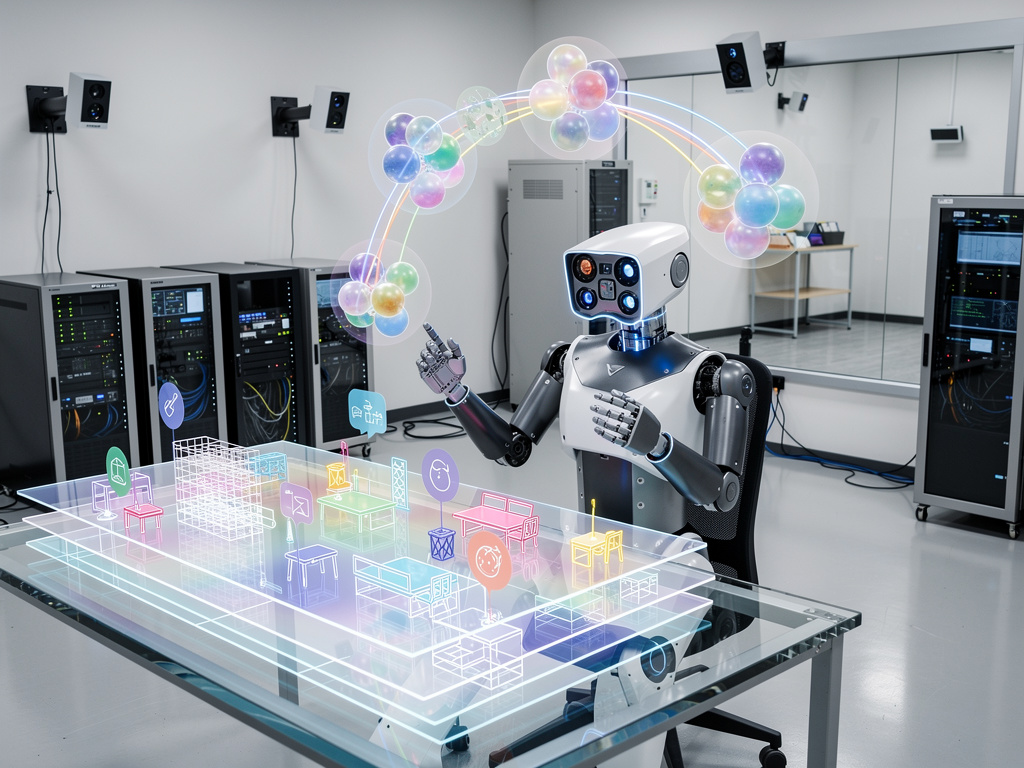
Robots have long excelled at navigating controlled spaces. Yet they falter when asked to remember yesterday’s details in a messy, changing world. A factory worker recalls the bin where she set down a half-built part. Her robotic colleague draws a blank.
That limitation may not last. Researchers at MIT have built a framework called DAAAM that equips mobile robots with persistent spatial memory. The system lets them attach rich language descriptions to objects they encounter and store those details in a 3D map they can query in plain English. Ask where the wallet went and the robot answers with location and context. The work appeared this week in MIT News.
Luca Carlone, associate professor in MIT’s Department of Aeronautics and Astronautics and director of the SPARK Laboratory, leads the effort. “If we want robots to work side-by-side with humans and interact better with humans, they must speak the same language,” he said. “The robot must be able to reason about time and space the same way humans do. That is essentially what our method is doing. It is turning a traditional map into a language-based map that is easier for the robot to think about and access using language.”
The approach bridges two previously separate fields. Computer vision models generate detailed captions for scenes but process them one image at a time. Robotic mapping systems build large-scale 3D environments yet rarely attach meaningful object descriptions. DAAAM, which stands for Describe Anything, Anywhere, Anytime, at Any Moment, merges the strengths of both.
As a robot rolls through a campus, warehouse or home, it identifies objects and generates descriptions. One building becomes the Stata Center with its distinctive architecture. A bike rack holds five bicycles; the red one sports a flat tire. These annotations attach to precise coordinates in a growing 3D map organized into spatial regions. The result is a hierarchical scene graph that grows over hours or days of operation.
Speed posed the first major obstacle. Earlier methods required seconds to annotate even a handful of objects. A robot exploring for minutes might encounter hundreds. The team solved this with an optimization step that selects key frames offering the clearest simultaneous views of multiple items. Nearby objects get batched together. Annotation happens once per object. Computation accelerates by an order of magnitude. “We annotate every object only once, so our framework can run in very large-scale environments in real time,” said Nicolas Gorlo, MIT graduate student and lead author. “And by clustering objects into regions, it can answer a wide range of queries about objects and locations in the environment.”
Retrieval demanded equal care. The finished memory contains thousands of objects and descriptions. A standard search would bog down or produce hallucinations. DAAAM instead routes queries through a large language model that selects among specialized tools. One tool performs semantic search on descriptions. Another uses location. The system returns an answer in seconds. Tests showed it delivered 21 percent to 53 percent higher accuracy than prior techniques, with gains varying by query type.
The paper, titled “Describe Anything Anywhere At Any Moment,” was presented at the Conference on Computer Vision and Pattern Recognition. A preprint sits on arXiv. Code and a project site live on GitHub under the MIT SPARK Lab. A short video demonstrates the robot scanning an environment, building its map and fielding questions about sculptures and other items seen earlier.
Practical implications stretch beyond factories. Maintenance crews could use augmented-reality overlays tied to the same memory to spot anomalies. Delivery robots might keep running tallies of inventory moved throughout a shift. The memory forms without prior mapping of the space. The robot constructs it on the fly while moving. That removes a costly barrier that has slowed deployment of helpful robots in unstructured settings.
Current commercial systems often reset between tasks or rely on rigid, pre-built maps. They forget what they saw yesterday. Or they demand expensive infrastructure before first use. DAAAM sidesteps both problems. It accumulates knowledge continuously. And it stays fast enough for real-time decisions on a mobile platform.
Gorlo points toward broader ambitions. “Ultimately, we want to have robots that can help with any sort of tasks. With this framework, we are trying to create the foundations to enable a generalist agent that can do anything you ask.” The team plans to extend the system so it records significant events rather than static object states alone. They also intend to add explicit confidence scores so robots can express uncertainty when memory grows fuzzy.
Lukas Schmid, formerly a research scientist at MIT and now a professor at the University of Technology Nuremberg in Germany, co-authored the work. Funding came in part from the U.S. Army Research Laboratory and the Office of Naval Research. Carlone is on sabbatical as an Amazon Scholar, but the research described was performed at MIT.
The The Next Web covered the announcement within hours of the MIT release, highlighting the wallet example and noting that the system remains a research prototype. Additional recent reporting from StudyFinds emphasized how the AI tracks what a robot saw, where and when, giving machines something close to continuous recall.
Other memory efforts have appeared in parallel. A project from Pi, detailed earlier this year, combines short-term raw observations with long-term textual notes to sustain complex tasks beyond ten minutes. Those techniques focus more on action sequences than on rich object descriptions across large spaces. DAAAM’s emphasis on scalable, language-grounded 3D memory sets it apart for environments that span buildings or campuses.
Challenges remain. The current version prioritizes object identity and location over dynamic events. A spilled cup or a moved chair might not register as noteworthy unless tied to a specific object query. Scaling descriptions to extremely cluttered scenes or handling rapid environmental change will require further tuning. Still, the accuracy gains and real-time performance mark a concrete step past earlier mapping systems that sacrificed detail for speed or sacrificed speed for detail.
Humans take such memory for granted. We glance around a room and later recall not only that the keys exist but roughly where they landed. Robots have operated without that luxury. DAAAM narrows the gap. It gives them a persistent, searchable record of their experiences expressed in the same words people use. The factory worker can now send her mechanical assistant with a simple instruction. The robot knows where to look. And it remembers.


 WebProNews is an iEntry Publication