
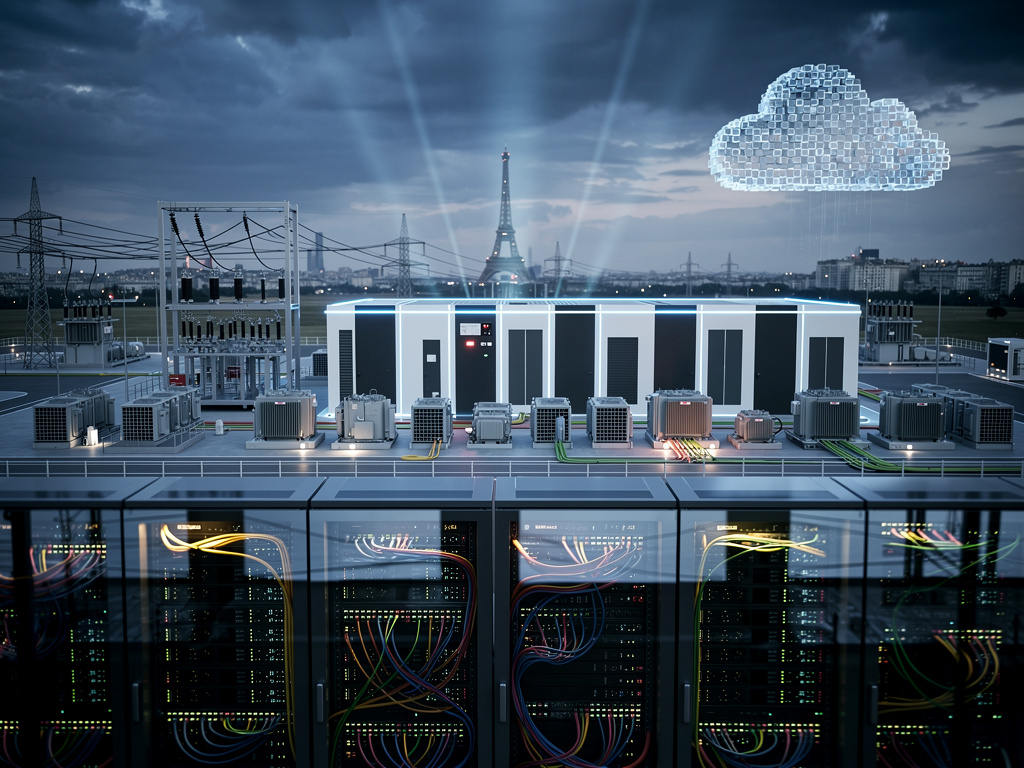
Mistral AI, the French artificial intelligence company that has become Europe’s most prominent challenger to American AI giants, just raised $830 million in debt financing to build a data center near Paris. The move marks a sharp strategic pivot for a company that has, until now, relied almost entirely on cloud providers for its computing infrastructure.
The deal is big. Not just in dollar terms, but in what it signals about the economics of running a competitive AI company in 2026.
According to TechCrunch, Mistral secured the debt facility specifically to finance the construction of a proprietary data center in the greater Paris region. This isn’t equity financing — the company isn’t diluting its existing shareholders. It’s taking on debt, a financial instrument that carries obligations but preserves ownership stakes. For a startup valued at roughly $6.2 billion after its last equity round, the choice of debt over equity tells a story about confidence, ambition, and the brutal capital requirements of staying relevant in AI.
The Infrastructure Imperative
Every serious AI company eventually confronts the same bottleneck: compute. Training frontier models requires staggering amounts of GPU time, and running inference at scale — serving millions of API requests — demands persistent, high-performance infrastructure. Renting that capacity from hyperscalers like Amazon Web Services, Google Cloud, or Microsoft Azure works in the early stages. But the bills compound fast.
Mistral has apparently decided that owning its own silicon makes more economic sense than perpetually renting someone else’s. And there’s a strategic dimension beyond cost. When your infrastructure sits on a cloud provider’s servers, you’re dependent on that provider’s pricing, availability, and — critically — its competitive posture. AWS and Azure both operate their own AI models. Google Cloud is deeply intertwined with DeepMind and Gemini. Renting from your competitors creates uncomfortable dependencies.
Building near Paris is no accident. France has been aggressively courting AI investment, with President Emmanuel Macron personally championing the country as a European AI hub. The French government has offered various incentives for data center construction, and the country’s relatively affordable nuclear-generated electricity provides a meaningful cost advantage for power-hungry GPU clusters. Mistral, founded in Paris by former Meta and Google DeepMind researchers Arthur Mensch, Guillaume Lample, and Timothée Lacroix, has deep roots in the French capital.
But $830 million in debt is a serious commitment. Debt must be serviced. Interest payments don’t care whether your latest model benchmark impressed the AI community on X. If Mistral’s revenue growth stalls or its competitive position erodes, that debt becomes a millstone rather than an accelerant.
So why take the risk?
Because the alternative — remaining infrastructure-dependent on American hyperscalers while trying to compete with companies backed by those same hyperscalers — may be riskier still. Microsoft has invested $13 billion in OpenAI. Amazon has poured $4 billion into Anthropic. Google funds its own models internally with virtually unlimited compute. For Mistral to compete at the frontier, it needs guaranteed access to massive computing resources on terms it controls.
The debt structure also suggests Mistral has revenue or contractual commitments substantial enough to convince lenders. Banks and institutional debt investors don’t extend $830 million facilities to startups on faith alone. Mistral has been building an enterprise business selling API access to its models, and the company has secured contracts with European governments and corporations that value data sovereignty — the guarantee that their information stays on European soil, processed by a European company.
That data sovereignty angle is increasingly potent. The European Union’s AI Act, GDPR enforcement actions, and broader geopolitical tensions around technology dependence have created genuine demand for non-American AI infrastructure. Mistral is positioned to capture that demand in ways that OpenAI and Anthropic simply cannot.
A Crowded Field, a Narrowing Window
Mistral’s infrastructure bet comes at a moment of intense competition and consolidation in the AI industry. OpenAI reportedly generated over $3 billion in annualized revenue in late 2025 and has been exploring its own data center investments. Anthropic, backed by Amazon and Google, has been scaling rapidly. xAI, Elon Musk’s AI venture, built a massive supercomputer cluster in Memphis, Tennessee, in record time. And Chinese competitors like DeepSeek have demonstrated that frontier-class models can be built with surprising efficiency.
Mistral’s models — including Mistral Large, Mixtral, and its newer offerings — have earned respect for their performance-to-size ratio. The company has carved out a reputation for building models that punch above their weight, particularly for enterprise use cases where efficiency matters as much as raw capability. Its open-weight model strategy has also built goodwill in the developer community, though the company has increasingly moved toward proprietary offerings for its most capable systems.
The timing of this debt raise is significant. AI infrastructure spending globally has reached extraordinary levels, with estimates from various analysts suggesting that hyperscalers alone will spend over $200 billion on AI-related capital expenditure in 2026. That spending spree has created supply constraints for everything from Nvidia’s latest GPUs to the specialized cooling systems data centers require. By moving now, Mistral locks in its place in the queue for equipment and construction capacity.
There’s also a political dimension. European policymakers have grown increasingly vocal about the continent’s dependence on American technology companies. The fact that Europe’s most valuable AI startup is building sovereign infrastructure on European soil — financed through debt rather than by handing more equity to foreign investors — aligns neatly with Brussels’ stated ambitions for technological autonomy. Don’t underestimate how much that political alignment matters when it comes to winning government contracts and favorable regulatory treatment.
Mistral’s previous fundraising trajectory has been remarkable by any standard. The company raised a $113 million seed round in June 2023, just weeks after its founding — one of the largest seed rounds in European history. It followed that with a $415 million Series A in December 2023, then a $640 million Series B in June 2024 that valued the company at $6.2 billion. Each round attracted marquee investors including Andreessen Horowitz, Lightspeed Venture Partners, and General Catalyst, alongside strategic backers like Nvidia, Salesforce, and BNP Paribas.
This latest $830 million is additive to all of that. And because it’s debt, not equity, Mistral’s existing investors aren’t diluted. That’s a sophisticated financial maneuver — one that suggests the company’s leadership is thinking carefully about capital structure, not just capital quantity.
The data center itself will likely house thousands of high-end GPUs, almost certainly Nvidia’s H100 or B200 chips, possibly supplemented by custom or alternative accelerators. Construction timelines for facilities of this scale typically run 18 to 24 months, though modular designs and pre-fabricated components can accelerate that. Mistral will need to recruit or contract significant operational expertise — running a data center is a fundamentally different discipline than building AI models.
That operational complexity is worth noting. Hyperscalers have spent decades perfecting data center operations. Cooling, power management, redundancy, security, networking — these are hard engineering problems. Startups that build their own infrastructure sometimes discover that the operational overhead consumes management attention and resources that would be better directed at their core product. xAI’s Memphis facility reportedly faced significant challenges in its early months, including power supply issues and cooling constraints.
Mistral presumably believes the benefits outweigh these risks. Owning infrastructure provides cost predictability, eliminates dependency on potentially hostile cloud providers, and enables the kind of data sovereignty guarantees that European customers increasingly demand. It also provides a tangible asset that can serve as collateral for future borrowing — a self-reinforcing cycle of infrastructure investment.
What This Means for the European AI Race
Mistral’s move will likely accelerate a broader trend of AI companies vertically integrating into infrastructure. The era of pure-play model companies that rent all their compute may be ending. The economics simply don’t work at scale — not when training runs cost tens of millions of dollars and inference demand grows exponentially.
For Europe specifically, this is a landmark moment. The continent has long struggled to produce technology companies that can compete globally with American and Chinese rivals. Mistral represents perhaps the best European bet in AI, and its decision to invest heavily in physical infrastructure signals a level of commitment and permanence that paper valuations alone don’t convey.
The French government will almost certainly trumpet this investment. And they should. An $830 million infrastructure commitment creates construction jobs, engineering positions, and a durable economic asset. It anchors Mistral to France in a way that a cloud-based operation never could. Companies don’t walk away from data centers.
But the hard questions remain. Can Mistral’s models keep pace with the billions being spent by OpenAI, Google, and Anthropic on research? Will European enterprise customers actually pay premium prices for sovereign AI, or will they default to cheaper, more capable American alternatives? And can a company that’s barely three years old manage the financial discipline required to service $830 million in debt while simultaneously investing aggressively in R&D?
The answers will determine whether this debt raise looks, in retrospect, like a masterstroke or an overreach. The AI industry has a way of rewarding bold bets — and punishing them in roughly equal measure.
For now, Mistral is betting on itself. With $830 million in borrowed money and a plot of land near Paris, it’s building the physical foundation for what it hopes will be Europe’s answer to the American AI giants. The concrete will be poured. The GPUs will be racked. Whether the models that run on them can compete at the highest level — that’s the question no amount of infrastructure spending can guarantee.


 WebProNews is an iEntry Publication